The Boston Phoenix October 26 - November 2, 2000
![[Dance Reviews]](/standard/image/headers/dance_performance_header.gif)
| reviews & features | dance performance | dance participatory | hot links |
Classic in retrograde
Boston Ballet does La Bayadère
by Marcia B. Siegel
LA BAYADÈRE: Production, concept, and choreography by Anna-Marie Holmes, after Marius Petipa. Staging by Sergei Berejnoi, Tatyana Terekhova, and Tatiana Legat. Lighting by Mary Jo Dondlinger. Set and costumes by Sergiy Spevyakin. Music by Ludwig Minkus, performed by the Boston Ballet Orchestra under Jonathan McPhee. Presented by Boston Ballet at the Wang Theatre through October 29.
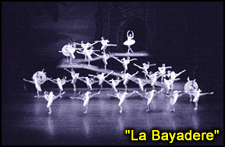
Boston Ballet artistic director Anna-Marie Holmes’s attitude toward a classic seems to be to treat it as spectacle, with lots of dancing and a plot that’s probably silly. Just get the dancers out there and fill the stage with them. At least, that’s what Holmes’s new La Bayadère does, despite its claims to be a restoration of the 1877 Marius Petipa original.
The plot of La Bayadère is certainly a fairy tale, but one with the capacity to project dancing qualities as a metaphor for the great conflicts of the soul. Set in an imaginary ancient kingdom, an Orient of the imagination, it opposes sensuality and spirit, pits temporal against magical powers, the corruptible against the pure.
Nikiya, the temple dancer or bayadère, is a kind of holy slave. Consecrated to the temple, she’s not immune to falling in love with the warrior Solor. Her rival, Gamzatti, the daughter of the Rajah, is glamorous and sure of her power. Even though he loves Nikiya, Solor is attracted to Gamzatti, and he accedes to the Rajah’s command that they marry. To make sure he doesn’t renege, Gamzatti arranges for Nikiya’s assassination. Solor of course regrets he ever set eyes on Gamzatti, and after a hallucinatory dream of Nikiya in the Kingdom of the Shades, he unites with her by committing suicide.
Old ballets today can only be approximations. You can look at scores, promptbooks, and eyewitness accounts of the time; you can consult dancers who’ve learned the work from insiders. But a ballet has a thousand ways of disappearing. To retrieve whatever exact patterns have slipped away, you practice guesswork, trusting your own intuition about issues of adaptation, comprehensibility, and taste. We don’t really want to see the heavy, overdecorated costumes or the matronly, corseted bodies of the Russian Imperial days, so you streamline.
And then, beyond authenticating whatever choreography can be captured, the directors determine the look of a big production, the tone, the effect of it as theater. Some images come down through history more or less intact, like La Bayadère’s Kingdom of the Shades scene, but even this has pitfalls. The 32 Boston Shades do faithfully descend a ramp one by one, in a timeless repetition of the same movement phrase, but someone decided to make the ramp hairpin back on itself instead of slanting straight to the stage floor. This seemingly simple modification distorts the classic effect of white phantoms stretching out to infinity by breaking up and cluttering their progression.
The Boston Bayadère, directed and choreographed by Holmes, with staging and other contributions by a squad of Russian experts, seems to have been influenced by Soviet ballet productions of the 1930s, with its heavy silent-movie mime and a tacky taste for vaudeville. It looks old-fashioned but not eternal. The spiritual aspects of the plot are de-emphasized in favor of variety turns and bland ensemble dancing.
It was the Soviets who eliminated the ballet’s last scene, the apocalyptic retribution for the hero’s betrayal of the bayadère, in order to end with the Kingdom of the Shades. Holmes’s version follows this scheme, including its coda, Solor’s quick suicide and reunion with Nikiya. By the time we reach this climactic set piece, we’ve already seen two hours of dancing, but the Shades is quite different from all that. After the ritualistic entrance of the corps, it opens out into more formal group patterns, into solo dances and finally into a grand pas de deux for Nikiya and Solor, all within a unified formal framework. No new styles or tricks are needed to keep the audience interested. Heaven, in this case, is defined as classicism — an environment for nurturing ever-inventive dancing.
The rest of the ballet frets from one dance novelty to the next. Take Holmes’s second act, a party to celebrate the engagement of Gamzatti and Solor. According to the tried-and-true formula of Swan Lake, Nutcracker, and Coppélia, exotic foreign visitors and captives provide entertainment for the Rajah’s guests. They all enter in a procession, accompanied by an elephant, who doesn’t have any subsequent choreography. There are children from the company school. There are classical dancers arrayed in lines facing the audience; there’s a woman with a vase she coyly balances on her head, a kick chorus of men dressed like Apaches, a riproaring solo for a gold-painted statue from the temple. (This apparition is a relic from the final scene that’s been dropped.) The pas de deux for Gamzatti and Solor is so deeply embedded in all of this I hardly noticed it.
Perhaps unconsciously reflecting the Soviets’ distaste for religion, Holmes’s team has glossed over the conflict between the sacred and profane. But this is a crucial dichotomy in La Bayadère, corresponding to the split between the good and evil sides of the heroine of Swan Lake, or the gossamer wood sprite and the down-to-earth Effie in La Sylphide. Nikiya and Gamzatti aren’t merely ballerinas of different talents.
On opening night the Nikiya was Larissa Ponomarenko, whose cool, careful line served to fine effect here. She seemed weightless and susceptible to Solor’s lovemaking in the first scene. When she had to take a role in celebrating Solor’s betrayal, she seemed tragic but powerless against the Rajah’s power. April Ball, her rival, was physically imposing, but her dancing seemed klunky and unmusical to me. It may have been the choreography. Yuri Yanowsky emerged from his self-absorption during his most spectacular solos but otherwise dutifully behaved as a porteur.
The second cast created much stronger drama. Pollyana Ribeiro made the bayadère a very young, spirited novice in the temple. You could see how her religious passion might be diverted to Alex Lapshin, the ardent Solor. When she played against Jennifer Gelfand’s Gamzatti, they made a grand contrast and worked themselves into quite a fight. All three principals’ dancing on the second night built higher and higher, until Ribeiro and Lapshin had their thrilling final pas de deux.
Despite the generous amount of dancing, a desolate sense of economizing hangs over this production. The sets and costumes (designed by Sergiy Spevyakin and built by the Art of Donbass in Ukraine) look almost second-hand. There are generic painted backdrops, sometimes unlit. The costumes are routinely designed in skimpy fabrics, gauche colors, cheap trimmings. The temple dancers in act one wear filmy pink full skirts and bolero tops made of gaudy silver wrapping paper. Later, the women in the Rajah’s palace — supposedly the worldly counterpart to the temple — wear the exact same costume, only with glittery peach tops and white organza skirts. The friends of the hero, sometimes called warriors, wear all-over red suits that you might see on a cadre of workers in a constructivist pageant.
I can’t help thinking of the Bayadère that has become the standard contemporary version. Mounted on American Ballet Theatre in 1980 by Natalia Makarova, it’s still in ABT’s repertory and has been adopted by other world-class companies. The great Kirov-American ballerina went back to the original, preserving the last act’s destruction of the temple, which was wonderfully executed with modern stage technology, mostly lighting and smoke. But she kept the production clean, the story line clearly focused on the ethical struggles of the main characters. And for ABT the Italian designer Luigi Pier Samaritani created settings that were beautiful to look at, suggestive of mysterious inner spaces and uncharted horizons. Theoni Aldredge’s simple Orientalist costumes looked gorgeous, moved well, and flattered their wearers.
One major character I haven’t mentioned, the High Brahmin who lusts after Nikiya, takes up a lot of the story but has almost no effect on it. This character is symptomatic of historical excesses that modern reconstructors have to cope with when they engage a ballet like this. Sergei Berejnoi was scheduled for most of the Boston performances. (Paul Thrussell will alternate next week.) Berejnoi, who shares staging credits with Tatyana Terekhova and Tatiana Legat, also appears to have influenced the souped-up melodramatics of the miming — the dithery holy man Magedaveya is an example. Berejnoi’s broad, gestural type of mime looks very artificial to our eyes. This alone would put his character in question, but the Brahmin’s role in the story is always puzzling.
Most productions obscure the fact that temple dancers often were the sexual as well as the spiritual attendants of the priests, which might make Nikiya less pitiable — or maybe more, who knows. The High Brahmin emotes his love for her and is crushed by her rejection. His disappointment turns to fury when he finds out she loves another man and isn’t just saving her virtue for the gods. He swears to have his revenge, but he’s trumped by Gamzatti and the Rajah. At the last minute Magedaveya slips him a snakebite antidote and he offers it to the stricken Nikiya, but even then he loses out. As played by Ribeiro, Nikiya would rather die than live in the world where her true love is married to someone else.

| home page | what's new | search | about the phoenix | feedback |
Copyright © 1999 The Phoenix Media/Communications Group. All rights reserved.
