January 20 - 27, 2000
![[City Hall]](/standard/image/headers/city_hall_header.gif)
Back to the future
New Roxbury city councilor Chuck Turner rode his history of old-school black activism into City Hall. Can he pump up progressive politics in Boston?
by Ben Geman
Last week, Chuck Turner made his first official speech at a Boston City Council meeting. It lasted approximately five seconds, just long enough for the newly elected District Seven councilor to announce that he'd sign on to a plan supporting a tax break for small businesses. Colleagues laughingly congratulated him, and council president Jimmy Kelly -- whose politics couldn't be more different from Turner's -- joked, "I suspect we ain't heard nothing yet."
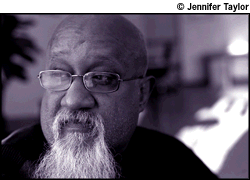
We probably ain't. In fact, later in the same meeting, Turner made a substantive, heartfelt speech criticizing the way the Menino administration had handled the siting of a new school. The 59-year-old Turner has been involved in organizing Boston's black community, from the grassroots up, since the mid 1960s, and he's not likely to change his outspoken ways now. Bald, with a long white beard, Turner has a stately, contemplative presence and a history of activism that bring to mind another black-community activist: the legendary Mel King, whose celebrated run for mayor in 1983 gave the city a needed injection of multiracial and left-of-center politics.
The similarities are more than coincidence. The two are close friends, and King is the one who first urged Turner to run for the council. Now Turner seems to be the best chance since King for a resurgence of progressive black activism in city politics. On a council ruled in seeming perpetuity by South Boston's right-wing Kelly, progressive politics have to fight for air time; Turner will be a strong voice for the urban left. He's already brought an energy to the council and to his traditionally low-voting district -- which encompasses Roxbury and pieces of the Fenway, the South End, and Dorchester -- that hasn't been felt in years. Even a Roxbury political insider who backed Tracy Litthcut, Turner's opponent for the seat, says Turner's presence on the council is a "jolt of caffeine."
Turner's activism has its roots in experience. The son of a druggist father and schoolteacher mother, he grew up in a middle-class household in Cincinnati -- at the time a legally integrated city, but still a racist one. When he was about 13, Turner decided he wanted to get a job at the city's open-air market. Arriving early, he thought he'd kill some time at a nearby diner. "A woman came out and said, 'We don't serve y'all here,' " he recalls. "I looked at the black guy in the back cooking and said, 'He's here.' " But the woman was so determined not to serve Turner that she closed the restaurant. He waited her out; when she eventually reopened, Turner was served. "Growing up African-American, you are continually confronted in various ways by the view that you and your people are expendable," he says.His path to activism, however, was indirect. As a student at Harvard, he followed the struggle for civil rights and took part in a few demonstrations, but his participation was limited. After getting a degree in government, he went to work as a reporter for the Afro-American, what he calls a "middle of the road" black newspaper, in Washington, DC.
His reporting career was short-lived. One night he met Stokely Carmichael, a leader in the Student Nonviolent Coordinating Committee (SNCC), who would later coin the term "black power." By this time, Turner recalls, he knew he wanted to be part of the movement he'd been covering for the paper. "Stokely and I and his girlfriend spent two or three hours talking about organizing, things going on in the South, what SNCC was doing," says Turner. "The conversation was really stimulating in terms of thinking about organizing."
Inspired, he left the paper soon afterward to join the Northern Student Movement, a group that tackled civil-rights problems unsolved by legal integration in cities such as Boston, New York, and Hartford. "This was way ahead of its time," says media critic and author Danny Schechter, who's known Turner since they were activists together back in the day. "In a way, civil rights was still defined as a Southern problem, a problem of segregation. . . . What we were saying was that the civil-rights problem in America was an economic problem, a problem of redlining, unjust housing, unemployment."
Since then, Turner -- who lives with his wife, Terri, his 15-year-old daughter, and his brother-in-law in a three-story house in Roxbury -- has broadened the scope, but not the focus, of his vision. He's worked with and helped found several community-based advocacy groups, such as the Boston Black United Front, the Center for Community Action, and the Coalition for Community Control of Development. He successfully organized against efforts to run an interstate highway through Roxbury in the late '60s. He's been a domestic-violence counselor. He was instrumental in getting an affirmative-action bill passed that guaranteed access to jobs on city construction projects for local residents, women, and minorities. With the Greater Roxbury Workers Association, he showed up to picket construction sites where it seemed blacks were being squeezed out of jobs. He has been especially interested in organizing multi-ethnic coalitions. He's been arrested several times for demonstrating. He counts among his influences Malcolm X, Harriet Tubman, 18th-century Massachusetts revolutionary Daniel Shays, and the late Ghanaian socialist Kwame Nkrumah. "I believe in economic cooperation," he says. "The corporate model is a mini-fiefdom that sets up enclaves that battle each other, and citizens are destroyed by that economic warfare. As humans, we have a responsibility to fight that thinking, or our children will be destroyed morally, spiritually, and physically."
Kwame Nkrumah? "Mini-fiefdom"? Turner -- whose broad economic-based critique of society centers on class and race, who's helped establish worker-owned cooperatives -- sounds almost, well, socialist. And he's on the Boston City Council.
Shortly before the New Year, Turner is at a morning meeting with Jemadari Kamara, the head of the Africana Studies department at UMass Boston and a long-time activist. The two have known each other for more than 30 years. They're discussing a new project that will link local universities and activists to form a community-organizing think tank. Both are fluent in organizing-speak -- they sound like management gurus for the left. Kamara talks of a "screen driven by priorities that come out of a process." Turner says he wants to make the initiative "project focused rather than organizationally focused."The approach of this project -- bringing people with different perspectives together for the same cause -- is typical for Turner. "One of the reasons I ran," he says, "was to see if we could use the city-council office to strengthen the organizing that's going on in different parts of the district and pull the district together." Citizen participation is key for Turner, and he has opened an office in his district where residents can come to advise him about school policy, housing, and other issues that are on their minds. "We are trying to set up a framework where learning experiences can go on continuously," Turner says. "And people can bring those experiences and perspectives to me." The office, he hopes, will function as a crossroads for the community, a place where the myriad organizations in the district can come together to share information.
And there's a lot to discuss. Turner wants the city to adopt a tax-abatement policy for landlords who agree to keep rents affordable. He also hopes for a housing trust fund to be created from tax-revenue set-asides. He wants the city to adopt a policy making one-third of housing built on city-owned land available to low-income tenants, one-third to moderate-income tenants, and one-third to those who can afford market-rate rents. He has talked about helping to organize an effort to bring back rent control, a stance that goes against prevailing political winds.
Turner's criticism of the Menino administration's educational policies is equally against the winds; he opposes the school committee's decision to eliminate race as a factor when assigning kids to schools, and he questions the push for more neighborhood schools. The mayor's people "have talked a lot about the placement [of new schools]," Turner says. "There has been no discussion of how those schools fit into a plan for quality education. We should not just be putting up those buildings."
At a time when affirmative-action programs are under attack -- in addition to the school committee's decision, for example, the Suffolk Superior Court last year struck down consideration of race in police-department promotions -- Turner remains committed. In particular, he wants to bring affirmative action to downtown development. "Name the number of black contractors, architects, lawyers . . . involved with downtown business development," he says. "I would suggest you would have trouble finding one. It's time the business community of downtown Boston ends the segregation and makes efforts to integrate the development activity." He's already met with an official from the Greater Boston Chamber of Commerce to discuss the issue.
One thing's for sure: now that he's city councilor, Turner's not going to just put his feet up. "There's a certain expectation that he will bring a new energy to the council," says Jovita Fontanez, a long-time Hispanic-community advocate. "I think what people are looking for is that he will bring issues to the table that progressives have asked for."
His election "brings a whole different view to the city council . . . most people on the council come with their base and [their] whole goal is to keep it," adds State Representative Byron Rushing (D-South End). "You have someone like [progressive ex-councilor David] Scondras and Chuck, and two things you can assume happen are they will concentrate on expanding the power of people who do not necessarily vote for them, and they will be interested in people who are not part of their base."
It's clear that Turner's election has given progressives more cause to be hopeful about city politics than they've had in a long time. "We really look to you, because of your campaign and your history, as being a vehicle for the people," a member of the Citywide Parents Council tells Turner when he meets with several members of the school-policy advocacy group shortly before taking office. And Danny Schechter enthuses about Turner's incredible patience, intelligence, and drive. ("I sound like his fucking campaign manager," he adds, laughing.)
But Mel King urges people to be "realistic about what to expect" as Turner settles in to his first term. The councilor can't be everywhere at once, King points out. And though King might not say so, Turner is trying to bring a broad agenda to a political body with limited clout.
Says long-time Boston community organizer Lewis Finfer, of the Greater Boston Interfaith Organization: "I think the challenge -- and Chuck has had this tension in his own life -- is how to be a strong advocate and leader for social justice and build relationships and be effective with people who don't always agree with you."
And there are many people who do not view Chuck Turner as a political savior. He was tagged as "confrontational" and "anti-establishment" during his campaign, and not by way of praise. Backers of city youth-services head Tracy Litthcut, Turner's opponent in the race, argued that the battles of the 1960s are over. Turner, they said, is too radical to be an inside player in City Hall -- a place he was not a fan of, certainly, when he was involved with an initiative a decade ago for Boston minorities to secede and form their own city.
The Reverend Eugene Rivers, co-founder of the Ten Point Coalition, says, "The political game in Boston is more of a chess match than an in-your-face street fight. You can go in and have a sensible, productive meeting with Mayor Tom Menino. You don't need to march on [Police] Commissioner Paul Evans. He will invite you in for a conversation."
Boyce Slayman, a Roxbury political consultant and former head of the Massachusetts Council of Human Service Providers, said last fall that he was worried Turner would march into battle with Menino-administration officials at the expense of ensuring good services for Roxbury. Now, Slayman says he's optimistic about Turner, but cautiously so; he says he hopes Turner will work to build bridges inside City Hall and will avoid throwing any "bombs."
AW, C'MON, not even just a little bomb? On January 3, when Jimmy Kelly was re-elected as president of the council, even those councilors who hadn't voted for him applauded. All except Turner, that is. "Jimmy Kelly has made it clear where he stands on issues of affirmative action, where he stands on issues of integrating the schools," Turner says, by way of explanation. "The majority of my constituents felt he does not represent their thinking."
The snub came right on the heels of Turner's first official spat with Kelly. In a meeting several days before the vote for council president, Kelly told the Boston Globe, Turner pledged he would vote only for Mattapan councilor Charles Yancey. Turner recalls saying that he definitely would not vote for Kelly, but he remembers mentioning his support for Yancey as a possibility, not a certainty. After that meeting, Councilor Dan Conley emerged as the symbolic anti-Kelly candidate. Conley eventually got all the anti-Kelly votes, including Turner's.
It's something of a tradition for allegiances and vendettas to take center stage in Boston politics; the political, often pointlessly, has a way of getting real personal. But this kind of thing is alien to Turner. He cares about helping his district put pressure on policymakers. Who exactly those policymakers are -- Mayor Tom Menino, Jimmy Kelly, whoever -- isn't as important to him.
"Chuck is interested in the issues," confirms Sarah-Ann Shaw, a reporter for WBZ's News 4 New England who worked as a community organizer with Turner in Roxbury in the 1960s and remains a close friend. "I don't think he is interested in the personalities."
"He's a very spiritual person, and he's reflective," adds the Reverend Graylan Scott Hagler, a friend and activist who's worked with Turner and now lives in Washington, DC. "When he approaches an issue it's not frivolous, off-the-cuff, or something he thought of or dreamed of last night, but something he feels in the very fiber of his being."
Organizers, says Byron Rushing, are catalysts who empower people to do things for themselves; politicians are agents whom people inevitably ask to do things for them. It will be interesting, he says, to watch Turner make the transition from one to the other.But Turner doesn't feel that he even needs to make a transition. His new job's not such a far cry from his old job. "It is not a difference in kind," he says. "It is a difference of degree." Indeed, his whole vision for his city-council post rests on the successful merging of his roles as catalyst, encouraging his constituents to be more than just passive supporters, and agent, acting on the concerns they bring to the table.
Turner is the most interesting voice to be heard on the Boston City Council in a long time. He may even prove himself to be a capable player of political chess who can also hold his own in an in-your-face street fight when necessary. Most of all, says Mel King, he's a coalition builder.
"I think," King says, "you are going to see people from other parts of the city more involved with issues connected to Chuck's presence than you will have seen in a long time." If Turner can make his organizer-as-politician experiment work, King may just be right.
Ben Geman can be reached at bgeman[a]phx.com.