February 3 - 10, 2000
![[Features]](/standard/image/headers/features_header.gif)
False advertising
Vineyard Christian Fellowship's Cambridge congregation is selling itself to the youth market with celebrities and rock bands. But its core beliefs are more conservative than hip.
by David Valdes Greenwood
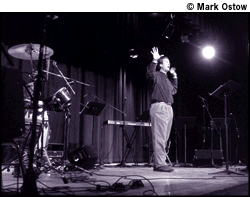
The crowd rises to its feet to sing and sway along with music that sounds like Beck by way of Amy Grant: a little reverb, a bongo backbeat, and a plea for salvation. Some of the numbers tend toward what you'd expect at an old-fashioned revival meeting; others -- if you ignore the lyrics about crucifixion -- could effortlessly slide into 'FNX's rotation. A Laura Dern look-alike sings with her eyes closed, her face slack, caught in a rapture; a woman in a dirndl dances like a fan at Lilith Fair.
The groove is on, and Jesus is the man.
Where am I? Not in the Deep South, province of conservative icons such as Jerry Falwell and Oral Roberts. Not in Colorado, where right-wing "family values" groups thrive. Not even in the heartland, where churches are more common than bars, and tent revivals still spring up in the summer. No, I'm in liberal Cambridge, attending a packed church service maybe a dozen blocks -- and a million light-years -- from ManRay. I'm having my first taste of the Vineyard Christian Fellowship experience.
I learned of the Vineyard the way most of its local congregants did: by riding the T. During my morning commute a few weeks back, I noticed something new amid the text-heavy posters for adult-education programs and health-insurance plans lining the subway car's wall: an advertisement for a church marketing itself with the surprising slogan THE BAND IS AWESOME. But what kind of church was this? The young guy in the picture seemed to be having a blast. The ad (which stopped running the last weekend in January) mentioned brunch but not doctrine. The closest thing to a theological statement was the tag line: PRACTICAL. SPIRITUAL. FUN.
Marketing itself on the strength of electric guitars and omelets -- without a whiff of dogma -- the Vineyard Christian Fellowship of Cambridge seems to be a church with its finger on the pulse of Generation X. Upon closer examination, however, what is being sold as a new kind of faith looks more and more like a fundamentalist religion that exerts considerable control over what its congregants believe and do. That gap between image and practice doesn't seem accidental.
Nationwide, churches of all faiths have wrestled with how to make spirituality seem relevant to a younger generation. According to a 1999 study by sociologist Stanley Presser, a professor at the University of Maryland, and his research partner, Linda Stinson of the US Bureau of Labor Statistics, houses of worship are having trouble filling the pews. Only 26 percent of the participants in their study were verifiably regular churchgoers. The term "verifiably" is important; although Gallup polls over the past 50 years have consistently reported that 42 to 49 percent of respondents claim church attendance, that polling has been backed by no other data. Presser and Stinson evaluated the daily diaries and journals of Americans who had responded as churchgoers and found that nearly half did not actually record any such behavior.
The Presser-Stinson figures show a stunning drop in church attendance (from half of Americans to one-quarter) between the 1960s and the 1990s. This means that Generation X has lived its entire life in a period of religious decline; the majority of Gen-Xers may not know anyone their own age who goes to church at all. Most churches don't need to see this study to prove what they can already see to be true: their congregations are graying or simply dying out. But not the Vineyard -- in the past 25 years, the church has grown to 550 congregations worldwide, and many of its members are young believers.
Though it took until 1998 for the denomination to find a Boston-area home, it approached the task with a sensible plan: market the church directly to youth, giving them what they want. Dave Schmelzer, pastor of the Cambridge church, says the Vineyard does that by offering "a whole new style of Christianity," which means in part "the music of today, not from 500 years ago."
He's on to something; type "religion" and "youth" into your Internet search engine, and link after link will take you to sites fronted by musicians -- rock groups, rappers, country singers -- who are house bands for particular churches. One such site, in McLean, Virginia, offers to let you listen to the church band and order its CDs (it may be telling that the link to the page outlining the church beliefs was the only link that didn't work when I checked). That band is so popular that the church added a second Sunday service and even an alternative-
rock Thursday service. And what's working for the Virginia church is working for the Vineyard -- in a big way.In its 18 months of existence, the Vineyard congregation in Cambridge has soared from an initial membership of seven to more than 350. Part of that growth has been due to the series of subway ads, which began with one headed MATT DAMON ATE IN OUR SANCTUARY, a playful reference to the church's original venue: Cambridge Rindge and Latin High School. (The congregation now meets at the Morse School.) The ad displayed the church's sense of humor, but it was also a brazen attempt to capture the media-saturated youth market. You can imagine the thought process behind it: hey, all we have to do is mention Matt Damon and our face value goes up. And that's exactly what happened; in the six months before advertising began, the church grew by about 60 members; in the 12 months after the ads debuted, it grew by nearly 300. The campaign featuring the band was a smart marketing move that built on the momentum of the Damon tie-in. In perfect sync with ad trends, the church didn't even need to bother describing its product.
That careful veiling of religious beliefs has earned the Vineyard criticism from the left (pro-choice Body Politic magazine described the church as "cultish" in 1997) and the right (the cult-watching Christian Research Index, an organization in the evangelical tradition, called it "coercive" in 1999). Chip Berlet, senior analyst for the Somerville-based group Political Research Associates (which monitors the activities of right-wing and authoritarian groups), says that when it recruits new members, the Vineyard is purposefully vague. "They are far less candid than is appropriate about what level of commitment is required to be in the congregation," he says. "There's a very simple word for this: `deceptive.' "At first glance, a Sunday service in the Morse School auditorium looks as unconventional as what one might imagine from the ads. On the stage, there are no crucifixes, no candles -- trappings associated with stuffy, traditional services. If it weren't for the elementary-school artwork lining the walls, you might think you'd arrived early for a show at a rock club. Electric and acoustic guitars, a saxophone stand, a keyboard, and bongos -- these are the only decorations on the Vineyard stage. Nearly a dozen congregants play together, in various combinations, for the portion of the service called "Meeting God in Song." As one of them, percussionist Josh Phillips, said to me: "You think bands, you think young people."
And young is right. In the two services I attended, there was nary a gray hair in sight. Schmelzer describes the crowd as "more singles than married, predominantly on their first and second jobs," and it looks for all the world like a college fair. (Interestingly, nine of the 10 people I spoke with were already married by their mid 20s.) The atmosphere is friendly and the dress is casual -- no ties and few dresses. In front of me sits a scruffy teen in a Japanese anime shirt, nodding along to the beat -- and it occurs to me that he looks like your average kid at a Guster show. That is, until I look closer: the very small print on his shirt is a Bible verse. The bodacious cartoon superhero on his chest apparently lives her life for Jesus, too. It is in that kind of juxtaposition that the Vineyard thrives -- and it is there that its truest nature is revealed. It may advertise itself with celebrities, tout its rock credentials, and free its services from old-fashioned symbols, but the Vineyard is at heart a deeply conservative denomination.
A measure of that conservatism is found in the top ranks of an organization whose cultural profile is higher than the Vineyard's: Promise Keepers. The widely publicized evangelical men's movement was founded by several members of a Colorado Vineyard congregation, with Bill "Coach" McCartney at the helm. McCartney had previously worked both with the anti-gay Colorado Family Values and with Operation Rescue; these affiliations are reflected in Promise Keepers' beliefs. On talk shows and in newspaper articles, McCartney had often described his work as both mission and battle, unapologetically fundamentalist in nature. Though perhaps one of the most bluntly outspoken members of the Vineyard denomination, McCartney is not unusual in the intensity of his religious opinions. The hand that welcomes you to a Vineyard church is a warm one, but it's kept firmly on your shoulder if you stay.
Think the popularity of the Vineyard Christian Fellowship is an aberration? Think again. From February 3 through 6, the Hynes Convention Center will be the epicenter of the region's evangelical movement, when Acton-based Vision New England hosts its annual congress. The theme of this year's meeting is "Jesus Christ: The Same Yesterday, Today, and Forever." Leslie H. Stobbe, Vision New England's vice-president of communications, says 12,000 participants are expected for "what we call a family reunion of Christians who want a significant worship experience." Gathering the faithful
It might be tempting to think of our religious landscape in terms of easy stereotype -- Southie Catholics and Cambridge agnostics -- but the actual picture is far more diverse. Evangelicals, who believe in a living God and the factual soundness of the Bible, have a strong, if quiet, presence all over New England. Vision New England alone encompasses 3000 churches representing 80 denominations. Founded 110 years ago as the Evangelistic Association of New England, Vision New England has grown dramatically in recent years and is now the largest regional evangelical association in the United States. When the group held its first congress, in 1960, it attracted only 220 participants. In the next 30 years, the gathering grew to more than 3000. But the 1990s were explosive -- in one decade, the congress has expanded to four times that size.
This weekend's event promises to be a veritable state fair of inspiration: 300 booths representing exhibitors such as Christian bookstores and Christian radio stations (with live broadcasts); two stages, with 11 local bands and vocalists; big concert events by national "Christian contemporary" stars O.C. Supertones; live dramatic performances; even mimes and a stiltwalker. But there will be plenty of more-serious spiritual pursuits as well, with seminars, mission opportunities, and worship services featuring what Stobbe describes as evangelical "speakers of national prominence," including Jack Hayford, of Promise Keepers, and Bart Campolo, a Philadelphia youth minister.
One of the goals of the congress is to further Vision New England's mission of fostering "healthy churches," a term Stobbe says the group arrived at after appointing a task force in 1995 to study what made churches successful or unsuccessful. After interviewing more than 100 pastors and surveying 3800 parishioners, Vision New England settled on a set of tenets for the spiritual health of a church. The top three tenets, according to Stobbe, are "God's empowering love; God-exalting worship; and personal/spiritual disciplines," which he describes as prayer, reading the Bible, fasting, and meditation. One of the goals is to encourage "learning and growing in community, to provide a safe and affirming place for faith." If there is safety in numbers, that goal is sure to be met this weekend at the Hynes.
-- DVGCirculation figures are from the Audit Bureau of Circulations.
The heavy hand of an old faith makes itself clear when you discuss just who is welcome to become a Vineyard member. According to Stacy Phillips, wife of percussionist Josh, "We're accepting of all types of people." That statement brings nods of approval from other young couples nearby, but in truth, "all" is an overstatement. When the subject of gay or pro-choice church members is mentioned, Phillips gently spins the denomination's disapproval into a spiritual process, assuring me, "People are welcome, and then it's only through God's love that people change."
Brett Conner, with wife Rachel at his side, tries to explain further: "The door to salvation is open to all people. Jesus can accept them -- but they still have to change."
Stacy adds, "We love people where they are at now, but we have to see forward."
The Phillipses and the Conners go on to explain how Vineyard members decide which newcomers need to change. Josh says that the Holy Spirit answers those questions, and Rachel adds that it takes time to "hear the voice of God" -- but "often it's what you know you already need to apply to your heart." When she says "hear," she means it literally; she believes firmly in what she calls "prophecy," audible instructions from the Holy Spirit. Church members are unlikely to disagree over questions of belief, Brett says, because, "for the most part, the [Holy Spirit's] answers just aren't going to be different." The neatly aligned opinions of the Holy Spirit may seem so clear because the church itself is more than happy to provide its members with direction on what the right answer is.
Such matters are not left up to either chance or personal interpretation. During the service, for instance, the associate pastor announces the weekly healing meeting for those who are "sexually broken" and for whom matters of "gender and sexuality" interfere with their relationship to the church. The subject also comes up in conversation with Schmelzer, who says, "Sometimes people will call and say they want to come, but they have to know how we feel about things like homosexuality and abortion first. I tell them it's not the heart of our ministry."
When pressed, he chooses his words carefully. He says he is "not aware" that the parent denomination has "any official opinions," but "we may have opinions ourselves, and the Bible certainly has opinions." He does not elaborate on what those opinions are, but the Vineyard statement of belief is unequivocal when it says that "the SCRIPTURES of the Old and New Testaments are the word of God, fully inspired, and entirely trustworthy in all matters of faith and practice." [Emphasis theirs.]
If you are not intrinsically gifted at ferreting out the Bible's opinions about how you should live but you still want to belong, you may attend Vineyard courses, which introduce you to church teachings the ads never mentioned and require you to sign a covenant regarding your personal practices and beliefs. You join the church only when you have completed the first course. As you complete each course and keep your covenant, you can advance to higher-level courses, eventually discovering your specific ministry. (It is worth noting that the Church of Scientology, which uses similar methods, is widely regarded as a cult by Christians.) When you are a member, you are encouraged to join weeknight "life groups." These are intended to "maximize your involvement with us," which the church bulletin says "the Bible commands." Life groups are like traditional Bible-study groups, but with a bite: 10 to 15 parishioners monitor each other's spiritual development and keep track of how well members are keeping their covenants, using the official church teachings as the moral yardstick. Says Berlet, "The demands are great, and the judgment -- of people who don't conform -- is harsh."
These activities may not be menacing in themselves, says Bob Harden, director of the New England Institute of Religious Research, which studies what he calls "high control" religious groups. "A lot of churches require attendance and that sort of thing," he says. He gets concerned, though, when a group crosses the line into life-controlling practices. Some Vineyard congregations are, in his opinion, "benign," because they eschew such tactics; but others more overtly apply emotional and spiritual pressure for conformity. Harden notes that national Vineyard leadership has wrestled since the '80s with how to make the denomination "fly in a way that wouldn't raise those concerns," and that it "has kicked out congregations for getting too far into high-manipulative behavior." Leslie H. Stobbe, vice-
president of communications for the evangelical association Visions New England (see "Gathering the Faithful," page 23), says that the local Vineyard churches "are fairly independent" from the parent organization, but he agrees that individual congregations can be problematic; for example, "the Toronto church was expelled for what [the denomination] saw as excesses in their practices."Even so, Harden is quick to point out, a bad Vineyard experience isn't likely to be "as devastating as what happened with the Branch Davidians." Members of that sect, which was known for its apocalyptic beliefs, died after a standoff with the FBI in Waco, Texas, in 1993.
So what kind of faith will membership in the Cambridge congregation provide? Don't expect some flexible new doctrine, a spirituality that has evolved along with the culture whose popular elements are used to promote it. Schmelzer's sermons, which are touted as practical and applicable to everyday life, clearly are intended to keep parishioners in theological line. One morning, as I sit quietly in the back of a full house, he tells stories about incidents when God spoke aloud to believers, telling them to do certain things on faith, and the believers met with miserable failure. Schmelzer, for instance, was convinced he was going to get a screenwriting fellowship -- God, he says, told not only him but also 12 others, who passed on the good news. In the end, he was rejected. A woman believed she was commanded to announce her pregnancy, without being tested, after 10 years of trying to conceive. The humiliating truth: she was not pregnant. A proclaimed Vineyard faith healer went on to suffer two strokes, a heart attack, and then a fatal cancer.Schmelzer's message? The key to surviving life's challenges is praising God anyway. Schmelzer's point is not the lack of happy endings, but that humans have no right to expect any in the first place. As understood by the Vineyard faith, God does not owe any explanation, nor should believers hesitate to act if God commands them to do something. All believers can do is praise and obey; that alone is their supreme duty.
The sermon lays the blame for the believers' unhappiness squarely at their own feet; it was likely error and pride in the first place that made them misunderstand God's will. Schmelzer makes no attempt to sweeten up that conclusion. "The disciples were all tortured . . . anyone trying to follow Jesus can expect to suffer," he says. It's a tough message, but one not without reward: doing as the church tells you without complaint in this life brings a heavenly reward in the next. After listening to a sermon on the subjugation of personal will, I'm not surprised that the closing song is a Christian-pop plea for God to conquer the human soul, with the refrain "reign in me." It is a mournful sentiment and a far cry from the witty sloganeering on the subway.
On some levels, it's hard not to find the whole Vineyard approach deeply cynical. The denomination knows it's not hip to advertise exclusion and self-denial; MTV and Hollywood are much cooler, no doubt about it, and that awareness drives the pitch. Schmelzer seems to recognize this, initially telling me the church was founded in the '80s by John Wimber of the Righteous Brothers, which he said made it "the first rock-era worship." In reality, according to its own press materials, the church was founded nearly a decade before Wimber joined, by a "burned-out" Los Angeles Christian named Kenn Gullickson. When his new church had grown to seven locations, Gullickson -- hardly someone with the mythic potential of a popular musician -- heard about Wimber, a charismatic pastor who seemed the right person to take over leadership of what church materials describe as the "rapidly expanding movement."
It is not only the denomination's history that Schmelzer fudges. In our first conversation, he tells me the Cambridge Vineyard congregation was founded because "my wife and I and others were meeting and praying," believing that "there was a ton of people with spiritual interest but no place that could do it for them." The image of the local church rising entirely from community desire is appealing, but it's not the story he tells the congregation when I visit. In that sermon, he relates how he was working for a Vineyard church in California when the denomination hired him specifically to come east and start up the Cambridge congregation.
Why would a pastor put a spin on such simple information? Schmelzer didn't respond to requests for an additional interview by press time, so I couldn't ask him why he fed me some white lies. But one answer leaps to mind: a rock star is sexier than a burnout; a sudden inspiration is flashier than being hired to get a job done. Few college students are going to be inspired by the slogan "Promise Keepers used to eat in our sanctuary," and fewer still by "I hear the servitude is terrific."
We are talking about adults here, even if they are young -- so you might ask whether we should even care that this church isn't practicing exactly what it seems to preach. Berlet notes that Vineyard churches are often established in towns with colleges, though members hold their meetings well away from campuses. He says they commonly recruit students on campus, but then redirect the students' focus as a way to "remove the community and cut off the discourse." That need to isolate its members is suggestive of the power-consolidation and mind-control tactics used by cults.
Few would argue that the Vineyard Christian Fellowship is a cult. But a group doesn't have to be a cult to be unhealthy, and leaders don't have look scary to manipulate their followers emotionally and spiritually. To put it simply: young people at a transitional period in their lives are easy to mold into the uniform shape a church would like them to take. With new kids arriving all the time, Boston is ripe for the picking, and the Vineyard knows how to harvest.
David Valdes Greenwood is a freelance writer living in Somerville.