February 17 - 24, 2000

Fighting back
Tom Menino teams up with other mayors to fight state budget cuts. Plus, Mickey Roache mulls a run against Menino, Mike Ross proposes same-day voter registration, and Tom Keane keeps his name in the papers.
by Ben Geman
Mayors of stiffed cities, unite!
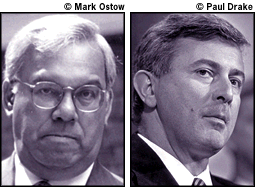
As incredible shrinking governor Paul Cellucci pursues his outside-the-State House strategy, Boston mayor Tom Menino is also looking beyond his home base. Irked by cuts Cellucci proposed in his budget for fiscal year 2001, Menino wants to join forces with other Massachusetts mayors to stop the damage from being done. Overall state spending will still increase, but areas of contention include local-aid and transportation-spending reductions, as well as too-small increases for education.
On Monday, Menino met with Springfield mayor Michael Albano, Somerville mayor Dorothy Kelly Gay, and mayors from Fall River, Weymouth, and Lynn to discuss presenting a united front when the state legislature begins debating the budget.
Cellucci's proposal -- an apparent effort to make his support of a sharp cut to the state's income tax seem sane by replacing some of the revenue that would be lost -- is particularly unfriendly to Boston. City officials say Cellucci's desired cuts would slash more than $17 million in state funding for the city in the next fiscal year -- including $5.3 million in educational grants. Also on the chopping block: $2.1 million in funding for summer jobs for Boston youth.
All this makes for a puzzled and angry mayor. Menino hadn't expected Cellucci to be so lousy on urban issues. He has disagreed openly with Cellucci's policies before -- on welfare, for example -- but it seems that now, in the mayor's eyes, the governor has really let him down.
No doubt Menino thought he'd get better treatment from Cellucci after giving only tepid support to Democratic gubernatorial nominee Scott Harshbarger in 1998. "Absolutely he feels screwed," says one Democratic insider.
Adds former city councilor Larry DiCara, "I have a feeling, and this is just gut instinct, that he believed the good personal relationship he had with the governor . . . would possibly carry over to some non-personal things, some non-personal issues, and it appears it may not have."
Why is Cellucci playing the Grinch? The governor has more reason to be lean and mean than he did last year at this time, when he proposed a budget that was not as tough on issues Menino cares about. For one thing, there's the tax rollback -- Cellucci has virtually staked his wobbly governorship on it. He's also jumped aboard the equally wobbly George W. Bush bandwagon, hoping to join W. in Washington (see "Talking Politics," News and Features, December 3, 1999), and that means he can afford to let things slide with the mayor. "If you are not in it for the long term, you are not thinking about every decision you make in terms of how it will affect your chances of re-election," says Boston Democratic activist Mark Merante. "Why bother trying to maintain a good relationship with the mayor of Boston? If you don't see yourself being governor for another six years, then having Mayor Menino, or any other mayor around the state, continue to be an ally is irrelevant."
Menino himself makes no secret of his unhappiness. He whacked the governor's budget in a high-profile speech before city business leaders last week, asking his audience to lobby Beacon Hill to increase education aid. And city officials have been grumbling about local-funding issues for weeks.
"The urban areas got him elected, if you look at the vote totals," Menino says. "I never thought we would have to battle with the governor on some of these local-aid issues."
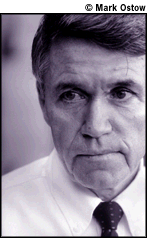
Mickey Roache has about $13,000 in the campaign bank ($12,961.78, to be exact), one failed run for mayor under his belt, a great work ethic, and big, big dreams.
According to a source close to him, the at-large councilor and former police commissioner has begun laying the groundwork that would allow him to snap into campaign mode and challenge Menino next year -- should he decide to take the plunge. "It's the first stages of basically putting together an organization to take the next step," says the source. "He wants to be in a position to go if he decides to go, but his friends won't let him commit suicide."
Roache, at this early stage, doesn't quite sound like a candidate yet. For now, he says only that he's "concerned no one stepped into the mayoral race last time around" and is keeping all his options open. When asked about his potential foe, Roache is, as usual, almost maddeningly polite and deferential -- he mentions constituents' concerns, but he doesn't openly criticize Menino. The furthest he'll go is to mention "lapses" by the mayor in development policy and to say, "I think the administration should get back on track."
But Roache is willing to discuss what he himself would focus on were he to run for mayor. For one thing, he'd bring the preventive and problem-solving model of community policing to all layers of city government. That sounds so much like a campaign theme that Roache's interest in Menino's position may be more substantial than he indicates now.
Roache, says the source, has been meeting with community and political leaders and has at least one potential campaign aide: retired Boston Globe writer Viola Osgood. Roache aide Jim Gordon says the councilor has used Osgood informally as an adviser since last summer. Osgood, who was part of the first wave of African-American hires by the Globe, consulted with Roache during the election-season firestorm regarding Roache's efforts to distance himself from the police department's racist behavior in the aftermath of the 1989 murder of Carol Stuart. But, Gordon says, Osgood's work with Roache isn't limited to that issue.
A run against Menino would be a long shot for Roache, who made his unsuccessful bid for the office in 1993. Menino is very popular and is a proven fundraiser, and it's hard to imagine Roache ever matching the mayor's existing war chest, which finance reports put at nearly $850,000 at the end of 1999. (The same problem faces another potential candidate, at-large councilor Peggy Davis-Mullen, who at year's end had just $1327.68.) In other words, sad as it is to say, the money issue alone makes any race against Menino seem a suicide run at this point. And Roache may be too gentle and affable to really stick it to the mayor. He is a labor favorite, but would organized labor really take a chance on someone facing such long odds?
But, says the source, the councilor may be able to play an angle that Davis-Mullen has also picked up on. Menino, so the theory goes, has become so immersed in downtown development and projects like the new Fenway Park proposal that he is vulnerable to charges of ignoring the little guy while shepherding through luxury-condominium deals. Roache has been the top vote-getter in recent council elections (he won with 30,271 last year), the source points out. "A lot of people think Menino's [poll] numbers are soft," he adds. "No one knows unless you challenge him."
City Councilor Mike Ross wants to change the way people vote in Massachusetts. The new councilor -- who represents Back Bay, Beacon Hill, the Fenway, and Mission Hill -- wants the Menino administration to push state officials to allow residents to register and vote on the same day.Ross, bothered by slumping voter-participation rates in city elections, says the law requiring people to register 20 days in advance of an election is one more roadblock in an electoral process that already has trouble attracting participants. Last week he called for the city to submit his plan to the state, pointing out that New Hampshire, which had good turnout in this month's presidential primary, allows same-day registration.
"Anything we can do to make it easier for people to practice their constitutional right and not make it more difficult is a step in the right direction," he says. "I don't think it will solve all the problems surrounding voter apathy, but it will do an important thing and remove any restriction to getting involved."
Before Ross can get to Beacon Hill, he'll need Menino on board. The mayor says he hasn't seen the proposal, but he appears cautiously interested. "I support almost any measure to get more people to turn out on election day," he says.
Secretary of State William Galvin, another person whose support would be critical, sounds more skeptical. "I am not saying it is something we should not look at," he says, "but the question is, are we prepared to deal with the administrative aspects and make sure people vote only once and appropriately in their correct district?" But, Galvin adds, he's "not averse" to the idea of testing the concept in a Boston city election.
That should please Ross, who is not alone in bemoaning the paltry 24.21 percent turnout for last fall's elections. The new councilor, who helped bring City Hall online when he worked for the Menino administration, believes the technology exists to make same-day registration work. The state, he says, has a responsibility to find a way. "We don't require people to register to have free speech," he says. "It's just something they have."
Even though Tom Keane has left City Hall, he still manages to get his name in one of the city's dailies as often as many of the current councilors. Keane, who formerly held Ross's seat, writes a weekly column on city issues for the Boston Herald, a gig he began discussing with the tabloid before he left the council after three terms.So far, Keane has weighed in on issues including the city's housing crunch (theme: regulation = bad), Menino's moves to bring the Boston Redevelopment Authority under his control, and the year ahead in Boston politics. Turns out Keane the columnist isn't that different from Keane the councilor: thoughtful, reasoned, and a little detached. (Although his scathing comparison of Boston's nutty taxi service to New York's relatively comprehensible system displayed his flair for tackling quality-of-life issues.)
"He's a keen observer, particularly of policy, perhaps more than politics," says John Nucci, another former city councilor who keeps an eye on his old haunt. Keane, who's also a partner in the New York City-based venture-capital firm Murphy and Partners, says he's "having a blast" writing for the Herald. "I love it," he says. "It's an opportunity to take some of what I've learned over the last six years on the City Council and talk about what's happening in Boston politics and why it matters."
It's also an opportunity to keep people from forgetting his name. Keane, who's only in his mid 40s, doesn't rule out a return to politics, despite his dismal finish in the 1998 race for the Eighth Congressional District. But he's not likely to return to the ring soon. "I'm not looking at anything now, not making plans to run for anything, and if I never did it would not bother me," he says. Then he adds: "If some opportunity came along in 10 years, sure, I would look at it."
Ben Geman can be reached at bgeman[a]phx.com.