February 10 - 17, 2000

The lost world
Harvard's Museum of Natural History is getting a makeover. What will become of the snarling hedgehog of Madagascar?
by Chris Wright
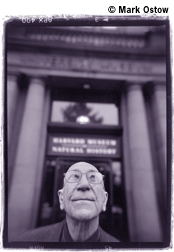
When Howard Allgaier started work at Harvard's Museum of Natural History, his wages were $65 a month -- not bad for an 18-year-old in 1930. Allgaier's first assignment was to print labels for the museum's collection of glass flowers. It was, he recalls, a nail-biting job: the labels were typeset by hand, painstakingly detailed, and fraught with possibilities for misspelling -- Taxus canadensis, Yucca filamentosa, Lathyrus splendens. "I had to learn fast in order to hold my job," Allgaier says. But he coped, and when he was done with the flowers the museum moved him on to its daunting selection of birds. "For two years that's all I did," he says. "Labels, labels, labels."
Over the next 70 years, Allgaier became something of an odd-jobs man at the museum. In 1945 he was put in charge of the turnstiles and given a raise of $200 a year. Later he manned the sales desk, flogging postcards and gift items. "I became Mr. Museum," he says from his home in Arlington. "I was doing everything that was outside the professors' field. I earned my keep." But it was the print shop that gave Allgaier his greatest satisfaction. "I was Ben Franklin the Second," he says. "I loved it."
In 1976, Allgaier went part-time -- half days on Monday and Wednesday, all day Friday. Then, in 1985, there was a reshuffle and Allgaier's hours were further slashed. "They took my shop away and closed it down," he says. "That ended my printing career." By December of last year, Allgaier, 88, was down to one morning a week. "I found out that after three-quarters of an hour I had done all my work. I couldn't sit around waiting for the end of the day. I made up my mind I was quitting. I walked out the door, and that was the end of my career at Harvard."
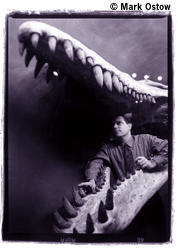
The same month Howard Allgaier walked away from the museum's grand Victorian building for the last time, Joshua Basseches was starting his second year as its executive director. Canny and energetic, given to ambitious ideas and spunky neckties, Basseches, 37, represents the new face of one of the oldest natural-history museums in America.If you've never heard of the Harvard Museum of Natural History, you're not alone. Tucked away behind Harvard Yard, the museum owns one of the widest collections of zoological and mineralogical specimens in the country, but has not enjoyed a particularly high profile in its hometown. Indeed, those who are aware of the HMNH often call it the Peabody, confusing it with the institution with which it shares a building: the Peabody Museum of Archaeology and Ethnology.
Basseches aims to change all that. His job is to steer the museum away from its frumpy, fusty public image and reinvent it as a modern institution -- a difficult proposition, given that the place hasn't had an honest-to-goodness shake-up since Mark Twain topped the bestseller list. Which is not to say there haven't been efforts to update the museum in the past.
"We get this talk about modernizing the museum every now and then," says a skeptical Allgaier. But the arrival of Basseches, a Harvard MBA whose expertise is "museum programming," suggests that this time the museum (or at least the board of Harvard faculty and administrators who voted to hire him) might mean business.
"There was a feeling that they didn't need one more PhD in the natural sciences," Basseches says, "but rather someone with the right kind of background, with an understanding of what a professionally run museum looks like. The goal is to create a new entity, not shuffle desks and have it basically be the same thing."
And so Basseches, along with his team of equally youthful, equally ambitious staff members -- many, according to one insider, "stolen" from other area museums -- is setting out to "reinvent the natural-history museum in the 21st century." What that boils down to, to use the idiom of 21st-century reformers everywhere, is making things more user-friendly. Whereas now the museum's halls are packed with impressive but totally static specimens, Basseches and his crew hope to make things more interactive, livelier.
If you visit the museum in the next few months, you'll get a sense of what form a future HMNH may take. On Valentine's Day, the museum launched a three-month exhibit called "Orchids: A Story of Seduction." The exhibit is interactive and information-heavy. As well as gazing upon a selection of real orchids, and glass orchids plucked from the museum's collection, guests will be able to read about the flowers they are seeing, and smell them at a "sniffing station."
Shortly before "Orchids" opened, the museum threw a champagne reception, complete with celebrity guest of honor (Stefanie Powers). It also invited best-selling author Susan Orlean to read from her book The Orchid Thief. The HMNH hasn't seen this much action since it moved the elephant up into the attic.
"The orchids exhibit is our first foray into doing real PR," says Kyle Roberts, an assistant to Basseches. "This is our chance to shine."
The research arm of the museum has been shining for a long time. Like most natural-history museums, this one keeps the bulk of its collection behind the scenes, preserved in jars and drawers. The museum's massive stock of 20-million-plus specimens -- second only to the 32 million at the American Museum of Natural History in New York -- attracts scientists and scholars from all over the world. The academic branch of the HMNH is home to some towering figures in the natural sciences: both E.O. Wilson and Stephen Jay Gould have offices in the building.
All this prestige, however, has not translated into popularity. Despite its marvelous architecture and spectacular collections, and its tantalizing proximity to the foot traffic of Harvard Square, the museum has somehow managed to avoid becoming a tourist hot spot -- or a hot spot of any sort. "We are the major natural-history museum in Boston," says Roberts. "And yet we remain this hidden gem."
Traditionally, a city's museums are dominated by a Big Three: a science museum, an art museum, and a natural-history museum. The Harvard Museum of Natural History, however, has never quite filled that role. Part of the reason is that it's a university museum. And part of the reason is that the HMNH wasn't even a single entity until 15 years ago. Before then, the museum consisted of three distinct bodies: the Museum of Comparative Zoology, the Botanical Museum, and the Mineralogical and Geological Museum.
Even in its unified state, the museum has not managed to keep pace with its institutional peers. The Museum of Fine Arts attracted 1.7 million visitors last year; in the same period the Museum of Science drew 1.9 million paying customers. The HMNH saw a little more than 100,000 visitors, many of those schoolchildren and college students. Meanwhile, the adult rates at the MFA and the Museum of Science are $12 and $10, respectively. The HMNH charges a $5 entrance fee.
And so, while other area museums cash in by providing slick, big-name exhibits and interactive doodads, the HMNH has remained cloistered and archaic. Walk through the exhibit halls today and you're seeing pretty much what Howard Allgaier saw when he started work there in 1930.
This is precisely why many of those who have discovered the museum feel such an affinity for it. The museum is a relic in itself -- as much as the specimens that are on display in its jumble of glass cases. "There is something wonderful about the spaces that are very historic in feel," agrees Basseches, "but I think we are very much seeking to move away from the perception that we are a museum of a museum."
The fact is, though, that this is part of what makes the HMNH an important and captivating place: we don't go there so much to see what a lion looks like as we do to see what a turn-of-the-century lion looks like standing before a postwar paint job. Paradoxically, the neglect that the museum has suffered over the past century has itself become a kind of preservation.
But then, Harvard's natural-history museum was built on paradox. The founder of its oldest and most venerable branch, the Museum of Comparative Zoology, was the Swiss zoologist and Harvard professor Louis Agassiz. Agassiz was a pioneer, an early proponent of the systematic classification of species. Rather than study organisms in isolation, he argued, science should dedicate itself to identifying the interrelationship of species. This theory of "comparative zoology" was pretty heady stuff for the mid 19th century, paralleling the groundbreaking work of Charles Darwin.And yet Agassiz was a staunch anti-Darwinist. While Darwin saw a brutally competitive world in which survival was the only guiding principle, the deeply pious Agassiz held a radically different -- and more comforting -- world-view: patterns of similarities between species, he argued, pointed to an overseeing intelligence. He laid his museum out as a kind of proof. Two birds, different continents, same physiology: ergo, there's a blueprint; ergo, there's a God. As Mary P. Winsor writes in her book Reading the Shape of Nature: Comparative Zoology at the Agassiz Museum (University of Chicago, 1991), "It is fair to say that Agassiz built his museum as a fortress against evolution."
At the same time Agassiz's specimens were being moved into his tremendously ambitious museum, in 1859, Darwin was publishing the work that would consign Agassiz's theories to the fossil case: his Origin of Species. Ironically, the work done at the Museum of Comparative Zoology in the years ahead would further the very theories against which its founder railed. Agassiz was the last great creationist, but if ever there was a monument to the triumph of science over superstition, it is the Museum of Comparative Zoology that he built.
For today's visitor, the museum really offers very little support for arguments on either side. As we wander amid Agassiz's eclectic collection of dinosaur bones, mounted birds, and stuffed animals, we sense not so much the mind of God at work as the mind of a brilliant natural scientist who found himself caught in a metaphysical trap. And we become privy to that peculiarly Victorian impulse to collect, to go out into the world and then bring parts of that world home with you. We are as charmed, touched, and mystified as we are educated.
The zoology museum is not the biggest crowd-puller at the HMNH. That distinction goes to the collection of glass flowers. Handcrafted by the father-and-son team of Leopold and Rudolf Blaschka, the 3000 individual flower models are the result of 50 years of work, starting in 1887.
The flowers' uncanny accuracy actually has a pragmatic purpose: in an era before freeze-drying, color slides, and plastic models, they were created as a research tool. And so, in addition to life-size plants, there are cross-sections, enlarged stamens and ovaries, even specimens stricken with blights and molds. Allgaier's labels -- still there -- are packed with the kind of arcane information only a botanist could appreciate. The models are so realistic that the glass-topped cases in which they are displayed are littered with signs reminding us that yes, the flowers are made out of glass.
Though the flowers have long since outlasted their scientific purpose, their singularity alone makes them one of the most valuable collections under the HMNH's roof -- no one alive would be able to replicate the Blaschkas' work. There is, quite literally, nothing on earth like the glass flowers.
But the flowers, some argue, precisely embody the museum's problem: its collection is beautiful to look at but educationally obsolete. "We want to move away from `rocks over there, flowers over there, stuffed animals over there,' " says Basseches. "You can wonder at the beauty of the mineralogical specimens, but that's about all you can get now. How can you also understand more about mineralogy? How are they mined? How did they get here?"
Nowhere is the sense of an excessive -- even obsessive -- amassing of stuff more apparent than in the extensive and idiosyncratic collections of the Museum of Comparative Zoology. The MCZ, as one employee puts it, represents "Harvard's insatiable lust for collecting everything from money to specimens."
The first thing you see upon entering the animal galleries is the maw of a hippopotamus -- its petrified teeth, its cracked pink gums. Flanking the hippo are a forest pig and a wart hog. To the left of this there is a coast gorilla; to the right, the snarling hedgehog of Madagascar. It's a little overwhelming, and it gets even more so as you make your way through the tightly packed maze of galleries. Indeed, the senses undergo such a battering that you can't possibly take it all in. All you can do is take stock of the stuff that jumps out at you -- or that looks as if it's about to.
There's the grinning mangabey monkey, the perplexed colobus monkey, the four bears -- grizzly, black, brown, polar -- lurking in various attitudes of savagery. There's the saddlebill and the lily trotter standing side by side, one about four feet tall and the other eight inches, but both with the same size feet. There's the infestation of squirrels, the hundreds of splayed hummingbirds hanging like a wallpaper pattern, the languorous python frozen mid-slither, the grimacing bridled weasel of Mexico. There's the great hammerhead shark, the diminutive black babbler, the mastodon skeleton, the towering ground sloth, the regiments of beetles, George Washington's pheasants.
And just when you think you've seen it all, another gallery opens up before you, then another, each weirder than the last. In the museum's Great Hall there are two whale skeletons looming overhead. Peer through the glass of a fire escape and you will see a gigantic elephant's head, just hanging there over the stairwell. There's the too-big-to-be-true fruit bat, the shabby camel, a Steller's sea cow. A model ship. Perhaps it wouldn't seem so strange if the thousands of specimens weren't crammed into such a small area, or if you didn't seem to have the museum to yourself, as is often the case.
If you can take time out from being stunned by this gathering of dead animals, consider their presentation, which is an education in itself. The way the critters are posed -- chest-pounding gorillas, snarling hedgehogs -- tells us a great deal about Victorian attitudes toward nature, which, perhaps understandably, tended toward the sensationalist. Equally revealing is the way many of the animals are lined up on shelves, like keepsakes. All this is, of course, in stark contrast to the environmental delicacy of our own time. You just don't go dragging carcasses back from Africa anymore. It's generally frowned upon to have an endangered species shot, stuffed, and mounted for public viewing.
True to his age, Basseches is well aware of the museum's ecological responsibilities. "As we enter the 21st century," he says, "the depletion of biodiversity and depletion of habitats is becoming a potential disaster. If we cannot, in addition to being a quirky, wonderful place, help people understand these issues, then I think we're doing a disservice to the community."
And yet the very idea of making the MCZ's plunderous horde environmentally correct seems vaguely absurd. Beyond this, many of the museum's specimens are in an awful state of disrepair: a cracked antelope with its stuffing poking through, tigers and zebras with faded stripes, apes that look more like homeless people than wild animals. You can actually smell how old these animals are. In the Great Hall there is a giraffe. "He had a split in his leg when I got there in 1930," says Allgaier. "And the leg is still split." It would seem, in order to create a spanking-new "museum of the 21st century," that much of this stuff will have to go.
"People worry that I want to come in and create a blank slate," says Basseches. "I don't want to do that at all. I want to come in and see what's important for us to keep." Then he adds, "That's one of the challenges of the coming years, how not to throw the proverbial baby out with the bathwater."
Which raises the question of what the museum will keep. Surely not the rhino whose head looks about to drop off. Not the freakish pelican that looks like a burn victim. Peter Money, the museum's assistant director for education and a proponent of "living museums," does not sound as devoted to maintaining the HMNH's historical heritage as does Basseches. Phrases like "redo on a large scale" and "wipe the slate clean" trip off of Money's tongue. "We want to make it more interactive," he says, "more lively. We want to make more of a splash in the community." There is even talk about installing computers, which would absolutely alter the museum's flavor.
"We have no intention of becoming the Museum of Science," says Basseches grimly. "Our strength is our specimens. We will not sweep these out. But we need to move forward so we can bring life to the material." The bottom line, though, is that all the interactive software and lifelike dioramas in the world won't bring the museum's cracked and faded African elephant to life.
"They'll have to take a lot of animals out," says Allgaier.
As it is, the great majority of the museum's specimens are hidden from view. Of the museum's six floors, five are given over to storage: a warren of long, largely deserted halls lined with antique cases, each crammed with tangled jawbones, stacked skulls, stuffed exotica. It's the kind of place horror films are made, an observation that doesn't sit well with mammalogy curator Maria Rutzmoser. You can't blame her: Rutzmoser's office lies at the end of one of these corridors. On the desk next to hers is a row of jars, filled with various pickled rodents from Uganda. A large bat has been stuffed into one of them, its milky-white eye gazing out from beneath a contorted wing.Rutzmoser opens a couple of the cases at random. In one drawer are 17 little shrews, circa 1922, outstretched on their bellies as if sunbathing. Judging by the stale, vinegary waft, this drawer hasn't been opened in a while. She opens another to reveal a full-size lion, about a hundred years old. As she slides open drawer after drawer -- a seal, a hyena -- it hits you: there are 23 million dead objects up here.
Rutzmoser has worked in this vast animal graveyard for 25 years, and she's still trying to figure out where everything is. And this is the organized storage area. Up in the museum's attic is a mishmash of animals, one of which is the elephant. No one seems to know exactly what else is up there. As Rutzmoser says, "We have storage issues."
Back in the public museum, Kyle Roberts points out a case so jammed with animals your eyes ache. "It's great that we have all these things to look at," he says, " but it can defeat the purpose." Then he asks a question that perhaps only Maria Rutzmoser can fully answer: "But what do you do with all these things?"
For those who have grown to love him, the idea of the snarling hedgehog of Madagascar being packed away in some dark and dusty attic space is appalling, even tragic. Allgaier is a little more philosophical about the prospect: "You hate to see the things you love taken away, but things are always going to change." Then, after giving this some thought, he adds: "As long as I live I hope my labels are still there. I don't want to be alive when they start changing my labels over."And yet, as one employee says, "Those labels are out of date."
Things have changed little since Howard Allgaier first joined the Harvard Museum of Natural History. Now, like it or not, the museum is being dragged into the 21st century. "The future is being shaped," said Peter Money one recent morning, looking down at a long-lashed secretary bird. "But what form will it take?"
A while later, a little girl wandered among Leopold and Rudolf Blaschka's exquisitely fragile glass flowers. In her hand she clasped a bouquet of purple blossoms. Though made of plastic, from a distance they looked very nearly real.
Chris Wright can be reached at cwright[a]phx.com.