February 24 - March 2, 2000
![[Features]](/standard/image/headers/features_header.gif)
Faith in numbers
The Greater Boston Interfaith Organization has a broad base and good press. Can it bend local politicians to its will?
by Ben Geman
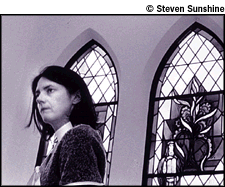
The suburbs were snowy and serene last Saturday morning, but at Newton's United Parish of Auburndale, a small group was plotting to fight the power. "This is a public outcry," said Julia Greene, the church's stained-glass windows behind her as she pointed to charts on an easel. "It's 100,000 people saying, `Yes, there is a housing crisis.' "
Greene, an organizer with the Greater Boston Interfaith Organization (GBIO), was referring to a project that has galvanized the four-year-old group: the gathering of 100,000 signatures on a petition to increase state funding for affordable housing, tenant protections, and appropriation of land for new low-cost housing. The signature drive, which has sent organizers into MBTA trains, supermarkets, Logan Airport, and even housing court in recent weeks, is part of a push that will test the power of this diverse coalition, which is made up mostly of churches -- about 90 in all -- but also counts synagogues, a mosque, advocacy and community-development organizations, and a union among its members.
GBIO has a simple goal: clout for the little guy, the kind of clout that can change policy. And it's done a good job of laying the groundwork. The group's first public meeting, in November 1998, drew about 4000 people. Cardinal Bernard Law supports the effort and has encouraged area Catholic churches to join, and GBIO members have met with police, city officials, and city-council candidates to discuss housing, public safety, and school cleanliness.
But coming months will mark the first real test of the group's influence. GBIO is planning a massive May 9 "action" to voice its concerns on housing and education before invited state and city politicians, including Mayor Tom Menino, Senate president Tom Birmingham, and Governor Paul Cellucci. In addition to collecting the 100,000 signatures needed to indicate popular support for their agenda (they currently have about 42,000), organizers hope to attract thousands of people to the May event. And for the weeks leading up to the rally, GBIO has planned "accountability sessions" in which members will publicly ask legislators to commit to the organization's goals.
"It's about the power of numbers as opposed to the power of money," says Father John Doyle of St. Peter's Church, in Dorchester. "We spent several years building our organizations within congregations and institutions, strengthening them. The purpose always was to have enough strength and numbers and power to influence the decisions made about the quality of life in our society."
GBIO began in 1996, when a group of 45 clergy met to discuss the idea of forming a local interfaith activist organization, but its roots go back decades. The group is affiliated with the Chicago-based Industrial Areas Foundation (IAF), which, along with the Association of Community Organizations for Reform Now (ACORN), is among the most influential urban grassroots organizations in the country. IAF was started by radical organizer Saul Alinsky, a pioneering organizer whose work in the neighborhoods surrounding Chicago's stockyards in the 1940s bred an approach -- known as "broad-based" or "institutional" -- that focuses on empowering entire areas. Unlike many activist groups, IAF groups don't start with an issue and then recruit the like-minded. Instead, they work in and across neighborhoods to organize people, who then decide for themselves what issues are most important to them. The idea, members say, is to build coalitions that transcend specific issues and to create a stable base of power across races and neighborhoods. Both IAF and a Boston-based group called the Organizing and Leadership Training Center -- which works with interfaith organizations in the Pioneer Valley, Brockton, and elsewhere -- were instrumental in helping to organize GBIO.
Because the IAF model stresses building relationships among members, personal stories play a major role in the organizing process. GBIO members held thousands of intimate "one to one" meetings before the massive 1998 gathering, and they continue to organize "house meetings" at which up to 15 people at a time discuss the issues that are important to them. Only after such meetings does GBIO decide which topics and proposals to focus on. "It comes together around stories," says the Reverend Frank Kelley of Dorchester's Way of the Cross Church. "People sharing stories of how they have lived and existed and what they see as challenges.
"In many instances," he adds, "it's what has angered them or made them feel helpless in terms of how to address these issues and overcome problems in their communities." That was the kind of thing members chatted about last weekend in Newton as they prepared to fan out with their clipboards.
"A two-bedroom in Dorchester was about $650, and now it's about $1000 to $1200 with nothing," said Karmyn Jones, who's lived in that neighborhood for about seven years.
Added GBIO organizer and Framingham resident Cheri Andes, recalling the struggles she and her husband faced when they moved to the area from Chicago: "The first community we could almost afford was Framingham. We couldn't get into Boston. We just couldn't."
Indeed, some of GBIO's power flows from the fact that it encompasses both people who can afford to live in Newton and people like Gerthy Lahens, a Haitian immigrant who wonders where she can move now that she's being asked to leave her subsidized Fenway apartment. (The management says her four children are too many for the unit; she had two when she moved in.) "We are everybody," says Lahens, who got involved with GBIO through the Mission Church in Mission Hill. "We are doctors and lawyers and students. We are dishwashers and homemakers, and we are housekeepers. Everyone is in it together."
Touchy-feely? Maybe. But members say sharing such experiences builds trust that will allow the group to stick together. "This is about taking back our political system for the people," says GBIO member Fran Early. "But we can't do that unless we come together effectively and work together effectively as a broad-based organization."
Alinsky-descended groups, organizing experts say, are particularly strong because they do most of their organizing through the churches. (GBIO's membership, for example, is about 75 percent faith-based.) This strategy gives the groups "a kind of reality, to the extent that congregations have a reality and a base," says Richard Healey, executive director of the Washington, DC-based Preamble Center, a progressive policy-research and education group. "They have potential for power because they have stable resources of already organized people and funding." It's true, he concedes, that tying itself to churches limits GBIO's ability to pursue certain issues, such as abortion rights or gay and lesbian rights. But when it comes to economic issues, religious affiliation is often a plus. Interfaith groups have already helped expand affordable housing in Baltimore, Washington, San Antonio, and Philadelphia, among other cities.
GBIO's goals for Massachusetts are ambitious. It is calling for the state to increase education spending by $250 million (Cellucci seeks only a $132 million increase) and to double its budget for housing, which now stands at about $137 million, for fiscal year 2001. Ideally, the new state money would be used to set up an affordable-housing trust fund, increase rent subsidies, preserve "expiring use" housing, and appropriate public land, such as the old Boston State Hospital site in Mattapan, for the building of affordable housing. GBIO also supports stronger protections at the city level, including increased "linkage" obligations for developers, stronger requirements that affordable units be included in new market-rate buildings, and tax breaks for landlords who agree to maintain reasonable rents. And the organization hopes to raise money, in part from no-interest loans from religious denominations, to build homes for low-income buyers. Other IAF-affiliated groups have had great success building large-scale low-cost homes in New York and other cities.Achieving these goals will be tough in a state where the housing budget has been on the wane since 10 years ago, when it stood at $220 million. Housing costs, meanwhile, are soaring. Even GBIO members don't know whether the group can overcome these obstacles.
Still, GBIO is the organization that stands the best chance of addressing the immediate crisis in housing and creating a lasting grassroots movement locally. Activists say it's been years, even decades, since a grassroots movement with such potential has been active in Boston. "Do you know when the last time something like that occurred -- a gathering of four or five thousand to express a political agenda, a political ambition?" says long-time organizer and Democratic activist Chris Gregory, referring to the 1998 meeting. "They are important because they are a political expression of a faith-based community. They are pretty smart about how they do this stuff, and they are carefully organized."
And Peter Dreier, who founded the Massachusetts Tenants Organization and served as director of housing for former Boston mayor Ray Flynn, and who is now a professor of politics and public policy at Occidental College in Los Angeles, calls GBIO's emergence the most important political development in the area since the large community-organizing group Massachusetts Fair Share broke apart in the early 1980s. "Groups like IAF, along with unions, are the best vehicles for mobilizing large numbers of people around issues of economic justice," he says.
"For the last 20 years in Massachusetts there has been no community or consumer organization with the capacity to organize and mobilize and turn out that many people, and that's what's been missing," he adds. "That's very different from traditional Boston organizing. It's [usually] very neighborhood-oriented and not very conducive to working across geography issues and racial lines or boundaries." GBIO, he says, could fill the vacuum.
And the group has another asset: buzz. The Boston Globe and other papers have had kind words for GBIO: political columnist Brian Mooney says that the group could "become the most potent grassroots movement in this state in decades," and an editorial late last year praised it for "injecting some moral excitement into the local debate on housing shortages." Organizers have even raised GBIO's profile enough that there were nods of recognition when they waded into a sea of frustrated travelers at Logan Airport to collect signatures over the Presidents' Day weekend. "I know Mayor Menino says it [housing] is a big concern of his, but he has a lot of pressure from developers," said Haverhill resident Nalana Dzivak after signing the petition. "Everything I read indicates this organization needs help."
But it's the state budget that will show whether GBIO has what it takes to sway policy. "I am assuming they are in this for the long run," says State Representative Byron Rushing (D-South End), once a community organizer himself. "The most important thing is that there be something in this budget that people will know, whether they admit it or not, got into this budget because of GBIO."
Will that happen? Johnny Jimenez, an airline mechanic from Chelsea whose church is a GBIO member, is confident that the group's size will make it impossible to ignore. "Power in numbers," he says. "When one or two people speak up, no one listens. When the masses speak, they have to listen."
Ben Geman can be reached at bgeman[a]phx.com.