February 24 - March 2, 2000

Save the whales
The MWRA's nearly completed outfall pipe will release 370 million gallons of treated sewage a day, just miles up current from a protected marine sanctuary. The sanctuary is home to the last 300 North Atlantic right whales on the planet. What were they thinking?
by Rebecca Pollard
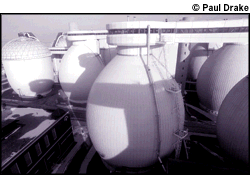
It's hard to miss the 12 enormous egg-shaped flasks gracing the entrance to Boston Harbor. At close range, one can hear the eerie meditative pitch they emit; it flirts with the ever-present wind on the near-treeless Deer Island. Their song arises from the turning of metallic stirring rods that pierce the center of each frame. Within each orb, these rods turn 24 hours a day, stirring some 60 million gallons of human waste.
The gleaming eggs, called "digesters," function much like human bodies. They're kept at 98 degrees Fahrenheit to encourage the growth of bacteria, which break down the contents of eight million daily toilet flushes. Each egg produces 700,000 cubic feet of methane every 24 hours -- enough gas to fuel the heating system that warms them to body temperature. A team of German engineers designed the eggs in the late 1980s, and they spared little expense. The eggs are one reason why, during the 14-year planning and construction of Deer Island's sewage-treatment plant, Greater Boston residents have seen their water bills rise more than 400 percent.
But the most costly -- and controversial -- part of Deer Island lies hidden from public view: a 9.5-mile-long, 26-foot-wide pipe, carved from solid bedrock hundreds of feet below the sea floor. The end of the pipe lies deep in the rich blue waters of Massachusetts Bay. To fishermen, these waters -- loaded with cod, haddock, and lobster -- are some of the most valuable in the North Atlantic. To environmentalists, Massachusetts Bay is home to the Stellwagen Bank National Marine Sanctuary, the feeding ground for humpback whales, whitesided dolphins, sea turtles, and some of the most critically endangered animals on the planet -- the last 300 North Atlantic right whales. To engineers at the Massachusetts Water Resources Authority (MWRA), this stretch of ocean is the perfect daily dumping ground for 370 million gallons of our sewage.
The outfall tunnel was originally due to open this spring, but the MWRA halted construction last July after two workers suffocated. The families of the two workers have filed suit, and operations have been postponed until the cases are settled. Certainly within the next year, however, we can expect our treated waste to travel -- with each flush -- from our homes through the street sewers to the Deer Island plant, then out the longest pipe of its kind and into the most biologically diverse toilet one could imagine.
How will this affect the right whales? These huge mammals were hunted almost to extinction in the 1800s, and among the 300 animals remaining, scientists have identified only five distinct genetic strains. This means that each North Atlantic right whale represents a significant portion of the gene pool: the survival of each whale is critical to the survival of the whole species.
MWRA officials say the new location of the outfall pipe won't harm sea life. They've spent millions of dollars ensuring that the effluent carried into the bay -- a "tea" consisting of human waste that's been treated to remove many pollutants -- is some of the cleanest sewage discharge in the country. But environmental activists say it's not possible to treat the effluent to the point where scientists can ensure the well-being of sea life in the Stellwagen Bank. What makes this conflict difficult to understand, however, is that unlike the environmental battles of the 1960s -- when Rachel Carson's Silent Spring galvanized a movement -- it has no good guys or bad guys. Everyone involved in the outfall pipe, from MWRA officials to the scientists who've studied the issue to environmental activists, wants to do the right thing. And they're trying.
But not everybody is subject to the same political pressures that bear on the MWRA, often at the environment's expense. To be sure, a number of studies -- all of them funded fully or in part by the MWRA -- have shown that the new location of the pipe will improve the water quality in Boston Harbor. But environmentalists point to the lack of independent research on how the treated sewage discharge will affect the marine sanctuary. They also note that the MWRA has a long history of compromising clean-water standards in order to lower costs and appease angry ratepayers.
Everyone agrees on one thing, though: the effluent that will eventually flow from the pipe into Massachusetts Bay has a chemical composition akin to that of common garden fertilizer. It's rich in nitrogen and phosphorus, nutrients that spur the growth of small ocean plants and algae.
Although MWRA scientists say this discharge won't harm the bay, environmentalists are less sanguine. The effluent could fertilize the bay, allowing certain types of plankton to crowd out those that form the right whales' precious diet. In the worst-case scenario, the effluent could bring on blooms of the infamous Alexandrium algae, an insidious species that created red tides along the Florida coast last April, smothering dolphins, manatees, and endangered sea turtles. Alexandrium's toxins accumulate in the animals that feed on it. Mackerel living in a red tide can poison fish-eating whales, such as endangered humpbacks; shellfish that feed in a red tide can cause paralytic shellfish poisoning in humans.
Algae growth occasionally blooms in Boston Harbor, and that's why the MWRA, with prodding from the Environmental Protection Agency (EPA), decided to move the location of the outfall pipe from the harbor's mouth to nearly 10 miles out to sea. It's the algae fed by the effluent's high nutrient concentration that causes the harbor's brownish hue.
But if moving the sewage farther out to sea may sound like a good idea, letting it dump just 16 miles from a protected marine sanctuary does not. "This is all one big experiment," says Mary Loebig, a high-school biology teacher in Dennis and co-founder of one of Cape Cod's most vocal citizen groups, Stop the Outfall Pipe (STOP). Concerned that the MWRA has funded just about all of the research that went into the planning of Deer Island, Loebig began her fight against the pipe plan 10 years ago when Bill Golden, a former state senator from Weymouth, warned Cape Cod residents about it. "This fight has been really hard, and it's been a fight the whole way," Loebig says. "All we wanted were some independent eyes out there."
STOP raised $20,000 -- via an Arlo Guthrie concert -- to fund two studies of the issue in 1991. The group hired Theodore Smayda, a renowned plankton biologist at the University of Rhode Island, and John Christianson of Oceanic Associates in Maine, to study the effects of nitrogen in the bay. (At the time, the MWRA was well along in its construction of the pipe but hadn't determined how the nitrogen-rich effluent might affect the waters.) Both scientists concluded that the effluent coming from the new outfall pipe could pose a significant threat to marine life. The studies found that certain natural processes, such as sediment dredging and freshwater mixing from rivers, remove some nitrogen from Boston Harbor. Because these processes do not occur in Massachusetts Bay, the bay might be more susceptible to ecosystem changes than the harbor. They also concluded that red tides are likely in the kind of high-nutrient conditions that might prevail in the bay if the effluent were released there.
Just over a decade ago, Boston Harbor achieved national infamy as the "the dirtiest harbor in America" during the 1988 presidential campaign. Then-vice-president George Bush levied the charge at Michael Dukakis and attacked the then-governor for his poor environmental politics. But although it's true that Dukakis failed to cash in on available federal funding to clean up Boston's sewage facilities during his first term as governor in the '70s, the blame for the dirty harbor hardly rests with him. Dirty water
Our first sewage system was constructed in the 1800s, when brick tunnels were built to carry human waste to the harbor islands. There, discharge stations released the raw sewage into the outgoing tide. It was a novel idea at the time; the practice even won international awards for engineering excellence. Unfortunately, much of the sewage simply washed back into the harbor.
By the 1980s, Boston Harbor was Massachusetts's embarrassing little secret. A fifth of all harbor fish had visible tumors -- presumably brought on by the polluted water -- and half the harbor's shellfish grounds had been closed. Beaches closed, too; Wollaston and Constitution Beaches lost half their swimming seasons to unsafe water. Algae blooms brought on by the glut of nutrient sludge clouded harbor water.
The stench prompted a number of grassroots environmental groups to take action. In 1983, Quincy city solicitor Bill Golden joined up with the Conservation Law Foundation to fight for clean-up of the harbor. In an inspired move, Golden presented two beakers of smelly harbor water to a Massachusetts Superior Court judge and dared him to take a whiff. Golden won the lawsuit. The judge ruled that Boston sewage did not comply with the federal Clean Water Act. It was the first of many cases that led to the $6 billion clean-up of Boston Harbor.
-- RP
As scientific research goes, two studies and $20,000 is but a drop in the sea. Nevertheless, STOP succeeded in bringing the issue to attention of the EPA, which then forced the MWRA to do more research on the environmental impact of the new outfall pipe. The subsequent studies, all funded by the MWRA, concluded that the bay wouldn't be harmed.
Don Anderson, a marine scientist at Woods Hole Oceanographic Institution, says that the new outfall pipe will have little chance of creating a red tide or any other type of algae bloom in the ocean. "I feel very confident that the outfall pipe won't increase the chances of algae blooms in Massachusetts Bay," he says. "We only expect to see the amount of algae in Boston Harbor drop off."
Anderson bases his opinion on computer models of the bay developed by a group of scientists at the United States Geological Service. These models take into account currents, water depths, temperatures, and a whole range of variables that may contribute to an algae bloom. Anderson says the new location of the pipe is safe largely because of its location in deep waters: the outfall will discharge 200 feet below the surface. Sunlight is limited at this depth, so the water temperature falls off abruptly (from about 70 degrees to about 40 degrees Fahrenheit), creating a separating layer called a thermocline. Because of the extreme difference in temperature, the nutrients in the effluent will stay closer to the sea floor, where they won't receive enough sunlight or warm water to fuel algal growths. What's more, computer models predict that the deep icy waters and the warmer surface waters won't mix across the invisible thermocline boundary.
Anderson is quick to note that although his research was funded in part by the MWRA, the agency gave him "total freedom." "Nobody was telling me what to find, or where," he says. "These are all peer-reviewed studies."
Not every scientist, though, puts so much faith in computer models. Mason Weinrich, a whale biologist and director of the Cetacean Research Institute in Gloucester, doesn't believe the models can address every variable in a living system as complex as the open sea. "Models make predictions, and predictions are not findings," says Weinrich. "I'm quite concerned, not just about right whales, but about all the whales in Massachusetts Bay."
Steve Tucker, a water-resources specialist with the Cape Cod Commission, a regional planning agency that's been involved in the EPA's permitting process for Deer Island, expresses similar doubts. "These models are some of the best that scientists have come up with. The people who've worked on this have done an excellent job," Tucker says. "But this is an extremely complicated system and we have to at least wonder: are the models good enough?"
Joseph Ayers, director of Research at Northwestern's Marine Center in Nahant, says that during big storms, which are common in Massachusetts Bay, the ocean waters mix thoroughly, easily crossing the thermocline boundary and increasing the possibility of algae blooms.
And Ayers, like Loebig, is skeptical about the lack of independent studies. "The MWRA has basically bought most of the scientists in the area," he says.
Over the past decade, the MWRA has made great strides to improve what it dumps into Boston Harbor. Since the MWRA upgraded the treatment system in 1995, the amount of sludge the facility releases into the harbor has dropped by 75 percent, the number of days harbor water has exceeded fecal-coliform bacteria counts has dropped from 139 to seven, and pollutant levels across the board have reached an all-time low. Beaches stay open all season, fish are healthier, and seals and harbor porpoises have begun a slow return to the region. In recent months, the outfall pipe has consistently complied with the Clean Water Act for the first time ever. All of which has Loebig and other environmental activists wondering why the dumping ground needs to be moved at all.To proponents of the new outfall pipe, the answer is simple: "Dilution is the solution to pollution." Bruce Berman, head of Save the Harbor/Save the Bay, used that adage when he praised the outfall plan; as did Mike Connor, the former head of the MWRA's environmental-quality department; as did Ken Moraff, an EPA attorney and a key player in the EPA permitting process.
Unfortunately, though, not every pollutant in the effluent will dilute so easily. One such pollutant became the focus of a telling controversy when, last month, the MWRA announced that it would consider raising mercury dumping limits in response to pressure from local hospitals that have difficulty meeting standards. The agency offered to quadruple the amount of mercury allowed in the effluent, a move that would add about 20 pounds of mercury a year to the discharge.
Peter Shelley of the Conservation Law Foundation, who helped bring the initial 1983 court case against the Metropolitan District Commission that led to the multibillion-dollar Boston Harbor clean-up, says he fears this relaxation of standards may foreshadow more concessions. "Once the public attention starts to soften -- and it will soften once the pipe is up and running -- there will be a tendency for the MWRA to listen to the only people talking: the ratepayers," he says.
The MWRA's history gives him reason to believe this. And, of course, the ratepayers' clout is strengthened by the fact that they elect the state officials who, in turn, elect the MWRA's board members. When sewage bills began to climb in the early '90s, citizen groups staged protests; at the "Waterstock" event at Boston City Hall Plaza in 1993, attendees set fire to their sewage bills. In response, the MWRA has tried to cut costs by lowering the standards for clean effluent. In 1991, the MWRA also proposed that secondary treatment facilities -- which remove most of the sludge from the effluent -- be left unfinished to keep costs low. Two years later, four local congressmen sent letters to the MWRA offering to alter the Clean Water Act in order lessen clean-up costs. The EPA forced the MWRA to stick to the original plan to finish construction on the secondary treatment facilities.
In other words, the agency has been willing to flout the Clean Water Act in the face of ratepayer pressure. That makes environmental activists nervous about its commitment to reducing pollution. Who, they wonder, will speak for the right whales and other sea life out in Massachusetts Bay should the new outfall pipe prove disastrous?
By the time the outfall tunnel opens, Boston's sewage facility at Deer Island will be the most heavily regulated pollution-discharge system on earth. The MWRA will monitor levels of 19 known pollutants, and will test the toxicity of the effluent as a whole."People should really understand, most of the folks who work here got into this business because they want to help the environment," says Andrea Rex, who heads the Environmental Quality Department at the MWRA. "None of us want to see a problem in Mass Bay. We feel quite confident that we won't."
In response to the public mistrust, the MWRA has made all its reports available to the public; the annual State of the Harbor report, monitoring reports, and abstracts of much of its research are available at the MWRA's Web site. The agency also now answers to a group of scientists appointed by the EPA (after the EPA deemed the MWRA's own science advisory board too susceptible to political pressure), and follows the most stringent waste-discharge permit ever written. "We have done everything we can to be transparent in our methods," says Rex.
Protected marine sanctuary or no, we have to put our shit somewhere. The MWRA has sunk billions of dollars into the research and planning of Deer Island, but the basic concepts of the treatment facility are ancient in origin. Ever since the Greeks developed large aquifer systems to carry water long distances, the planning of Western cities has centered on the notion that it's okay to use clean water to wash away waste. And though the profile of urban centers has changed some in the past couple of thousand years, civil engineers have yet to rethink that precept. Storage problem
Most large American cities -- certainly the coastal ones -- send their sewage effluent into some body of water, be it a river, a lake, or the sea. Only about 2000 of the country's 16,000 treatment facilities reuse their effluent for industrial wash water or agricultural fertilizer or irrigation, and most of these facilities (there's one in Phoenix, Arizona) do so because they are entirely landlocked. On occasion, one hears murmurs that a gated Northern California community has installed composting toilets for each resident. But the rest of us operate according to the Western sewage world's status quo: dilute it with clean water, flush it as far away as possible, and don't think about it again.
-- RP
Still, public mistrust abounds. Maybe environmentalists lost faith in the MWRA's commitment to protecting the whales, sea turtles, dolphins, porpoises, and fish in the ratepayer scuffles of the early '90s. Or perhaps the mistrust stems from the decades during which state officials dumped barely treated sewage directly into the harbor. Or perhaps groups such as Stop the Outfall Pipe and the Conservation Law Foundation have simply learned from experience that they must be vigilant. It was a public lawsuit, after all, that launched the clean-up of Boston Harbor. And it was research funded by environmental activists that got the MWRA to study in depth the effects of effluent in the bay in the first place. Maybe a workable answer to one of the Commonwealth's most foul dilemmas lies somewhere in the middle of these push-and-pull politics.
It's hard to believe, though, that the solution to our sewage problem lies in dumping effluent in some of the most productive waters of the North Atlantic. Surely a society as technologically proficient as ours -- one that has advanced so far that it can bore a 9.5-mile tunnel out of solid bedrock hundreds of feet below the sea floor -- can come up with a more sustainable way to deal with our shit than piping it out into the ocean just 16 miles from a protected marine sanctuary.
Conservation ethics haven't driven engineering design in the past. But maybe they should. While we still have time, perhaps 3.6 million composting toilets are in order.
Rebecca Pollard is a freelance writer living in Boston.