March 2 - 9, 2000
![[Features]](/standard/image/headers/features_header.gif)
Dressed for success
The free-form comedy of Eddie Izzard
by Matt Ashare
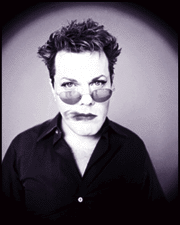
The HBO special built around British comedian Eddie Izzard's one-man show Dressed To Kill opens with a clever bit of footage shot on the streets of San Francisco, where the performance itself was taped in 1998. It's really nothing more than a bunch of anonymous tourists riding a cable car down one of the city's infamous hills toward the bay, with Alcatraz visible in the distance. But Izzard makes the most of this otherwise generic bit of film with what sounds like a rather impromptu voice-over, something he might have thought up off the top of his head one afternoon while the hour-long special was in post-production. The passengers, we're told ominously, are prisoners. The driver is a guard. And the trolley is a transport to Alcatraz, "once a Native American paradise where people worshipped the gods of the, ah, Native Americans," but now the most feared prison in all the land. It's a silly, somewhat sloppy little routine with production values that bring to mind something a friend might have thrown together in an introductory film class. And that's the haphazard manner in which Izzard -- the 38-year-old cross-dressing comedian who's been hailed on his home turf as Saint Eddie, the savior of British comedy, and proclaimed as "the funniest man in England" by no less an authority than Monty Python's John Cleese -- essentially chose to introduce himself to the bulk of his American audience.
Fortunately, the routine -- though that's really not quite the right word for it -- is very, very funny. So, before Izzard even appears on stage, sporting shiny polyvinyl pants, a short dress-type top that comes down over the top of the pants, heels, lipstick, eyeliner, and the works, you already have a sneaking suspicion that everything this guy touches, no matter how shabby it may be to begin with, turns to comedy gold. And it's something that just seems to come naturally to this fast-talking charmer.
Izzard, who cut his teeth as a street performer in England before being swept up in a stand-up comedy boom that hit London in the late '80s and has yet to abate, is the first British comedian since, well . . . the first British comedian in a very long time who's even made a dent in the US market. In fact, he's really the first comedian, period, to attempt to make his mark here doing stand-up (as opposed to a sit-com or Saturday Night Live stint) since Denis Leary used the stage as his launching pad to celebrity in the mid '90s (though it was really those MTV spots that made Leary a somewhat marketable Hollywood commodity). And, since there's really no longer a national network of comedy clubs to support the rising stars you used to catch on a Friday or Saturday night, he's had to do so with a little sleight of hand -- namely, by giving his stand-up routine a name, calling it a one-man show, and touring theaters instead of clubs. Dressed To Kill was the vehicle that brought him to the US in '98, and now he's back on the road with Circle, on a tour that started in Toronto on February 29 and comes to Boston's 57 Theatre from March 7 through 11 before moving on to Chicago, Philadelphia, New York City (where Dressed to Kill ran for four months), Australia, and then the West Coast of the US.
"I don't really write new shows," Izzard admits when I sit down with him over Coca-Colas and cigarettes at 29 Newbury on a Monday afternoon. "I just roll one show over to the next. I'll begin by ad-libbing new material one night and then, gradually, the old show will change into an entirely new show."
In fact, unlike most comedians, Izzard -- who's supplemented his comedy career with acting roles in Velvet Goldmine, Mystery Men, and other film and stage projects -- doesn't write anything down. He basically develops his material by going on stage and letting loose. "Note to self: never make that connection again," he jokes in Dressed To Kill after comparing the guy who rings the bell on San Francisco trolleys to the guy who rings the bell at the New York Stock Exchange and getting nary a laugh. The "Note to self" line, though, comes perfectly timed. And, though he's not the first comedian to employ that strategy (Letterman's monologues, and Carson's before him, have always included self-critiques that get more laughs than the jokes themselves), in Izzard's case you get the sense that he's only half kidding -- that he really is taking mental notes that will be applied to future performances. And, though he certainly has routines that he performs night after night -- "I only improvise maybe five to 10 percent of every show," he says -- the entire performance has a stream-of-consciousness sensibility that creates a unique tension. Comedy relies in part on the comedian's ability to surprise listeners because they don't know what's coming next. In Izzard's case, you sometimes feel that even he's not sure what's about to happen.
"It's a big conversation where no one else gets a word in edgewise," is how he describes it. "It's also quite fluid in the sense that when I'm developing a new piece, I'm ad-libbing new stuff onto it every night, and there's real energy to it because I haven't heard it all yet. After a while, once you get it locked down, it becomes like a prayer that you simply recite. And it can get a bit tired. So I thought that if I could keep the material in this fluid state as molten material or something, then it would always have the chance to be added to and ad-libbed from and have that kind of new energy in it. That's why I don't write the material. Things do get locked down from time to time, but then I'll get bored with it, leave it alone for a bit, and then pick it up again -- and, like a band will do a new arrangement of a song, I'll do a new arrangement of it. It may go slightly worse, but hopefully it eventually comes up as something better. It does work for me in the sense that it keeps me from getting sick of the material when I'm on tour."
So what distinguishes Circle from Dressed To Kill and his previous one-man shows? "I called it Circle because, well, one needs to have a certain title on it. Like a band's album. Why is it called 'the White Album'? Because it needs a title. Actually, they didn't call it that at all, did they? We named it 'the White Album.' Anyway, you know what I mean. And I was trying to build into the show this whole idea of circles. There's something about the whole universe that can be explained by curves. All the planets are circular, everything goes around in orbits that are circular, space-time is curved, the galaxies are spirals. So I wanted to build that in as some kind of theme without turning it into anything like a concept album. So in some way it has some sort of link to it. But also, I guess, it fucking hasn't got much to do with it at all."
That said, Izzard will be working from a set list. "It's like a map for a journey between two cities, but I can go off on all these little side roads," he says. "And then I come back on to the main motorway. I talk about the early Greek thinkers, and about how the English are supposed to hate the French but the French really don't seem to be that bothered at all about the English. I think we just want to be living in France. It's warmer there, and they have the south coast. So we're geographically jealous. And drugs and sports is another one of the topics. Drugs are illegal in sports because they're performance enhancing. But there are a lot of performance-debilitating drugs too. So I think there ought to an Olympics where everybody has to be pissed, where drug testing is there to make sure that everybody is off their faces. And you'd get to see people do the hurdles and the high jumps and everything when they're off their faces. I think people would pay money to see something like that."
One subject, though, that never fails to come up is Izzard's penchant for wearing women's clothing. It's something he's not the least bit defensive about, though he does like to clear up certain misunderstandings. "I am a transvestite," he explains. "That's my sexuality. It's a built-in thing -- I've known since I was four years old. It is an alternative sexuality, but it isn't the same thing as being a drag queen, and it's not part of gay sexuality. It's slightly different. I've described it as male lesbianism. It's being a male tomboy. As I say in the show, 'It's running, jumping, climbing trees, and putting on makeup when you get to the top.' So there's a big slice of boy in there and a big slice of girl, too. I do have a girlfriend, but I don't really talk about that. And I've always fancied women. The bloke part of me fancies the opposite sex and the girl part of me fancies the same sex. Even when transvestites change sex from male to female, they still tend to live with women and be with women.
"I used to use the word 'heterosexual' when I was explaining to journalists that I fancied women. And some of them would then say things like 'He insists that he's straight,' as if there were some sort of denial going on. Of course, the idea that someone would go through the hell of coming out and saying that you're a transvestite and then hide the fact you might be gay is just insane. Why go through that pain and then not admit the sexual thing, which is going to add no extra baggage? It's ridiculous."
Despite all that, Izzard had a remarkably easy time connecting with American audiences on the Dressed To Kill tour, as the HBO special and the four-month run in New York demonstrated. And in large part that seems to be a reflection of the fact that his style is influenced by American comedy and by the British comedy that has gone over well in the US, such as Monty Python. His command of current events and world history, coupled with his brisk delivery, brings to mind Dennis Miller in his heyday, and his penchant for absurdist flights is reminiscent of the young Steve Martin. And that's just scratching the surface. "The alternative comedy scene that developed in Britain starting in 1979 was based on post-Lenny Bruce American stand-up comedy. And that's what I was inspired by," he says. "But I also feel that there are several different senses of humor in every country. Some people like surreal comedy, some people like political comedy, some people like observational comedy. It's that way in Britain and in America. Middle America might not get me or my stuff, but Middle Britain doesn't either. And that's an attitude of mind and not a geographical thing. I learned a lot from American comedians, but I learned it in Britain. So in some ways it's like the Beatles when they came over here with their music and Americans said, 'Oh, we know this, but we don't know it.' That's because the Beatles listened to American R&B for so long and then did their own version of it. So it was familiar, but it was different, too. So I always thought my comedy would work here, and I'm very pleased that it has."
Eddie Izzard plays the 57 Theatre from March 7 to March 12. Call (800) 447-7400.