March 9 - 16, 2000

Mayor Lynch?
Speculating about Stephen Lynch's post-State House plans. Plus, pols make promises on housing, and the city yanks a protest permit.
by Ben Geman
State Senator Stephen Lynch (D-South Boston) is no Billy Bulger -- despite his having gracefully taken over Bulger's MC duties at the annual South Boston jokefest known as the Saint Patrick's Day breakfast. But could he one day fill the shoes of John Hynes, John Collins, Kevin White, or even Ray Flynn? That's what some of the attendees will be wondering at this year's breakfast, on Friday, March 17.
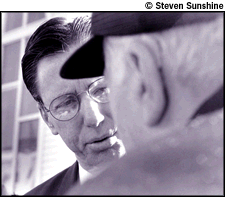
Lynch will once again serve as master of ceremonies at this gathering of the city's and state's political power brokers. In his second term in the state senate, Lynch is among Boston's rising political stars. And with issues in his district heating up (the South Boston Waterfront, for example, is currently dominating the city's development agenda), the former ironworker has never had more clout -- so it's worth asking where he might go from here. "He has been very involved with the Gore campaign in Massachusetts, and he has really solidified his position using the Saint Patrick's Day breakfast, raising his profile," says Democratic political consultant Mary Anne Marsh, who notes Lynch has "been talked about for a variety of offices."
Lynch has been out front on such issues as the battle in Southie against a new stadium for the New England Patriots, and he can raise money (in 1999, when he was not up for re-election, he raised $153,585). Another plus: labor loves him. Would Lynch ever want to work on city development as the mayor of Boston? It's a possibility, if a highly speculative one. The man is clearly ambitious (he went from ironworker to law-school student to state senator) and well connected (he counts Michael Whouley, a Boston political consultant who's among Al Gore's top advisers, among his friends).
At this point insiders link Lynch to Washington more than to City Hall. Many believe Lynch will look to replace a close friend of his -- powerful South Boston congressman Joseph Moakley, the dean of the state's Democratic congressional delegation -- when Moakley steps down. "People think he will take that career path," says Allston-Brighton city councilor Brian Honan. "He is a big player in Boston politics; he's very effective, with a lot of union backing coming out of a very large voting base. . . . He would be a very serious candidate for any office he would choose to run for."
But if Moakley hangs around for a long time, running for mayor might look like the better option. Observers say Moakley has not been this energetic in years. If the Democrats take back the US House of Representatives, he will be more powerful than ever. What's more, though the Ninth Congressional District seat includes parts of Boston, the majority of the district is outside the city in places such as Taunton, Easton, and Stoughton. When Moakley leaves, a race for the Ninth will bring a host of candidates out of the woodwork -- not unlike what happened when Joe Kennedy stepped down from the Eighth Congressional District seat. Potential candidates include state senators Marian Walsh (D-West Roxbury), Brian Joyce (D-Milton), and Marc Pacheco (D-Taunton), all of whom have greater name recognition in the suburbs than Lynch.
Plus, a run for mayor would offer Lynch advantages that a run for Congress wouldn't. For one thing, city elections are held in odd-numbered years, so Lynch could run for mayor without giving up his state-senate seat. But elections for Congress, like elections for the state senate, are held in even-numbered years; a run for Congress would mean Lynch would have to abandon his current post. South Boston, with a high and reliable voter turnout, would be a good staging ground for a mayoral run. And Lynch is a lifelong Boston guy with a taste for nuts-and-bolts city issues; long stretches in Washington might not suit his style. (It should be said, though, that Moakley never shies away from weighing in on local issues.)
Lynch says he's interested in moving up the ranks in the state senate; some have speculated he could replace Thomas Birmingham as the body's president. Birmingham is probably running for governor, and he faces a four-term limit in the presidency post he gained in 1996 from William Bulger. Even if Lynch didn't take over for Birmingham, Birmingham's departure would probably mean a shuffling around of other leadership posts, too. "Let's just put it this way: I just love the work in the Senate, I enjoy the legislative debate," Lynch says of the speculation. "If there were opportunities there, that would be more attractive to me right now." Running for Congress or mayor, he says, would be "long-long-term possibilities."
Still, it's easy to imagine Lynch casting his eye on the mayor's office. Lynch is comfortable challenging incumbents and legacies. In 1994, he toppled incumbent Democratic state representative Paul Gannon to win a seat in the Massachusetts House. After less than one term there, he ended the Bulger family's political hold on South Boston by beating William Bulger Jr. in the race to replace Bulger Sr., who had stepped down from the state senate to become president of the University of Massachusetts at Amherst.
Lynch says he won't challenge Mayor Tom Menino, but it's worth noting that Lynch and Menino are not exactly the closest of friends -- or even political allies. Lynch joined other Southie pols in criticizing Menino's plans for the emerging South Boston Waterfront, and Menino's people supported Gannon in 1994.
When asked about running for mayor in 2005, Lynch opens the door ever so slightly. "I would have to reserve my rights on 2005 if he [Menino] did not run again," he says. "If it were an open seat, I would have to figure out where we are at that point.
"That is high speculation," he adds.
Maybe so, but with no strong challenges to Menino on the horizon, thinking about what might be waiting down the road is fun.
Speaking of Lynch, the senator was among the city and state politicians who attended a meeting of the Greater Boston Interfaith Organization (GBIO) last Saturday and pledged to fight for more housing resources. The first of 11 planned "accountability sessions" to be held by the grassroots group, this March 4 event drew about 200 people to the Fourth Presbyterian Church in South Boston.All four of Boston's at-large city councilors, Southie councilor Jimmy Kelly, and state representative Jack Hart (D-South Boston) joined Lynch in promising to step up their
efforts to deal with the city's housing crisis. Of course, that's not surprising. Would they say otherwise in front of a group that's trying to double the amount of money being spent by the city and state on housing issues?Lynch and Hart said they'd write to and talk with Senate president Tom Birmingham or House Speaker Tom Finneran about housing, and would propose floor amendments that would double the state's housing budget. They pledged to back a $250 million increase in spending on education (Governor Paul Cellucci is proposing a hike of only $132 million). And they agreed to meet with GBIO leaders the day after the legislature's budget proposals are released to plot strategy.
The city councilors, too, agreed to meet with GBIO to strategize. In Boston, city councilors can't initiate new city spending, but they can approve or deny the mayor's spending plans, which leaves room to negotiate concessions and increases with Menino. The councilors pledged to press the mayor for new housing money -- $13 million more than he committed to in his State of the City address in January. This sounds nice, but the city councilors will have to work as a team here, and who knows if they can?
On May 9, GBIO plans to draw thousands to an "action" with city and state politicians to push the same demands that it did in South Boston; between now and then, it will hold 10 other meetings similar to the March 4 meeting. (The first, in which GBIO members in Dorchester will meet with Finneran, various city councilors, and state legislators representing Dorchester, was scheduled at press time for March 7.) Which means there'll be plenty more pledges to keep track of. Watch this space for progress reports.
City officials have yanked a permit granted to activists who had planned a March 26 Copley Square protest to coincide with the opening of a biotech-industry convention. The protest is part of Biodevastation 2000, a planned week of forums and demonstrations by critics of the biotechnology industry (see "Food Fright," This Just In, News and Features, March 3).On March 3, the Boston Parks and Recreation Department rescinded the activists' permit for the rally because, according to a letter sent to the organizers, the activists "misrepresented the scope and size" of their event.
The activists had planned a 1 p.m. rally to be followed by a march to the Hynes Convention Center, where the annual Biotechnology Industry Organization conference will be getting rolling. Parks-department spokeswoman Mary Hines says the agency was not aware the protest would involve a parade and a band when the permit was granted in February. She says officials were clued in later, after an inquiry about the parade prompted them to research the protest on the Internet.
To try to get back in the city's good graces, organizers will meet March 14 with the "City Wide Committee" -- a group that includes representatives from the police, fire, parks, and transportation departments -- to review plans for the protest. If the activists update their plans and get the green light from the committee, says Hines, they will get another permit from the parks department.
Boston police are also skittish about Biodevastation 2000. The city's police department has met with officers from Seattle, the site of last year's protests against the World Trade Organization conference, to get advice and guidance. And police have organized a media briefing lunch (planned for Wednesday, March 8, after the Phoenix press deadline) to discuss their preparations. "We are ready for anything, and we are not just going to sit back and hope for the best," says Sergeant Margot Hill, a police-department spokeswoman.
Meanwhile, Mark Pelletier, a Biodevastation 2000 organizer, promises that the protests will be "creative, nonviolent direct action."
Ben Geman can be reached at bgeman[a]phx.com.