April 6 - 13, 2000

"Glass towers on Viagra." That's how activist Shirley Kressel describes recent development projects in Boston. She calls the modern structures rising above 19th-century brick and stone façades "glass towers with historic socks." And she's afraid the towers will take over the city. Size matters
A building proposal in the Leather District goes far beyond what local zoning allows. Who wins may affect development in your neighborhood.
by Laura A. Siegel
She's right to be afraid. After a slowdown that lasted most of the '90s, building is booming in Boston again. In the midst of an unprecedented run of prosperity, the commercial vacancy rate has fallen below a previously unheard-of three percent, and rents have reached new highs -- nearly $70 a square foot for prime commercial space, more than double the price just five years ago. And little vacant land is left to build on downtown. For developers lucky enough to own a piece of what's left, the higher they can build, the better.
But these remaining parcels are often in or near historic districts, as recently proposed projects in Chinatown and the Back Bay remind us. Boston's appeal is based largely on its urban villages -- neighborhoods such as the North End, the South End, Bay Village, and Beacon Hill. Besides casting shadows, blocking sunlight and views, attracting more traffic, and disrupting the sidewalk with garage and service entrances, a too-tall tower can spoil the architectural unity and vintage character of a historic neighborhood. "It would look out of place. It would look out of scale," says Joan Goody, a Boston architect and chair of the Boston Civic Design Commission. "It would distract from the continuity and harmony of a district whose value is in letting you see what it might have looked like 50 or 100 years ago."
When developers do try to build high, it's not uncommon for union workers to line up with them, while neighborhood residents spend endless hours negotiating with builders. In such cases, the city often finds itself in the middle. And when the struggles drag on for years, no one is happy.
The drama being played out in the Leather District right now is emblematic of these tensions. The outcome could affect development in your neighborhood.
Twenty years ago, the Leather District was abandoned, derelict, its low brick buildings relics of a dead industry. Today this National Historic District is a lively area where trendy restaurants, residences, and Internet companies share turn-of-the-century structures -- factories and warehouses built after the great fire of 1872, now updated with sleek designer interiors.
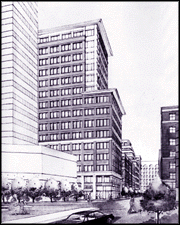
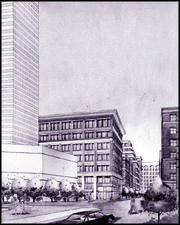
On a corner next to One Financial Center is a parking lot. That site, Two Financial Center, is where Rose Associates proposes to build a 15-story building -- down from an original proposal of 20 stories after months of negotiations with residents. An architectural rendering shows it jutting five stories above the rooflines, looming over the streetscape and blocking out a large chunk of sky. The residents don't oppose a building there, but they'd like it to be 10 stories high, as the zoning allows, or "wedding-caked" back in receding layers, so that from the street it would seem to disappear after 10 stories.
There's little doubt that the proposed structure would be out of place in the eight-square-block district. If you look south from the middle of South Street, in the heart of the district, you see a textured streetscape of warm brick buildings that date from the 19th century. The roofline is low and even, showing a wide arc of sky that lets sun fall on the sidewalk. A block farther south the roofs are only a little higher, but the street feels narrower and gets less sun. To the north, the gleaming 46-story One Financial Center building soars upward. Beyond it: the Financial District, a thicket of high-rises. Phantom towers rise on the other sides -- one block to the east, a tower will soon be built above South Station; another will rise on Lincoln Street, to the west.
But developers and union members alike are pushing for a structure to be built at Two Financial Center that exceeds the zoning limit of 10 stories. Jay Hurley, business manager for Ironworkers Local Number Seven, wants the building that replaces the parking lot at Two Financial to be as high as possible. "When we build, our people are working," he says. As it stands, the proposed project would create 300 to 400 construction jobs. Residents who want a shorter building, Hurley believes, are losing sight of the fact that "they're hurting people who work in Boston." That's why he organized more than 50 members of his union to fill the hall at a recent community meeting to discuss this proposal.
Rose, for its part, insists that it can't afford to scale back its plans any further. "We've done our best to try to answer the residents' questions and concerns," says Michael Vaughan, a spokesperson for the developer. "The current evolution of the building is a bare-bones project."
Explains Edwin Shanahan, CEO of the Greater Boston Real Estate Board: "You lay out all these costs and have to look at this building and say, `Okay, if I can get X dollars per foot, then how many floors do I have to have? Does it work at 100 feet or does it not work at 100 feet?' If the numbers don't work, then the building doesn't get built." And hassle from neighbors might push developers to go elsewhere -- taking their jobs and money outside Boston entirely.
That, in the view of both developers and the city, could mean forgoing some important benefits. Rose Associates estimates that its proposed building would provide space for more than 1000 jobs. The public would also profit in other ways, the developer says. Rose would help maintain a park that will be built as a result of the Central Artery project, and the building would include first-floor retail space as well as underground parking available for resident use.
"This building demonstrates all that we want in the city," says at-large city councilor Michael Flaherty. He says it will provide increased tax revenues to the city -- and more floors, hence more rent, would mean more revenues. Plus, in the Rose project alone, hundreds of thousands of dollars are at stake in "linkage" funds. For every square foot over 100,000, the developer is required by law to give $5 to the community for affordable housing and $1 for jobs. "By the Rose family scaling down, we lost out on hundreds of thousands of dollars in linkage at a time when we're in a housing crisis," Flaherty says. Still, with the building at 15 stories, the total in linkage funds for the city comes to more than $900,000.
With such incentives in mind, the city has worked to arrange negotiating sessions between Rose and neighborhood residents, who almost unanimously oppose the planned structure. People like filmmaker Larry Rosenblum, who was one of the first residents of the Leather District, fear that allowing even a few extra stories will threaten the neighborhood they helped create -- and set a dangerous precedent. Rosenblum, who moved in with a group of friends and renovated an old warehouse more than 20 years ago, also helped design the new zoning codes for the area in 1991. If Rose can get city approval to drastically exceed the 10-story limit, he worries, then other developers will follow suit. "It begins death by a thousand cuts," he says.
Market forces are like the jet stream with airplanes: you still want to make sure you have good air-traffic controllers," says Nicolas Retsinas, the Harvard professor whom the mayor asked last October to review the structure and operations of the Boston Redevelopment Authority (BRA), the city's planning and development agency.Neighborhood activists say that no one is really controlling the traffic. "When you have an environment where developers are expected to overreach the law, it sets off a speculative frenzy, where anything is possible," says Kressel, the president of the Alliance of Boston Neighborhoods.
Rosenblum agrees. "Developers get bolder and bolder," he says. "The rule of law disappears."
It's true developments in Boston have often gone outside zoning in one way or another. Much of Boston was zoned in the 1950s and was underzoned for modern building, so exceptions to zoning became the rule. But according to BRA planning director Linda Haar, that has changed. Within the past 15 years, most neighborhoods have re-zoned themselves, reflecting more-recent visions of their futures. And the BRA has tightened the rules for going outside the zoning code, requiring more community input. Now, says Haar, "going beyond the zoning is the exception rather than the rule. When a case comes up seeking to exceed the zoning, it really stands out." She adds: "Development pressure is strong, but the city is very vigilant about the protection of historic neighborhoods."
But residents of neighborhoods across the city worry that if the city makes an exception in the Leather District, with its recent,
community-approved zoning code, then the same thing could happen anywhere development is an issue. In the Fenway, for example, controversy centers on a proposed new ballpark and concurrent redevelopment of the whole area. In Chinatown, a glass tower will soon top historic façades. On the waterfront, the city is debating how high buildings can go. "We are keeping a very close eye on what is happening in the Leather District as a microcosm of the effectiveness of zoning for the city," says Dan Wilson, an attorney and community leader in the North End.Although the economy is hot, Boston's current building boom is nothing like the development scene of the 1980s, when overscale structures such as the first International Place building (built in 1985) and the tower of the Stock Exchange Building (built in 1984) sprouted all over the city. "We're in a little boom," says Geoff Lewis of the BRA's research department.
Still, neighborhood activists fear more '80s-style monstrosities -- or, worse, repeats of what happened in the West End in the 1960s, when the city leveled a lively neighborhood to put in Charles River Park. They invoke images of Houston and Atlanta -- miles of pavement, glass towers, office parks, malls. Kressel sums up the concerns of many: "We're going to end up like all the cities that are having little theme-park districts [built] so they can look like us."
Leather District residents and representatives from Rose Associates are meeting again this week. Though it looks as if they might be close to a settlement, nothing is firm. Watch closely for what emerges. The final decision will reveal how rigorously the city will stick by its new zoning rules. It will tell us how much power neighborhood activists can wield in the face of wealthy developers. And no matter what the outcome, the very length and passion of this struggle tells us how strongly Bostonians feel about the character of the city's neighborhoods."Right now we are building the Boston of the future," says Wilson. "If we don't make the right decisions, we're not going to achieve the greatness that we can as a city."
Laura A. Siegel can be reached at lsiegel[a]phx.com.