April 27 - May 4, 2000
![[Features]](/standard/image/headers/features_header.gif)
Activism
Monkey business
by Kristen Lombardi
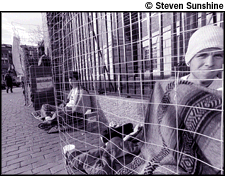
A warning to those walking through Harvard Square this week: beware the human-filled cages on Mass Ave. Local animal-rights advocates have borrowed a page from in-your-face PETA-style actions and plan to spend the week in cages -- outside -- to draw attention to the monkey research conducted at Harvard University's New England Regional Primate Research Center (NERPRC) in Southborough.
As you read this, four activists from the Animal Defense League (ADL) sit in three-by-five-by-three-foot cages outside Harvard Yard, across from Au Bon Pain on Mass Ave. They'll be there until Saturday, when they'll be released. In another act of solidarity with the monkeys, they won't eat or drink while caged. But Shon Mahoney, who volunteered for the cage-in, isn't worried. "Considering monkeys are in cages all the time," he says with a shrug, "this is the least we can do."
Mahoney and his caged counterparts will be kept company by other ADL activists, who will host nightly vigils throughout the week. ADL members hope the cage-in will force NERPRC officials to debate animal experimentation -- something the research center has been reluctant to do. And members want NERPRC to do experiments that are more directly related to humans, including epidemiological, clinical, and genetic studies.
"If people knew what really happens," says Danielle Tessier of the ADL, "they'd demand an end to these types of brutal experiments." She points to lab pictures of monkeys with steel posts sticking out of their heads. The photos, she explains, depict a brain-mapping experiment, in which an electric current is pumped into animals to shed light on how the cerebral cortex relates to perception and behavior.
But because animal experimentation has occurred for decades, ADL activists know their goals will be hard to reach. "Once grants get funded, they're hard to kill," says Michael Budkie, an animal-health technician turned activist who drove in from Ohio for the local event. "Let's face it," he adds, "this is job security for vivisectionists."