May 4 - 11, 2000

The accident tourists
Sometimes the whole TV news industry comes down to two guys driving through Peabody in a Chevrolet
by Chris Wright
I. 'These guys are not credible journalists.'
For Jay Tankanow and Alan Webster, the city of Lynn is a plexus of human suffering. "Accident," Tankanow will remark, driving past a bedraggled teddy bear tied to a light pole. "Drunk driver, triple fatality," and his partner will nod knowingly.
"We can't turn a corner in this city," says Webster, "without remembering something: 'Girl shot here, pedestrian killed here.' "
It's Friday night, and Tankanow, Webster, and I are speeding across the North Shore in search of accidents, bar fights, house fires, homicides. We've heard there's been a nasty car crash in Revere. Tankanow and Webster are prepared for the worst. "Last night we got a call that there was a pretty serious car accident," Tankanow says ruefully, "and the person turned out to have minor injuries."
Heartless? Maybe so. It's all part of the job. Since 1996, Tankanow and Webster have owned and operated the Lynn-based City Wide News Agency -- a freelance company that specializes in filming catastrophes, then selling the footage to local news stations. "It started out as a hobby," says Tankanow, "and turned into a way to make money."
Some nights are less lucrative than others. As we drive around the area where the crash is said to have occurred, we cross paths with fire trucks, police cars, and ambulances -- all, like us, looking for the accident. Absurdly, none of us is able find it.
City Wide is not what you'd call a high-end operation. In fact, what the agency amounts to is two guys driving around in a Chevy Lumina, armed with a police scanner and a couple of camcorders, looking for trouble. "It's fun," says Tankanow."You get a wicked adrenaline high," adds Webster.
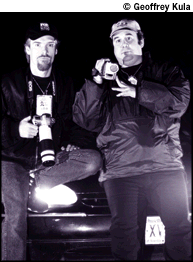
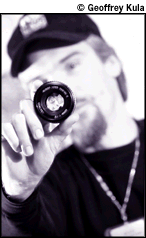
Tankanow and Webster are something of an odd couple. Webster, 31, is trim, good-looking, with a neat goatee and a head of slightly feathered, freshly shampooed hair. He is calmer than his partner, less of a risk taker, more of a pragmatist.
Tankanow, 40, is stubble-chinned, heavyset, with a shambolic dress sense and wisps of hair that creep out from beneath his baseball cap like vines. He is energetic to the point of edginess, a Walter Mitty who clearly craves the glamour and excitement of the news industry.
Discussing the various human tragedies they have covered, the two friends will bicker, speak over each other, finish off each other's sentences. "A lady down the road got stabbed with a poker by her boyfriend . . . " says Tankanow. " . . . he jumped off a railway bridge . . . " adds Webster. " . . . here I am filming this guy and my camera breaks," concludes Tankanow, and they both chuckle at the irony.
It's an open secret in the TV industry that for all the helicopters and satellite trucks local news stations deploy, the footage they use isn't always their own. When a shoe factory burns down and Channel 4 doesn't have a crew available, they'll fall back on one of their freelance videographers. In the event that one of those guys isn't available -- that's where City Wide steps in.Depending on how you look at it, the City Wide guys are either the foot soldiers of the news industry or the bottom feeders. They have been described as "professional rubberneckers," "the disaster paparazzi," and "a couple of jerks."
"We're semi-professional freelance videographers," sniffs Tankanow.
No matter what you call them, there's no denying these guys are motivated. They clamber over rooftops, sprint along major highways, and brave sub-zero temperatures. They log thousands of miles at breakneck speeds, pull grueling all-nighters, and gaze upon scenes of untold horror.
And they alienate countless media professionals in the process. "These guys are not credible journalists," says one local assignment editor who asks that his name not be used.
"Jay Tankanow has been a thorn in the side of every news station on the market," says a local cameraman, who also wishes to remain anonymous.
The main criticism leveled at the City Wide guys -- and Tankanow in particular -- is that they violate the journalistic edict of maintaining a disinterested distance. Indeed, some say, Tankanow is often so in the thick of a story that he becomes a part of it.
"We go to seminars and meetings and learn how to shoot stories, how to not get in the way," the cameraman continues. "We'll be standing up on Jersey barriers and Jay will be on the ground chasing gurneys around, getting into all our shots, and basically pissing just about everybody off."
"The cameramen we meet hate us," allows Webster. "We get the extraction [of a body], they get the car in the middle of the road."
Webster and Tankanow also admit to having a prickly relationship with the police. "The most unnerving thing about our job is having the cops yell at us," Tankanow says. "Some of them are absolutely horrible." He sees this as a First Amendment issue. "We have a right to be there," he says. "We have a right to make a living."
Of course, the First Amendment doesn't protect the right to obstruct firefighters or hinder EMTs -- a point that, by some accounts, Tankanow will often overlook. Even the most hardened war photographer knows that getting a picture involves more than tramping into the middle of a situation and shooting away. As war photographer James Nachtwey said in a recent interview with the Phoenix, "You have to justify your existence in the middle of someone else's tragedy." (See "Shooting War," News and Features, March 10.)
Tankanow, though, denies that his methods are overly aggressive. "We're very careful about what we shoot," he says. "We're very sensitive. If there's a kid on the ground, we're not going to show blood pouring all over the floor. We shoot the same quality as shown on every network."
And he bristles at suggestions that he gets in the way of rescue efforts. "People's lives comes first," he says. "The story is secondary."
Even if it does abide by the ethical standards of network news stations, City Wide still has some catching up to do on the equipment front. In the absence of $150,000 cameras and million-dollar digital technology, the agency's survival rests on a single principle: Get There First.
"Timing is everything," explains Tankanow, who says he sleeps with his police scanner on. He and Webster relate their desolate exclusives with pride, as if describing game-winning grand slams.
"A boyfriend and a girlfriend were having a fight -- I guess they'd been partying and stuff," Tankanow recalls. "The girlfriend threw him out of the car. He was walking along 128 and a pick-up hit him. I had to walk across a swamp to get to him. When I got there he was dead -- the body was on the ground, and his foot was about 10 feet from him. I was the only one there, at three in the morning."
Tankanow says he ended up selling that footage to three or four local stations, the same stations who reportedly "cringe" at the idea of doing business with City Wide.
"It's a pact with the devil," says Emily Rooney, host of Channel 2's Greater Boston, and a former news director at Channel 5. "These guys are resented because they don't pay [union] dues. On the other hand, it's a waste of a photographer to have someone work the overnight beat. No one wants to use them, but there's no other way around it."
In other words, when it's 3 a.m. and you have to walk across a swamp to get to a corpse, a couple of too-enthusiastic video cowboys come in very handy indeed. Perhaps the real question is why Tankanow and Webster would even want to go tramping across a swamp in the middle of the night. They don't do it for the money, that's for sure.
At the best of times, City Wide's market consists of six local news stations: WBZ-4, WCVB-5, WLVI-56, WHDH-7, WFXT-25, and New England Cable News. At $150 per video clip, the most they can make on a really big local story is around $900. Even if you discount the fact that some of these stations have said they are blacklisting City Wide, these are not the kind of earnings upon which media empires are built -- nor, for that matter, the kind of earnings upon which rent is paid. For Webster and Tankanow, the phrase "don't give up the day job" carries very real weight.
"My partner and I have other careers," says Tankanow. Webster supplements his City Wide income by working at a local photo lab. Tankanow is currently between jobs, having recently quit a position at Walgreens. "Shooting video is very competitive and not very lucrative," Tankanow says. "But you hit that one big story and you could make a lot of money."
II. 'Let's see what we can do here.'
It's Friday night at the Webster household in Lynn, and Alan Webster is poking objects into a dodgy VCR. Friday and Saturday, between the hours of 10 p.m. and 2 a.m., are prime time for City Wide, and the guys have promised to show me some action. Before this, though, they want to show me exclusive footage they shot a few years ago of a couple drowning in Nahant -- footage they say netted them the princely sum of $3000 from national news shows. Unfortunately, their equipment is on the fritz.
As Webster mutters and prods, his two young boys and a manic dog bound around the room. Tankanow, meanwhile, fidgets in his seat. "You've got to see this," he says, meaning the Nahant footage. "If . . . I . . . can . . . just . . . ah, fff . . . " says Webster.
Then something happens: beep, beep, beep.
Besides their police scanners, Tankanow and Webster rely on the dispatchers at East Coast Paging and Wireless Systems, who send out the 411 about 911s via little pagers. "One alarm, Boston," Tankanow says. Beep. "Two alarm. If it goes to three we'll be there in 20 minutes." He makes the first of many calls to a network of fire buffs called MRS -- Metro Radio System -- for an update. "Not worth the run," he concludes.
Then we get another page: Malden, armed gang fight. "Let's roll," says Tankanow, deadpan. If you've never barreled through the North Shore on a Friday night in a car driven by a guy with one hand holding a cellular phone and the other twiddling a police scanner, you've missed one of the most exhilarating and complex near-death experiences imaginable.
As we duck and weave through traffic, Webster reads a book of maps and tries to navigate -- "Left! Left!" -- above the squawks and crackles of the scanner.
"We're scanning 150 stations," says Tankanow over his shoulder. Then he's on the cell phone with the Malden police department: "Is the scene still active? What's the location?"
And Webster's going: "Take a right. Take a right!" Neither one is wearing a seat belt. One day, I think to myself, someone's going to be training a camcorder on these guys.
In order to minimize confusion -- or possibly just because it sounds cool -- City Wide and other emergency buffs use a system of codes: 1045 Code 1 means "incident with fatalities." 1043 means "medflight required." 1040 Code 1 means "jaws of life required." 1029 means "photo worthy." When you're dealing with City Wide, though, confusion often prevails: "Is this Route 60?" asks Webster. "Is it?" replies Tankanow. By the time we cross the Malden line, the shooting scene's a 1020: "no response needed."
We head off to Katz Bakery in Chelsea for a late-night snack. "Their pizza bagels are great," says Tankanow, swinging a U-turn and hurtling back down a road that may or may not be Route 60.
Katz Bakery, Chelsea: eleven-thirty and the most exciting thing to have happened so far is a pizza bagel that is neither too chewy nor too soggy -- impressive, but hardly breaking news. As we sit in the car and munch, the scanner comes to life. Accident on Route 93, jaws of life requested, multiple ambulances requested, helicopter requested. Tankanow and Webster exchange meaningful looks.By the time a voice on the scanner says, "We're gonna drop the bird right on the highway," we're peeling away from the curb like people peel away from curbs in the movies. An entire can of Diet Pepsi spills into my lap. "Let's see what we can do here," Tankanow says.
As we race along, Tankanow keeps up his communion with scanner and cell phone, only now he's added a pizza bagel to his repertoire. Webster and the map book, meanwhile, have long since parted company. We manage to shoot past the entrance to 93 in Somerville, pick it up again in Medford, and hurtle along at a tailgating, headlight-flashing clip: "Four exits to go," says Tankanow. "Three exits, two, one . . . "
Then we find ourselves confronted by a spectacular 1047: a traffic jam.
No problem. We slide over into the breakdown lane and zip alongside the stalled traffic until we can zip no farther. We stop, jog up the highway to a line of parked squad cars, and stand there hopping from foot to foot. We're close enough to be dazzled by a carnival of flashing lights, but not close enough to get a good shot. Tankanow approaches a state trooper and asks him if we can move closer. "This is it," the trooper says, arms crossed.
Undaunted, Tankanow enters into his pissing-off-the-police mode. Though I can't quite hear what he's saying, he seems to be employing the toddler method of persuasion: But why? But why? But why? "Don't argue with me!" the trooper finally barks, sending Tankanow running back to where Webster and I wait. "Get back in the car," he says.
We reverse back down the breakdown lane, pull off at the nearest exit, and drive through Tewksbury, trying to stay parallel to the highway. By the time we get stuck at a railroad crossing, an endless trawl of carriages oozing by, near-hysteria has given way to numb resignation. After a few interminable minutes of muttering, dashboard-tapping desperation, we're on our way again, careening through the Tewksbury night.
Finally, Tankanow jerks the car into an office park and, miraculously, we find ourselves within yards of the accident scene, separated from the highway by nothing more than a six-foot chain-link fence and a strip of trees. In a flash, the un-athletic Tankanow has scaled the fence and vanished into the woods. Webster stays put. "It's called trespassing," he says.
I take Tankanow's lead and chase after him. As I push through the trees, my legs are jabbed, my face is lashed, my ankles buckle on the lumpy ground. And then I'm out on the highway, surrounded by scores of emergency vehicles, hundreds of flickering lights. It's a fantastic scene -- a dream-sequence disco.
Webster appears at my side. Ambulances creep back and forth, their tires crackling a carpet of glass. Gurneys trundle by, some of them followed by Tankanow. A helicopter sits on the asphalt, its rotor whirring. There are cars with their roofs peeled away, dark stains on the road. And cops, cops, cops. Oddly, they don't seem to mind Tankanow's skittering presence. One of them even stops to give us a statement.
Tankanow wheels around and fixes his lens on a woman in the back of an ambulance. Then he shoots a grim-faced trooper, a mangled car. This is an MCI -- a mass-casualty incident -- and he's spoiled with choices. In all, seven vehicles are involved, 11 people have been injured, and two drunk drivers are in police custody. Amazingly, we are the only media people there to record it.
Next thing I know we're running back through the woods. A police officer yells at us: "Come back here!" We keep going. In the car, the mood is triumphant. Tankanow actually pumps his fist in the air. If it felt wrong to stand about observing that parade of misery, it feels doubly wrong to celebrate it now. But you rationalize with yourself: I'm not glad the accident happened, I'm only glad I was there to catch it.
James Nachtwey, who says he has seen thousands of dead people, would shudder at the idea of post-horror celebrations. "It's not the kind of work you can ever say you feel happy about," he says. Neither does he buy the idea that exposure to tragedy builds an immunity. "You become more sensitized, not less sensitized."
"Actually," says Tankanow, "you do get desensitized."
It's about one in the morning as we dart toward the nearest station -- New England Cable News -- to try to sell the footage. If anything, Tankanow's driving has deteriorated. He fusses with his cell phone: "Breaking news! Twelve injured!" When Webster corrects him that it was actually 11 injured, Tankanow says, "I'm counting myself." It turns out he stumbled into a pool of water during his run through the woods. Strange to say under the circumstances, but I feel sorry for him.Fortunately, none of the 11 people injured in the Route 93 incident died. This may not be such good news, however, for City Wide. "I hate to say it," Tankanow says, "but unless there's a fatality, the stations don't want the footage. That's what the news market is all about: 'Did anyone die?' "
With no fatalities, City Wide can find only two buyers for their footage: Channel 4 and NECN. After five hours, three incidents, and 125 miles, Tankanow and Webster have made about $150 apiece -- and that's before gas, paging-service fees, and pizza bagels.
Needless to say, City Wide's future seems uncertain. "We won't be using them again," says a spokesperson for one local station.
"Tankanow has burned so many bridges," the disgruntled local cameraman says. "You won't get anyone to say a good word about him."
And yet it's doubtful that the company's undoing, when it comes, will be at the hands of rival cameramen or disapproving editors. More likely City Wide will go under when it forfeits its place at the bottom of the media food chain.
Already there are signs that the agency is being beaten at its game of one-downmanship. "These days," says Tankanow, "a tragedy will happen and you will get there and there will be a neighbor standing on his porch with a camcorder."
No one, after all, has lower overheads and higher mobility than the Joe Public News Agency. As Tankanow puts it, a trace of wounded pride in his voice, "It's getting very hard to stay established."
Chris Wright can be reached at cwright[a]phx.com.