May 4 - 11, 2000
![[Urban eye]](/standard/image/headers/urban_eye_header.gif)
Earth Day
Cleaning up Chelsea
by Ben Geman
Earth Day came a week late in Chelsea, and maybe that's appropriate. The oil-storage yards, dense industry concentration, and dirty waterways of this small and gritty city don't often make people leap to celebrate its environment.
But on this Saturday, in a parking lot behind a Walgreens, next to the muddy, trash-strewn banks of Mill Creek, evidence of change is apparent. Dozens of people have turned up for an afternoon of building birdhouses, taking nature walks along the creek, and even descending its banks to clear away trash and debris, as part of the city's Earth Day
festival.Call it a snapshot of what city activists say is a movement to improve the city's environment. In recent years, groups such as the Chelsea Green Space and Recreation Committee have played defense and offense -- first blocking a planned
asphalt-storage facility they say would have polluted Chelsea further, and now pushing for more access to Mill Creek and the city's other waterways.The Earth Day festival was staged by groups that focus on youth -- the Green Space and Recreation Committee and the Appalachian Mountain Club's Urban Stewards program (both of which work with city teens to increase environmental awareness), and ROCA, a Chelsea-based nonprofit that works with young adults and runs a conservation program. "Chelsea is like a dump," says 22-year-old Carlos Cordova, a staff member at ROCA's Youth Star program, standing in the parking lot moments after announcing a watermelon-eating contest. "If the youth don't clean it, who's gonna do it? We're not getting younger. We're doing this for the future generation, so they can live in a cleaner city."
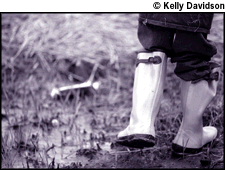
The parking lot has been transformed into a festival space, with a grill, Latin music booming from speakers, and face-painting too. But the goal of the celebration is undeniably serious. Nearby, several kids have donned big yellow boots and ventured down to the muddy Mill Creek. Brian Keating, a teen advocate with the Charlestown Boys and Girls Club, stands with an open trash bag as the youth from the club, who are also in the Urban Stewards program, swarm around him. One of the kids is using the small booze bottles littering the bank to shoot jump shots toward the open trash bag. A motor-oil bottle is found and delivered into the bag too. "There's a tennis ball over here. A dead tennis ball!" says one youth. "This place is getting cleaned up!" exclaims another.
"I'm just trying to help," says Jeison Castillo, 14. "It's pretty dirty." He's right. Down by the creek, it's easy to see why people like Cordova won't sugarcoat talk of the city's environment. A tire is visible through the mud. There's plenty of trash around, and recently a dead seal was found nearby.
The Green Space and Recreation Committee says pedestrian access, a walkway, and benches at Mill Creek would help make Chelsea's environment healthier and more pleasant. "We need open space, and good-quality open space," says the committee's Gladys Vega. To Vega, improving Chelsea's environment is also about "environmental justice," or ensuring that a low-income minority community doesn't bear a disproportionate share of environmental burdens. "Why dump in Wellesley when you can dump in Chelsea?" is an attitude she says has prevailed too often. The government is concerned about Chelsea too -- the Environmental Protection Agency this year began assessing environmental and other problems in the Chelsea River area.
But Cordova makes clear who should lead this charge to change. In the lot, where kids are drawing pictures and words on the ground with bright pieces of chalk, Cordova joins in. He writes GREEN SPACE and, nearby, YOUTH STAR #1. A few feet away, Thai Taing, a 23-year-old who supervises the ROCA conservation program, is handling the food, grilling hot dogs and sausages. "The city of Chelsea is primarily people of color, and they decide to put all the dumps and . . . oil tanks and salt piles in here, and they affect the overall health of the community," he says, standing over the grill.
"[But] whether it's publicized or not," he adds, "there's a big movement to bring positive change."