June 22 - 29, 2000

Time's arrows
We know that British novelist Martin Amis is arrogant, acerbic, and annoyingly talented. Now, with the publication of his new memoir, we can add emotional, vulnerable, and even fallible. Chris Wright asks: is it time to give literature's luckiest bastard a break?
It's hard not to hate Martin Amis.
If you're a writer, it's very hard not to hate him. You'll be chugging through a sentence -- stalling, grinding gears, breathing in the fumes of your own exertion -- and Amis will go breezing by, sunroof open, one hand on the steering wheel. While most writers are content to get from point A to point B, Amis will be doing fishtails, flying leaps, hairpin turns. As if the job of writing weren't tricky enough, he once wrote a book -- Time's Arrow (a novel of the Holocaust, no less) -- in which the narrator lives his life backward. He makes writing look easy, and it's easy to hate that.
In Britain, Amis has come to be seen as a sort of Lucky Bastard Laureate: son of the renowned novelist Kingsley Amis, Oxford grad, a Times Literary Supplement editor at 23, New Statesman literary editor at 25, bit of a lady-killer in his time, now married to a beautiful heiress . . . the list goes on, but it ends, always, with his prose. Amis's 15 books to date have established him as perhaps the most brilliant stylist of his generation.
On top of all this, Amis enjoys extraordinarily high visibility, particularly in England, where he is a bona fide celebrity, the object of unprecedented -- for a novelist -- media scrutiny. The only problem is, a lot of the press Amis gets is negative. Negative bordering on vindictive. He's lambasted for being arrogant and aggressive (Amis has, indeed, engaged various antagonists in some very public squabbles over the years). He's hounded over his personal life (in 1995, the press had a field day with Amis's divorce, his decision to drop his agent, his huge advance for the novel The Information, and some very pricey dental work). He's even taken to task for the way he looks; not long ago, a reporter mocked Amis for wearing an "unfashionable suit." And he is constantly criticized for his work.
The London Independent recently devoted two pages to a collection of opinion pieces penned by up-and-coming young authors on the subject of Amis's prose. With one or two exceptions, the opinions were dismissive, even derisive. Ironically, some of the more scathing pieces were written in a style suspiciously similar to that of Amis himself.
But Amis probably shouldn't complain: when he first came onto the literary scene, 27 years ago, Amis displayed a similar penchant for iconoclasm, a similar delight in duking it out with his elders. Even then Amis had the swagger, the attitude, the air of aristocracy about him. And even then he was seen as the consummate Lucky Bastard. As several reviewers have recently reminded us, back in the early '80s the New Statesman invited its readers to come up with the most unlikely book title imaginable. Martin Amis: My Struggle took the prize.
Twenty years on, Amis's candid, comprehensive, sometimes rambling memoir Experience comes pretty close to being that book. The successes are there in abundance, but so are the pickles, the catastrophes, the cock-ups, the angst. He comes across as sensitive, vulnerable, even fallible. Does this mean we'll have to start liking him? Well, not entirely. The book also has plenty of the famous Amis saltiness and scrappiness. If Amis feels he's had a hard time with the press, Experience soon makes it clear that he won't be extending any olive branches. It takes him all of six pages to take a swipe at his old foes -- and, as always, he's not averse to hitting below the belt. "[W]hat was the extent of your hopes for your prose," he writes, addressing literary journalists, "bookchat, interviews, gossip?" And then, in a butter-wouldn't-melt tone, he turns his attention to us: "Valued reader, it is not for me to say this is envy. It is for you to say that this is envy."
Needless to say, the journalists have not been amused. One of the more spirited attacks came from Julie Birchill, who, writing in the New Statesman, frothed: "[A] lightweight mind attempting to grapple with heavyweight matters is one of the most wretched spectacles metropolitan life has to offer." You can almost see her, staring into the fog of Amis's exhaust, shaking her fist out of the driver's window: "Road hog!"
Yet the "lightweight" charge is nothing new. One of the more enduring criticisms of Amis is that he uses his facility with language to mask the facile nature of his work, that he is all surface and no depth. Experience should go a long way to defusing this idea. The book is not only tremendously complicated in its arrangement -- with its scrambled chronology, its latticed themes* -- it is also remarkably astute emotionally and philosophically. For once, you get the sense that Amis isn't playing games. If he (and we) were 30 years younger, we might say Amis was keeping it real.
It's no surprise that Experience is entertaining. We expected the celebrity gossip (Salman Rushdie once challenged Amis to a fight), the literary criticism (Finnegans Wake "reads like a 600-page crossword clue"), the comedy (a newborn baby resembles a "howling pizza"), and the rancor (Kingsley Amis's biographer, Eric Jacobs, is given an appendix-length drubbing). The fact that we also get such a tender, nuanced exploration of life and death, love and loss, family and friendship, innocence and corruption -- that's the shocker. But maybe it shouldn't be. As many a recent profiler has commented, Amis is a changed man. He has, as they keep saying, mellowed.
* The book is also strewn with footnotes: asides and observations litter the bottom of almost every page and often creep perilously close to the top.
It's a chilly Wednesday afternoon, and Amis arrives at the Phoenix offices looking a couple of notches below mellow -- as if he'd just been through the spin cycle of a washing machine. The previous night he'd been at a cocktail party in New York, thrown in his honor by Talk editor Tina Brown, and he looks -- we'll give him the benefit of the doubt -- tired.Amis is past 50 now, no longer the bad boy of British fiction. The hairline's waning and the eyebrows are waxing. He's a little crinkled, a little frayed. In fact, if Amis were to hold out his hand and ask for some change right now, I'd give it to him.
But don't get me wrong: I am not a hater of Amis. I am a big, lolloping, quivering fan.
In Experience, Amis captures the journalist/fan's dilemma with hilarious precision. "This business of writing about writers is more ambivalent than the end-product normally admits," he writes, warming up to an interview with his literary mentor Saul Bellow. "As a fan and a reader, you want your hero to be genuinely inspirational. As a journalist, you hope for lunacy, spite, deplorable indiscretions, a full-scale nervous breakdown in mid-interview."
What you don't want is tired. What you don't want, under any circumstances, is mellow.
Amis and I retire to the Boston Billiard Club, the pool hall downstairs from the newspaper offices. I've invited Amis here ostensibly to talk about his book, but what I really want is a game of pool (see "Rack and Ruin," below right). But first things first. He orders a spicy tomato juice -- "Very spicy" -- and pours himself into a chair. Something tells me I won't be getting the full-scale nervous breakdown. Amis seems resolutely, unassailably happy.
"I count my blessings," he says, sipping his juice, puffing on a roll-your-own cigarette, "and they are considerable."
Whoa: I count my blessings?
"I've been able to earn a living doing what I love most, and there's not a day that goes by without me thinking how lucky I am for that. And having a full quiver of kids, all of whom seem to be very charming, it gives you a feeling of luxury."
Indeed, Martin Amis has become the kind of person who, unbidden, whips a snapshot of the kids out of his wallet. Where's the cutthroat sarcasm, the puffed-up self-promotion? Where's the man who could whip his interviewers into fits of sputtering disapproval?
"I definitely, self-evidently, haven't been successful in my dealings with the press," Amis says in a rare moment of understatement. "I made a few semi-jokey boastful remarks, arrogant or maybe just ambitious remarks. I once said something like, `In 500 years I want them to be talking about Shakespeare, Dante, and Martin Amis.' I didn't mean that literally; I was just exaggerating an impulse that all writers have."
In his 1984 masterpiece Money, Amis has his inspiredly debauched protagonist, John Self, say, "Sometimes I feel that life is passing me by, not slowly either, but with ropes of steam and spark-spattered wheels and a hoarse roar of power or terror. It's passing, yet I'm the one who's doing all the moving."
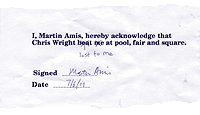
I'd written up a little certificate: Rack and ruin
I, MARTIN AMIS, HEREBY ACKNOWLEDGE THAT
CHRIS WRIGHT BEAT ME AT POOL, FAIR AND SQUARE.
SIGNED ________
DATE ________
A bit presumptuous, maybe. But I did, I meant to beat him. A lot rested on it.
Amis is, of course, a very successful writer. He is also a very competitive pool player, and a good one. "Earthquake Amis," he calls himself.
I myself am not a very successful writer. But I'm not a bad pool player. Then again, I'm not a good pool player: I'm a flighty pool player, able to miss the sitter and sink the triple-bank combo with equal facility. But I'm usually a more successful pool player than I am a writer, so it was very important that I beat Amis at pool.
That, at least, was my logic as I prepared myself for the big match: Earthquake Amis v. Flighty Wright. Single game, straight eight ball, winner take all.
Having won the toss, Flighty got the break. Tink. The cue ball approached the other balls tentatively, reluctantly -- like a shy person at a party. It didn't so much break the balls as jostle them. In the silence that followed, Amis stood there, chalking, appraising the table as if it were a chess board.
I told him my situation. I needed this one.
"I'll see what I can do," he said.
What he could do, it turned out, was play extremely well. Oh Jesus.
People have told me that when I am lining up a pool shot, the expression on my face is one of severe constipation -- all grimace and scowl. Earthquake didn't look that way at all: his expression was solemn, intent -- a gunfighter's face. No mercy.
The first few minutes of the game were a blur of super-pristine shots: plop, clack, plop-clack, clack-plop, plonk. I don't know -- four, maybe five balls went down before my turn came. Stay cool, I said to myself.
I stayed the opposite of cool. I stayed jittery. And I seemed to have pioneered a new style, one where you swing the stick rather than stroke it. Amis, meanwhile, remained extremely gracious, saying "Good shot" every time I came within a foot of a pocket.
The only bright spot was that the cue ball, in its chaotic journey around the table, tended to settle in positions that made it difficult for Amis to get a clear shot. We plodded on with this game of hide-and-seek for what seemed like months. Maybe I would simply wear him down, bore him into submission. And then . . .
It's hard to describe what happened next. It was like the climactic scene in The Karate Kid, where Ralph Macchio taps into latent reserves of strength and courage. It was like a miracle. Chariots of Fire. Like Lazarus, like Bill Clinton's 1992 presidential campaign. It was a full-fledged return from the dead.
In slow motion, bathed in a blaze of golden light, Flighty began sinking balls. If there had been a crowd, it would have been on its feet. If there had been music, it would have been a crescendo of strings. And then, when it came down to the eight ball, everything would have gone quiet. Beads of sweat would have formed on Flighty's brow.
Well, we had the sweat all right. Plenty of perspiration. And the odd "Good shot" from Amis. And me going: "Oh God." And Amis muttering. And the PR person fidgeting. And me again, lining up the eight ball, looking like I'm taking a crap.
It was not an easy shot. The eight ball was on the cushion, about a foot from the pocket. It was not an easy shot. Not with Martin Amis looking on. I toyed with the idea of asking him to leave the room. But no. I took it. I took the shot: gently, gently . . .
As I write this, I can see the little certificate hanging above my desk: I, MARTIN AMIS, HEREBY ACKNOWLEDGE THAT CHRIS WRIGHT BEAT ME AT POOL, FAIR AND SQUARE, signed and dated by Amis, with a slight amendment. The words BEAT ME have been scratched out. The words LOST TO ME have been scribbled in.
After Amis had shaken my hand -- "Good game" -- and left, when I was all alone, I set it up again: the black on the cushion, about a foot from the pocket. There was nothing to be gained this time, and nothing to be lost. In the calm, quiet room I lined up the shot, took it, missed.
-- CW
In Experience, he writes: "It would be a ferocious slander of Martin Amis if I called Money autobiographical. . . . But I see now the story turned on my own preoccupations: it is about tiring of being single; it is about the fear that childlessness will condemn you to childishness."
In Experience again, Amis quotes his father, Kingsley: "[My novels are] firmly unautobiographical, but at the same time every word of them inevitably says something about the kind of person I am."
If Money says something about the kind of person Amis was when he wrote it, then you have to assume he wasn't counting his blessings at the time. It's wonderful for Amis that he is so content these days, but for those of us who relish his misanthropic bite, this development raises a troubling question: what kind of novels can we expect from the snapshot-wielding doting daddy before us? The worst-case scenario presents itself with depressing clarity: a literature of burping babies, domestic wrangles, trips to the all-night pharmacy.
"Just to reassure you," Amis says, gesticulating with his scraggy cigarette, "the novel I'm writing is very much the same stuff. There's a guy in it called Clint Smoker, who works for a newspaper that's rather like the Daily Sport, called the Morning Lark.* There's also pornography in it, and an East End gangster, and a parallel royal family. The king is Henry IX, and he has a daughter who is kind of entrapped in a sexual thing by . . . I don't want to give too much away."
* In the British tabloid the Sun, Page Three is famously given over to shots of bare-chested women. The Daily Sport took this a step further, filling its pages with semi-nude photos.
MA: The Sport's all Page Three. Page one is Page Three. Though there is a pathetic news bit on page two.
CW: And that's the bit you use to wipe yourself with.
MA: Yeah, yeah. Some of the stuff in the Sport is so good as horror. There used to be a column written by a guy who poses for the photograph completely cross-eyed. It's all about nudity on the telly, remarks like, "Another Channel 5 wrist-fest coming up." "This is a three-Kleenex movie, and I don't mean it's a weepie." "Make sure you leave enough bog roll for your morning dump."
Not giving too much away has been one recurrent criticism of Experience. In particular, reviewers have complained that there isn't enough juice about Amis's romantic -- or sex -- life. Implicit in this criticism is the belief that there is a contract between memoirist and reader: a promise of full disclosure."I don't think there's any -- what's that phrase where you deceive a customer? -- false advertising," he says. "I didn't decide not to put that stuff in, it was just sort of instinct and manners, really. Manners are an index of morality, too." Amis refuses to play the catty tattletale -- no gleeful malice, no jolly slander. "All of these things," Amis says tartly, "are decided by your tact."*
Then there are those who wish he'd left more out. The publication of Experience led to the bizarre spectacle of critics saying: "I wish he didn't go on so much about the teeth." These, of course, are the very same teeth that, a few years ago, became a national obsession in Britain. Details of Amis's huge dental bills consumed gobs of newsprint at the time and came to symbolize the author's slide into vanity and decadence. The story was that Amis had taken his crooked English gnashers to New York, where he'd forked over $20,000 for an impeccable, American-style smile.
Though he insists otherwise, you do get the sense that Amis's painstaking accounts of his dental adventures are an attempt to set the record straight. His surgery, he explains, was anything but cosmetic: the teeth were a frequent source of swellings and throbbings. There was even a possibly life-threatening tumor lurking in the lower jaw (it turned out to be benign). If the teeth loomed large in the press at the time, they loomed even larger for Amis.
"I know all about the expert musicianship of toothaches," he writes. "Toothaches can play it staccato, glissando, accelerando, prestissimo and above all fortissimo. They can do rock, blues and soul, they can do doowop and bebop, they can do heavy metal, rap, funk and punk. And beneath all this anarchical stridor there was a lone, soft, insistent voice, always audible to my abject imagination: the tragic keening of the castrato."
One thing that has been largely overlooked in reviews of Experience is how funny it is -- especially when Amis turns his wit against his younger self. "What elicits my hoarsest moan of shame," he writes, "was the plumed and crested manner I vainly tried to cultivate." As an accompaniment to this self-deprecation, Amis regularly supplies us with examples of what he calls the "Osric Archive": toe-curlingly naive letters from Martin to his father. "I put those letters in," he says, wincing, shifting, "to sort of ground myself in what I inescapably was. Here was conclusive evidence of what I was like then. Every 20 pages or so I had to type out these letters, wanting to suppress bits and not doing it."
In one letter, dated November 4, 1967, Amis indulges in a bit of early literary criticism:
Ezra Pound -- Trendy little ponce.And you have to give Amis credit for not suppressing the following, an entry from his brother's diary: "Mum told me she found Mart crying in the night about the size of his bum. I do feel sorry for him, but a) it is enormous, and b) it's not going to go away."Auden -- Good, but I feel he must be an awful old crap.
Hopkins -- Great fun to read, but doesn't stand up to any analysis.
Donne -- Very splendid.
Marvel -- " "
* Amis says his tact did slip on one occasion: "My description of my mother's second husband is perhaps a bit sharp: a dumpy-shaped tightwad. But he was a mean sod. He used to, you know, lock up the drink and hide things. He was a tightwad and he is a tightwad."
But it's not all larks and giggles. There are other tears shed, over matters far more grave than a fat arse. Central to the book is the death of Amis's father. Kingsley's death doesn't just happen -- yerk! -- it infuses the final hundred pages of the book, hanging over the family's efforts to carry on with day-to-day life. You imagine that Kingsley would have appreciated the subtlety -- perhaps more than he appreciated the ceaseless hyperbole of his son's novels.
Drama: Amis on . . .
Excerpted from Experience: A Memoir
"[T]he drama is handily inferior to the novel and the poem. Dramatists who have lasted more than a century include Shakespeare and -- who else? One is soon reaching for a sepulchral Norwegian. Compare that to English poetry and its great waves of immortality. I agree that it is very funny that Shakespeare was a playwright. I scream with laughter about it all the time. This is one of God's very best jokes."
His teenage years:
"Quietly, patiently, unobtrusively reeking, I lay there on the bed as my mother yelled my A-level English result up the stairs: `You failed.' I arose, and spent the rest of the day transferring a sock from one end of the room to the other. . . . I did claim to myself that I wanted to be a writer. So what did I do all day? Did I dream and doodle, did I read, did I pray? No. I was groping my way back across the bedroom, looking for the other sock."
Serial killer Frederick West:
"Frederick West, like [his wife] Rosemary West, was a paedophile. He raped and sexually tortured his own children, and murdered two of them. `Your first child should be your dad's,' he used to tell his girls -- a line that seems to have a kind of caveman rectitude about it (you could imagine it being parlayed into some sententious village-idiot couplet, beginning, `Unless first child by father be / . . . ')."
Kingsley and alcohol:
"Part of his enthusiasm was hobbyistic . . . the heated wine glass, the chilled cream poured over the back of a spoon, the mint leaves and the cucumber juice, the strips of orange peel, the rims of salt, the squeezers and strainers. It was the only time I ever saw him busy in a kitchen. . . . Kingsley could claim, then, that he was researching his regular drink column, but of course it was more the other way around. He wrote about booze to salvage something from all the hours he devoted to it."
As the book makes clear, Kingsley and Martin had a very complex relationship. Though they plainly shared a deep affection for one another, there was friction between them, too. Some of this arose from their opposing political views (Kingsley responded to Martin's left-wing leanings by calling him a "fucking fool"). Far more punishing, though, was Kingsley's public dismissal of his son's novels. He made no secret of the fact that he "couldn't get on" with Martin's work.*1
When asked what his father would have made of Experience, Amis slumps in his chair. "The only way I can imagine him reading it is in the hereafter," he says, "because I wouldn't have written it while he was alive. I think he'd have been pretty gripped by it, actually, and moved by it. It would probably appall him to know how complete his collapse was in those areas that he cared the most about."
In addition to Kingsley's death, there are other calamitous episodes in the book. There is the discovery that Amis's cousin, Lucy Partington, was a victim of the serial killer Frederick West. There is Amis's falling-out with his friend Julian Barnes, the life-threatening illness of his friend Saul Bellow, the divorce from his first wife, Antonia Phillips, and the wrenching separation from his two children. And then, of course, there are the teeth.
Most of this stuff occurred in 1995, Amis's annus absolutely fucking horribilis *2 -- the same year the press waged a kind of war against him.
"It would seem that I was in poor shape, as the year turned," Amis writes of the period. "It would most definitely seem that I was in poor shape. Notebook: `If weepy is poor shape, then I am in poor shape.' "
And yet, in Experience, as in so much of Amis's work, tears and laughter intersect. Even when discussing the death of his father, Amis cannot resist the odd nifty turn of phrase. "[N]ow, with my old man pegging out at St. Pancras's?" he writes, describing his recently improved tennis game. "Watch me leap as high as the umpire's chair for those slam-dunk overheads. Watch me twirl beyond the tramlines for that topskin backhand pass. Watch me run that dropshot down -- look at that get . . . "
This is a masterstroke on Amis's part -- in the face of death, life exerts itself with renewed vigor. And yet there are still those who groan at the convergence of audacious style and emotional substance. "Ingenuity and gravitas don't mix," wrote one reviewer, taking to task the book's combination of sorrow and rhetorical play. That, Amis says, "is a real A-B-C non-criticism, a ridiculous category error."
Besides, "it's the old English spirit," he adds, slipping into a cockney accent: " `You gotta larf, uvverwise . . .' " Otherwise you'd go mad. "The rewards of being sane are not that many," Amis says, quoting from his father's novel Stanley and the Women, "but knowing what's funny is one of them."
If there's one thing Kingsley and Martin Amis shared, it was a highly developed sense of humor. Indeed, Kingsley's death in the book is marked not by the moment his heart stops beating, but the moment he stops finding things funny. Physical death comes as a sort of afterword to the death of laughter. "Humor and words are what he lost," Amis says, "and that felt kind of novelistic. You have to take your hat off to life, or to death, for being so symmetrical. If death is an artist, then he certainly did a good job with my dad."
But of course, as Amis points out in Experience, life is too messy, too incoherent to work as a novel -- even Kingsley's life. It is the life that is in the book, not vice versa. "[Kingsley's] books are all over my room," Amis writes, "on the desk, on the table, on the floor, on the shelves. I keep having to go and look for the one that I want and I keep thinking: What a lot of books you wrote, Dad, and what a lot of work you did. These are your last words. . . . All this is you and is the best of you, and it is still here and I still have it."
This is what Amis means when he declares that writing is "not communication but a means of communion."
*1 CW: You write that your father was not one to equivocate about literary matters. But this doesn't seem enough. There must have been times when you craved unqualified praise.
MA: He said you can get that from a dog. It was never going to be uncritical admiration. He was not a great admirer of anyone's prose. Anthony Powell's, perhaps, but after that you slam him up against a wall and say, `Who's good?' and very quickly he's reduced to saying Dick Francis. So I was in excellent company. But it was hurtful. It was like a blow the first time. I was stunned, but it didn't rankle.
CW: Was it something you had to forgive him for?
MA: He made it up to me partly. He read Time's Arrow in a sitting. I said, "Oh good, you were gripped by it?" and he said, "I was gripped. It was good, too." And that was . . . it was so nice to hear that, it made me think, "Yeah, I could have done with quite a bit more of that." But it was a hell of a lot better than nothing.
*2 CW: Was this a kind of emotional boot camp for you? Do you come out of something like this with more emotional muscle?MA: I think you do. When everything is against you, you toughen up. You have to. You're sort of tensed up for more and you get more, and you get through it.
CW: And now you're through it.
MA: I find that when you're not going through it, when life is pretty smooth, that's when a paranoia of happiness sets in, when you expect this wall to come down on you. I do an incredible amount of exhausted fretting about my children. I keep imagining them falling or getting knocked down and I twist around on my chair, I torture myself with it. When things are okay, that's a fairly jumpy state to be in.
"I don't think there's a huge contrast between my novels and this book," Amis says toward the end of our conversation. "I always used to say that if I died tomorrow, my two youngest children would not remember me, but they'd eventually find out a great deal about me by reading my novels. Hopefully, they'll find out even more now. But it still stands, I think, that novels say a lot about the kind of person you are."At the same time, novels also say a lot about the kind of person you are not. Amis is certainly not a John Self or a Keith Talent or a Big Mal -- the "spiteful and vicious people" who populate his novels. These men are hard, at ease in the harsh, criminal world of Amis's imagination. They are the close-browed bullies, the thick-necked bruisers. And they are a far cry from the physically slight, emotionally taut protagonist of Experience -- who once crapped in his pants when he was shouted at by a laborer, who winced beneath the blows of childhood bullies.
"Perhaps this is why I feel such equanimity now," Amis says (and you don't get this stuff in the novels, either). "I've only recently stopped worrying about being beaten up every time I go out. That sort of peer-group hostility -- it's a relief when that goes away."
But has it gone away? There will probably always be people eager to take potshots at Martin Amis.
In Experience, he recalls being manhandled, as an adult, on a London street. His assailant, apparently, was annoyed that Amis was walking too slowly. (Big Mal, of course, would have clocked the fucker there and then.) Oddly, Amis seems less upset by the assault than by the misunderstanding that provoked it: it wasn't me dawdling, he tells us, it was an old lady ahead of me.
"No, I wasn't choosing to walk slowly and, no, you don't seize strangers round the back of the neck and, no, I wasn't shitting myself and, no, I. . . . The sense of compound injustice, and compound futility, the conviction that the universe was without reason or redress: this reminded me of something.
"It reminded me of being in the papers."
Chris Wright can be reached at cwright[a]phx.com.