June 22 - 29, 2000

Development
Sad Sox
by Ben Geman
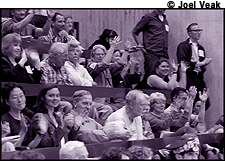
One of the best moments in Monday's three-hour Boston City Council hearing on the Red Sox' plan for a new Fenway Park came toward the end. Helen Cox, an irrepressible Fenway activist who loathes the team's $627 million plan, was criticizing the team's use of inside muscle -- people such as consultant John Sasso, former chief of staff for Governor Michael Dukakis, and developer Robert Walsh, former head of the Boston Redevelopment Authority (BRA) -- to sell the scheme to state and city leaders.
During her rapid-fire speech she paused briefly, at which point Councilor Paul Scapicchio, chair of the council's committee on economic development and transportation, urged Cox to refrain from more personal attacks. "No, no, forget that," she said in response to Scapicchio's warning. "I want to mention the Red Sox' arrogance."
Indeed. Sox CEO John Harrington didn't even attend. Nor did Dan Duquette, which prompted one city official to say later that the team had made a mistake in not sending a representative from upper management. The snub stood as a metaphor for the team's strategy to sell its plan -- a strategy that may backfire on Harrington. To judge from the ratio of new-park opponents to supporters at Monday's meeting, Harrington has alienated quite a few people.
And not just Fenway residents. Beyond Menino's skepticism -- which may yet prove a calculated move to make it look as if he fought for the best deal -- the team faces a real hurdle in, yup, the lowly city council. As Monday's meeting proved, councilors remain highly suspicious of the Sox' scheme, which needs the council's approval before any land can be taken for a new park. "I think the cost to the taxpayers is unreasonable, and I think the health effects of 10,000 [more] fans coming into the area . . . is too much," said Councilor Chuck Turner of Roxbury. "I am ready to vote against any land-taking that would facilitate the stadium being built at that site." At-large councilor Stephen Murphy questioned the taking of private land for a private purpose. And Councilor Brian Honan of Allston-Brighton said it "appears the votes are not here" for land-taking right now.
City officials maintained that the Fenway neighborhood was the best location for a new park. A BRA representative said that the site of the city's old incinerator at South Bay was too small for the project, while the South Bay neighborhood was seen as too isolated from mass transit to support a new park. The waterfront, another frequently mentioned site, was also dismissed because of inadequate access to transit. And it was noted that in 1995, when the convention center and new stadiums for the New England Patriots and the Red Sox were all being considered for the area, the BRA concluded that South Boston could handle only one such project -- the convention center.
Although it now seems unlikely that the council would support a new park in the Fenway, there's still plenty of time for councilors to be "convinced," as they say. If Menino, Harrington, and Beacon Hill leaders are able to strike a deal on the Fenway site before the legislative session ends in July, then councilors would be pressured not to sink the whole thing. Think convention center. But House Speaker Tom Finneran and Senate president Tom Birmingham might be less willing to play ball with the Sox if the city council gave itself a shot of political courage and let it be known that councilors simply won't approve the taking of land for a Fenway deal.
During the hearing, both Bob Walsh and Menino aide Jim Rooney channeled their bosses well. Walsh, who's advising Harrington and the Sox on development issues, tried to sell the plan as a benevolent civic-improvement project. He noted that planned transit improvements to the Fenway-Kenmore-Longwood area are "long overdue," and added that with new development slated for the area anyway, improvements pitched alongside the team's plans "will go a long way to making sure the development that will occur in that area is tolerable."
Rooney said that whatever money the city agreed to lay out in site-acquisition and preparation costs, which is $140 million by current plans, would be the only money the city would sink into a deal. But those costs are likely to be much higher -- possibly as much as $450 million (see "Fenway Neighborhood May Be Too Expensive for the Red Sox," News and Features, May 25). Also, Rooney flatly stated that the team's current pitch -- which would displace 30 businesses, including the Boston Phoenix, which has editorialized against the plan -- doesn't meet Menino's "principles" regarding return on city investment, transit improvements, and protection for other city spending priorities.
There's still a chance that the Red Sox will pull hard enough on the heartstrings of city and state pols to get a deal done in the Fenway. And, just to put things in perspective, the beating the team took Monday at City Hall wasn't nearly as bad as the 22-1 throttling the New York Yankees gave them the same night. ("I guess they need better pitchers across the board," jokes one city official.) But if the Sox' prohibitively expensive scheme can't gain any more public momentum, and soon, even that Pyrrhic victory could be their last for a while.