July 20 - 27, 2000
![[Features]](/standard/image/headers/features_header.gif)
Splendor denied
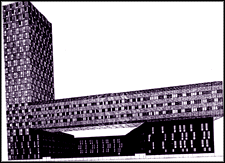
When Harvard commissioned the internationally acclaimed Boston-based architects Machado and Silvetti to design a new dormitory, it hoped for a masterpiece. It got one. Then politics intervened.
by Douglass Shand-Tucci
Mayor Menino, on whom I now officially give up, has turned thumbs down on Harvard's proposed graduate-student dormitory tower in Allston, an action few noticed because we were all so transfixed at the time by his activities at the other end of town with the South Boston Betterment Trust.
The Harvard tower is in the front of my mind, however, because in the new version of my book, Built in Boston: City and Suburb, 1800-2000 -- little knowing what a fiasco the mayor would turn the project into -- I chose the Allston dormitory and Harvard's proposed art museum on the opposite side of the river to culminate a series of illustrations representing two centuries of building in Greater Boston.
Why? Because I think the Allston tower is the design that holds the most promise for Boston architecture at the start of the 21st century.
It is the work of Rodolfo Machado and Jorge Silvetti, who are arguably Boston's best architects -- designers of international rank. Both are professors of architecture at Harvard, both sometime heads of fine architecture schools (Silvetti is now the chair of architecture at Harvard's Graduate School of Design). Most recently celebrated for truly memorable buildings that they designed at Princeton, they are currently at work on the Getty Villa museum in Los Angeles. That their architectural vision for Harvard has now apparently fallen victim to politics is a huge tragedy for Boston.
This sort of thing is nothing new, of course. Not only have Bostonians been known to tear down landmarks -- John Hancock's house, the Boston Opera House -- but we make every effort, it sometimes seems, to stop them from being built in the first place. In the last century, a projected Frank Lloyd Wright work in Boston's orbit was vetoed by a politician because Wright was an "out of state" architect. Poor Wright. Poor Boston!
Then, not so long ago, there was I.M. Pei's original design -- and it was magnificent -- for the Kennedy Library, which would have been built in Cambridge just upriver from the site of the present Allston project. It was killed by the Brattle Street Development Police, who feared hordes of tourists and traffic. Neither, of course, has plagued Dorchester, where the library was finally built. But now one has to go to Paris to see Pei's scintillating glass pyramid at the Louvre -- and only architectural historians like me recall that he first designed it for the Kennedy Library on the Charles. Greater Boston's loss.
Paris's gain, to be sure. And France's capital, I suspect, is less Balkanized than New England's, where the Seaport (I'm sorry, South Boston Seaport!) brouhaha is hardly the only example we've seen lately of the way one neighborhood can hold the whole Boston area hostage, over and over again, to its inevitably narrower interests.
In the case of the Harvard dormitory, the local civic-association spokesperson explains that Allston objects to (among other things) the way the proposed dormitory, in fronting on the Charles, turns its back on what Allston sees as its neighborhood.
Douglass Shand-Tucci is a historian and critic of American art and architecture and a scholar of New England studies. He is the author of Built in Boston: City and Suburb, 1800-2000 (forthcoming from University of Massachusetts Press).