August 3 - 10, 2000

Total kombat, continued
by Michelle Chihara
The list is not long, but it is meaningful: moves and blows with a higher-than-average chance of causing paralysis, death, or serious damage are not allowed. For a sport concerned on all levels with legitimacy, seriously damaged or dead competitors are not an asset.
THE MC of the Pawtucket fight is Kipp Kollar. Sales director for a medical scanning company by day, Kollar is the president and founder of the North American Grappling Association and the man responsible for introducing much of New England to submission fighting. He looks a little bit like the Joker. He sports a golden tan and a shining shaved pate, and he smiles a lot -- a sudden, brilliant, pointed grin.
Kollar loves ultimate fighting because it's "exciting" and "realistic," and because "it really works."
"A lot of wrestling and boxing matches go to the time limit, and then how do you pick a winner?" he asks. Ultimate fighting, in contrast, is usually crystal clear.
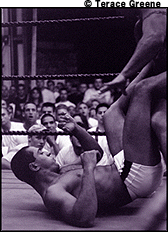
Clear, and sometimes brutal. For fight fans, part of the excitement is undeniably rooted in blood lust. In Pawtucket, the crowd cheers loudest for the big, heavy blows, and one man cheers a prolonged leg bar by shouting, "The pain! The pain!"
An official of the UFC calls ultimate fighting "the perfect blend of sport and spectacle," and points out: "A lot of fans watch auto racing and boxing and hockey to see blood. Whether it's our instinct or blood lust, who knows? But it's true for all sports."
For the fighters themselves, however, the appeal is different. It's about how their discipline measures up.
The Ultimate Fighting Championships were born in 1993, when Rorion Gracie walked into the offices of the Semaphore Entertainment Group in New York City with a videotape of Gracie victories in Brazil. The Gracies are Brazilian fighting superstars who had taken an established Japanese grappling discipline -- jujitsu -- and put their own spin on it, increasing the emphasis on joint manipulations and submission holds. The Gracies had issued open-door, winner-take-all challenges in Brazil, daring any fighter to beat them in open fights with no rules. Almost no one could.
No one at Semaphore had ever heard of the Gracies, but Rorion's videotape looked like the pay-per-view hit they needed. Rorion's younger brother, Royce, helped prove them right.
The first Ultimate Fighting Championships pitted sumo wrestling against French Savate kickboxing, Thai kickboxing against karate, and boxing against Royce Gracie. For that fight and for four tournaments to come, Royce Gracie blew just about everyone else out of the water. He would seem lost under a hail of blows, until he would reverse the fight all at once by pinning the other guy -- maybe a guy 60 to 90 pounds heavier than he was -- in a chokehold with his legs.
Gracie jujitsu proved itself almost as unbeatable in America as it had been in Brazil. Another of the brothers, Rickson, showed up in the US in 1993 with one of the typical Gracie challenges: $100,000 to anyone who beat him.
Kipp Kollar, who at the time had spent a decade teaching the graceful kicking arts of tae kwon do, remembers the shock. "We went there thinking were going to do well against this guy," Kollar says of himself and his martial-arts buddies. "And he smashed everybody."
One glimpse of Gracie was enough to set a generation of martial-arts buffs down a whole new path. The "strikers" -- the boxers and the acrobatic high-kickers -- can do damage. Kickboxing can beat sumo. But the real badasses, the people who could win in an ultimate-fighting ring, finish their fights on the ground.
"A karate guy throws one kick or punch," says Kollar, "and immediately gets taken down. The grappler throws some sort of submission moves, and -- think about a street situation, in a bar, a fight always ends up going to the ground. It's much more practical in a real-life self-
defense situation."The consensus among mixed martial artists is that the best fighters are "well-rounded" fighters who know both a striking and a grappling art.
Showing them both off, though, can be difficult. In most states mixed martial arts is more or less illegal. Combat sports need licenses from athletic or boxing commissions. Most commissions banned true no-holds-barred fighting in the mid '90s, especially after Senator John McCain went after the sport for what he deemed its sick brutality. The UFC's early promotional campaigns, trumpeting the bloody-brute "two men enter, one man leaves" side of the fights, turned the sport into a political scapegoat for violence in society.
Organizers are just now starting to recover. They're working hard with the commissions in the hopes of getting sanctioning bodies across the country to license them. They've toned down the hype, instated new rules, and beefed up safety precautions. At least one huge market, California, is about to legalize the UFC.
Michelle Chihara can be reached at mchihara[a]phx.com.