The Boston Phoenix October 19 - 26, 2000

The vision thing
(continued)
by Susan Ryan-Vollmar
If Menino has his way, the Sox will stay in the Fenway and 300-foot office towers will go up along the waterfront. At a press conference held the day of Harrington's surprise announcement, Menino said he didn't understand why anyone would raise the possibility of building a new park for the Sox elsewhere in the city -- much less outside city limits. "It's the same location," he said. "The site's the site right now. . . . The thing I have an issue with is that we've shown you the other sites."
Actually, he hasn't shown us the other sites. The Boston Redevelopment Authority (BRA) conducted a study of 21 potential sites for the park within Boston's city limits. The BRA has not made that study public, but one City Hall insider who viewed the results told the Phoenix that of the original 21 sites, only six are still available: two at Crosstown, one at Suffolk Downs, and three in South Boston, including the waterfront. The waterfront easily surpassed every other location on several important criteria for building a new park: it was accessible to public transportation and major highways, and construction disruption to existing homes and businesses would have been minimized. But the site was rejected, she said, because of the possibility of fog coming in over the park from the harbor.
Despite Menino's wishes to keep the team in the Fenway, right now it doesn't look as if the Boston City Council will approve financing of city bonds to pay for the $112 million Menino has promised the team. "I think the bill that came out of the State House that needed the local [approval] of the city council is probably dead," says at-large councilor Stephen Murphy. Councilor Mike Ross, whose district includes the Fenway, is more blunt. "The likelihood of the council approving financing for a new park is the same likelihood as me climbing Mount Everest before the Sox are sold," he says. It takes a two-thirds majority of the 13-member council to approve bond financing, and seven councilors have publicly stated their opposition to the deal. And Menino has said that he won't even put the financing deal before the council until a new owner is named.
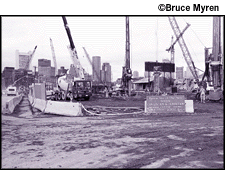
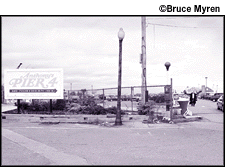
That leaves the Sox without the money to build their new ballpark in the Fenway. They do have options, however. In addition to McCourt's waterfront property, Assembly Square in Somerville is frequently mentioned as a possibility; Somerville mayor Dorothy Kelly Gay says she'd welcome the team to her city should the Fenway deal fall through. Suffolk Downs has also been mentioned, as has property in Everett. The most interesting of these prospects, however, is the waterfront -- because it would keep the Sox in the city, and because McCourt already owns the land needed to build a park.
But there could be an even bigger obstacle to building on the waterfront than McCourt's apparent lack of interest: community opposition. South Boston activists sent New England Patriots owner Robert Kraft packing five years ago when he proposed building a new football stadium on the waterfront. It's always been assumed that the community would react the same way to any other sports-stadium proposal.There's a big difference, though between the effects a football stadium and a baseball park would have on a community. For one thing, baseball games aren't day-long events that attract lots of tailgating parties. Baseball parks, which host about 80 games per year, also have bigger economic effects than football stadiums, which host only about eight games per year. A baseball park could provide jobs to members of the community. As one City Hall observer puts it: "A lot of kids who live in South Boston could pay their tuition by working [at a new ballpark]." There's no question that a baseball park transforms a community more profoundly than a football stadium does. But LEPAC's Mahoney says that given the choice between a baseball park and 300-foot office towers, he'd take the park.
Building a ballpark on the waterfront has been a "topic" at some of LEPAC's meetings, according to Mahoney. (LEPAC has a membership of about 125 people from around South Boston, Mahoney says, although the Lower End is the South Boston neighborhood closest to the waterfront.) "There's some type of illusion that the community is dead set against [a baseball park on the waterfront]," he says. "The community may very well be. But the community hasn't been asked."
So will Menino ever ask the people of South Boston whether they'd welcome a baseball park? Such a question would require a radical shift in thinking about the waterfront. As one City Hall insider says, it would require "vision" from the mayor. It's been said, remember, that Harrington wanted to build his new park on the waterfront from the start -- but was directed back to the Fenway by Menino. That plan is now crumbling. Does Menino have what it takes to push a new plan into place? Can he set aside his grudge against Boston City Council president Jimmy Kelly and rework the waterfront plan to include a ballpark and shorten those 300-foot buildings? Can he set aside his grudge against McCourt to do the same? Or will he stubbornly insist on keeping the Sox in the Fenway, to the point that a new owner packs up the team and leaves?
Mayor James Michael Curley is remembered for building Boston City Hospital. Mayor John B. Hynes initiated the "new Boston" by getting the Prudential Center development off the ground. Mayor John Collins brought the "new Boston" concept to fruition. Mayor Kevin White built Faneuil Hall Marketplace, which became a national model for revitalizing downtown urban spaces. Mayor Ray Flynn will be remembered not only as a champion of the neighborhoods, but also as ambassador to the Vatican. What does Mayor Menino want to be remembered for? Revitalizing the waterfront, and creating a new downtown neighborhood in the process? Or caving in to developers' demands and "Manhattanizing" the Boston skyline, while driving the Red Sox out of town?
Susan Ryan-Vollmar can be reached at svollmar[a]phx.com.