Talk
Spiking Hollywood
by Loren King
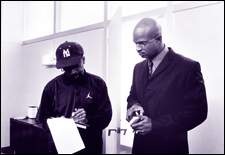
Spike Lee's latest film, Bamboozled, may be fizzling at the box office, but Lee himself can fill the seats. On November 6, the largest audience ever to attend an event at the Arco Forum of Public Affairs at Harvard University's Institute of Politics filled the main hall and jammed overflow rooms equipped with closed-circuit television to watch the auteur and provocateur talk about his new film.
Monday's panel on race and the media, moderated by Harvard Medical School psychiatry professor Alvin Poussaint, featured Lee and several academics and scholars, including writer and cultural critic Stanley Crouch, producer and director Octavia Hudson, University of Chicago professor W.J.T. Mitchell, and photographer Carrie Mae Weems. But it was Lee that the racially mixed, mostly young crowd had come to hear. The night before, the Forum had screened the audacious and controversial Bamboozled, a pungent satire starring Savion Glover that uses the blackface and minstrel-show traditions to skewer racial stereotyping in the entertainment industry. The film reportedly had many young members of the audience in tears - of grief.
Lee told the crowd he's been asked why he made Bamboozled in 2000 "when there have been so many advances." The audience was then treated to a Hollywood history lesson according to Spike: "The Legend of Bagger Vance is directed by Academy Award winner Robert Redford and it takes place in Georgia about 1931. Bagger Vance, a saint or a spirit or God, has come to Georgia during the Depression. Blacks are being lynched and castrated. Why is he trying to teach Matt Damon a golf swing?" After citing a similar saintly character played by Michael Clarke Duncan in The Green Mile, Lee took on Mel Gibson's The Patriot. "They tell the slaves, 'You help us fight the British and we'll set you free.' " Affecting a drawl, Lee continued: " 'No, I'm gonna stay right here and help Mel Brooks [sic] build his house'. . . . In the new millennium you don't have to wear blackface to be part of a minstrel show."
Crouch, author of Don't the Moon Look Lonesome: A Novel in Blues and Swing and Always in Pursuit: Fresh American Perspectives, applauded one of the bolder assertions in Lee's film: that successful black entertainers are complicit in these negative racial images. "We'll see porch monkeys on The Tonight Show in just a few hours," said Crouch, referring to the show's house band. (In Bamboozled, the fictional minstrel show's band is called the Porch Monkeys.) "It used to be that just Kevin Eubanks had a mike; now all the band members have mikes so they can be a flesh-and-blood laugh track for Jay Leno."
Crouch told Lee that Bamboozled's powerful finale, a montage of blackface performers throughout entertainment history, should have ended with images of contemporary rap artists "with their boobies in the camera and guys with gold teeth and chains." "Then people would know what the minstrelsy of today is," Crouch said.
Lee countered that his film's cavalcade of images - which includes Al Jolson, Mickey Rooney, and Judy Garland - is powerful because they are authentic, and that no contemporary record label or recording artist would license its material for use in Bamboozled. The most pointed barbs in Bamboozled, the panelists agreed, are aimed at an entertainment culture that restricts black performers largely to comic caricatures, and at black performers' eagerness to accept and embrace this role.
Said Crouch: "If all white guys in entertainment were always Laurel and Hardy or the Three Stooges or even the Marx Brothers, people would be upset."