The Boston Phoenix November 16 - 23, 2000

Got Soy?
(continued)
by Nina Willdorf
Another charge critics levy against milk is that it is linked with cancer. Bruce Friedrich, the vegetarian-campaign coordinator for PETA, points to a paper published in the June 1999 Alternative Medicine Review, “An Ecologic Study of Dietary Links to Prostate Cancer,” to back up his claim that there’s a “preponderance of evidence” linking cancer to dairy products. The paper’s author, William B. Grant, is an unlikely milk expert: he’s a senior research scientist at NASA. Grant writes: “A number of studies have found high correlations between prostate cancer and diet, of which the most significant correlations as risk factors are total fat, animal fat, milk, and red meat.” Friedrich says the American Institute for Cancer Research also backs up those claims.
But Jeffrey R. Prince, the institute’s vice-president for education, says PETA severely misread his organization’s findings. “They cited our report on food nutrition,” Prince says, “and on the basis of all our evidence, we will tell you there is insufficient evidence as yet to indicate a causal link between dairy products and cancer.”
The strongest complaint against the milk industry, and the one that may actually have some validity, is its use of minority celebrities to target populations that have high rates of lactose intolerance. According to Jeannette Jordan, a spokeswoman for the American Dietetic Association, people of color are more susceptible to this problem: 90 percent of Asian-Americans and 75 percent of African-Americans and Native Americans produce an insufficient level of the enzyme lactase, which is needed to break down lactose, the sugar in milk. Opponents of milk marketing say the “Got Milk?” campaign used celebrities of color to promote a lactose-laden beverage to people unable to digest it.
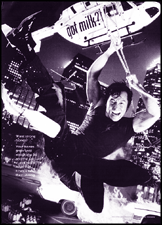
Mindy S. Kursban, the legal counsel for PCRM, says that the ad campaign has stepped up its targeting of minorities without adding necessary information on lactose intolerance. She cites a recent ad featuring the Asian actor Jackie Chan. The text underneath his photo reads, “Your bones grow until about age 35 and the calcium in milk helps.” Kursban and PCRM demand a disclaimer, similar to the small print in drug ads, cautioning the ad’s target audience against lactose consumption.
But while executives behind the ads insist that the campaign has always played it straight with the lactose-intolerant population, a document leaked to the Phoenix reveals that the executives have changed their strategy to placate the PCRM. In an August 11 memo titled “Lactose Intolerance 1999 Effort — Consolidating Funds,” executives at BSMG, the New York–based company that does marketing for the ad campaign, wrote, “[I]n response to PCRM’s recent activity, we have revised the 1999 lactose intolerance program which is scheduled to execute this fall. The new program not only communicates the lactose intolerance messages to the general public, but has specific tactics to communicate to the African American and Hispanic communities.”
Meanwhile, PCRM has sent a petition to the Federal Trade Commission asking it to investigate the National Fluid Milk Processor Promotion Board, the dairy-industry executives behind the “Got Milk?” ads, for violating the rules of advertising by distributing false health claims. A few months ago, the petition was filed for the second time in two years. Kursban, PCRM’s legal counsel, likens the milk ads to those for tobacco or drugs. She says that since the organization is claiming health benefits in its ads, it needs to include disclaimers.
On the animal-rights front, PETA has lobbied against milk with its trademark sadistic vigor. Under a campaign dubbed “Dump Dairy,” the group started issuing public spoofs of the “Got Milk?” ad campaign in March: “Got Zits?”, “Got Breast Cancer?”, and “Got Beer?” In “Got Zits?”, a pimple-marked teen grins over claims that the fat and sugars from milk led to her unfortunate complexion. “Got Breast Cancer?” suggests that milk drinkers are at higher risk for the disease. And “Got Beer?” — which sparked a fair amount of criticism on college campuses for its St. Patrick’s Day release date — encourages people to switch from milk to beer, which lacks the fat, cholesterol, and hormones of cows’ milk.
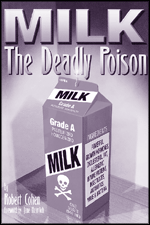
The anti-milk crusade also relies on people like Robert Cohen, the executive director of the Dairy Education Board, an anti-milk organization in New Jersey. Cohen, who thinks that milk is just one gross “hormone-delivery system” — “pus with hormones and glue” — tirelessly tours the national radio circuit, alerting people on three to four shows a week to what he considers alarming research on milk, cancer, and heart disease. He also promotes his book Milk: The Deadly Poison. “I want people to realize that milk is America’s number-one killer,” he says. To Cohen, drinking cows’ milk is simply unnatural, and he blames the “false health promotions” of the powerful dairy industry for obscuring this fact. “We don’t drink milk as adults from our own species,” he reasons. “Why would we drink it from other animals?”
Finally, the movement against milk is bolstered by rare but well-placed celebrity put-downs (such as Alicia Silverstone’s talk-show remarks). Even Prince has aired his views on the topic. On his 1998 album Crystal Ball, The Artist took on his friend Spike Lee, who posed for a “Got Milk?” ad in 1996. In the song “Animal Kingdom,” Prince sings:
I saw a friend of mine 2day
In an ad sayin’ what would do my body good
I told him he was wasting time I say
If God wanted milk in me
The breast I suck would have a line around the hood
No member of the animal kingdom nurses past maturity
For all the noise, however, the critics of America’s cookie companion don’t seem to know what they’re hoping for. With meager medical proof for their claims, and milk’s successful public image to contend with, they’re left doing little more than grossing people out. From radio show to radio show, the Dairy Education Board’s Robert Cohen touts his “milk kills” agenda with vehemence, conviction, and no small number of seemingly rehearsed one-liners: “We say people have beer bellies; they actually have milk bellies”; “It’s like pouring gasoline on a fire”; “I just want Americans to die better.”On a day-to-day basis, he just hopes to persuade those around him to ditch the drink. When Cohen finds himself presented with milky goodies at dinner parties, he doesn’t keep his disgust to himself. “I say to my hosts, ‘You really want me to drink this pus?’ ” he demonstrates, with a sneer. “And then,” he says, smiling victoriously, “no one wants to drink it after I finish with them.”
Nina Willdorf can be reached at nwilldorf[a]phx.com.