The Boston Phoenix November 30 - December 7, 2000

Strange bedfellows
Washington Street's revitalization could be jeopardized by the MBTA's bad planning. But for the South End and Roxbury, alliance with politically savvy South Boston is the last, best shot at fighting back.
by Dorie Clark
South Boston won a major battle on Monday when Environmental Affairs Secretary Robert Durand called for a "peer review" of the MBTA's plan to purchase diesel buses that cause more pollution than the buses they had initially promised for the neighborhood's portion of the Silver Line. Their success, due in part to their unlikely alliance with activists in Roxbury and the South End (the other end of the proposed transit line), gives those underprivileged neighborhoods their best chance in years to fight the MBTA's plans for Washington Street.
Roxbury and the South End have endured inadequate transit service for a long time. When the elevated Orange Line was torn down 13 years ago, residents were promised "equal or better service," and many feel the buses the MBTA wants to give them -- as opposed to the light rail many residents would prefer -- are yet another example of what activists call "transit discrimination."
The MBTA, which broke ground on the Washington Street portion of the Silver Line on September 28, insists that there is no longer room for argument about what form the new transportation should take. The agency is moving ahead on bus-line construction, to be completed in 2002. But just as Durand's decision opens the door for discussing other forms of transit in South Boston, including electric buses (and possibly an eventual conversion to light rail), it is also likely to reopen discussion about the Washington Street corridor, since the MBTA intends for both ends of the Silver Line to connect.
As a result, activists from communities at opposite ends of town are beginning to look at the Silver Line as a whole, and are reaching out to each other as allies. Roxbury and South Boston are both hobbled by abnormally high rates of asthma (Roxbury's is one of the worst in the state), so members of both neighborhoods are concerned about the prospect of more bus emissions. South Boston -- the politically savvy Irish enclave that brought the city such heavyweight pols as former mayor Ray Flynn, former Senate president Billy Bulger, and current city-council president James Kelly -- could lend the transit battle its political experience and clout. But Southie is newer to the Silver Line struggle than the historically underprivileged residents of Washington Street. You wouldn't expect South Boston residents to go to Roxbury looking for political advice, but that's what they've been doing: neighborhood activists from the two communities have been meeting for months, briefing each other and plotting strategies. Their teamwork is paying off. South Boston's appeal to Durand may end up benefiting more than that community's air quality: it has indirectly given Washington Street hope and ammunition -- after 13 frustrating years of activism -- to take on the MBTA and insist that the promise of "equal or better service" is kept.
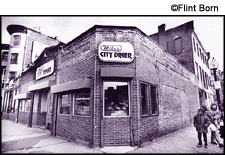
Washington Street's hard times are finally beginning to turn around. The area is being developed, but community members insist that the corridor needs better transportation than the current #49 bus to sustain the momentum, and to keep the seedy past at bay. When Sheila Grove moved to the Washington Street neighborhood in the early 1970s, it was rife with prostitutes and drug dealers. Grove, now the director of the Washington Gateway Main Street program, a nonprofit dedicated to the area's revitalization, recalls an evening during her early days there. "I was having a friend from the suburbs over for dinner one night," she says, "so I went into the Red Fez for take-out while my friend waited in the car outside. When I came out, there was a man, all bloody, and he was banging on her windshield. I yelled out for him to stop, so he came after me. I jumped into the car and we peeled off. I was upset, but I really wasn't surprised."Nowadays, the surprising thing about Washington Street is how much it's changed, especially since Mayor Menino formed a task force to study the area in 1995. Lately, Washington Street seems to be the mayor's second home. On November 9 -- with Cardinal Bernard Law and Governor Paul Cellucci in tow -- Menino broke ground on Rollins Square, a 184-unit housing complex being developed by the Archdiocese of Boston. Five days later, he was back to cut the ribbon for Flour, a bakery owned by Joanne Chang, former pastry chef of trendy nightspot Mistral. The day after that, he celebrated the development of Wilkes Passage, a swanky condo development. Earlier this year, he even brought some star power to the neighborhood, chowing down with President Clinton at Mike's City Diner. Upscale diners visit the area nowadays for a choice of 14 martinis (at Blackstone's on the Square) or high-end Vietnamese noodles and dance music (at Pho République).
In fact, the prediction that development would stream into the area once the loud, ugly El was torn down has in many ways come true. Because the city of Boston owned 60 percent of the land along Washington Street (because of an unusually high number of housing projects, parks, and city-owned vacant lots), development has been able to move briskly. Randi Lathrop of the Boston Redevelopment Authority reports that $350 million has been pumped into the 1.4-mile stretch of Washington Street between the Mass Pike and Melnea Cass Boulevard, thanks to public-private partnerships.
In the area beyond Melnea Cass, however -- namely Dudley Square, the heart of Boston's black community -- the wounds went much deeper and have been harder to heal. Despite successful recent efforts to revitalize the area, its lack of a subway stop remains an obstacle. The El used to power its way from Dudley to downtown in just eight minutes. But when it came down, the new Orange Line was relocated along Columbus Avenue, and Dudley Square was bypassed entirely. Says Seth Kaplan, an attorney at the Conservation Law Foundation, "You have one of the historic centers of Boston, a thriving commercial center up until the 1960s, and suddenly it doesn't have a train station. Dudley had its legs cut out from under it." Nowadays -- despite the massive transit station in the heart of the neighborhood -- Dudley's only connection to downtown is by diesel bus. "The bus service there is lousy," says Will Holton, a sociologist at Northeastern University. "I've tried to take the bus from Dudley Square and it's always crowded, standing room, very erratic. [With the El] they used to have very good service."
If the MBTA had followed through on its legally binding promises, activists say, this community would have good service today. Kaplan notes that the state agreed in 1989 to complete a number of mass-transit projects to offset the increased car pollution caused by the Central Artery project. The Big Dig not only puts the Artery's lanes underground, it also expands them, making driving in and out of the city more appealing. But to ensure that not everyone would opt for the ecologically damaging automobile, the state consented to build better public transportation. One of those projects was replacement service for Washington Street -- to be completed by December 31, 1994. "When it comes to certain urban neighborhoods," says Bob Terrell of the Washington Street Corridor Coalition (WSCC), "[transit improvements are] always five, 10, 15 years in the future. It's always `wait and be patient.' This is a con game the MBTA is running."
But the agency is finally attempting to deliver on the Silver Line. MBTA officials extol the new buses' eco-friendliness (they're powered by compressed natural gas, rather than the standard diesel); their large capacity (they are 60 feet long, as compared to the 40-foot buses in today's fleet); and the line's unprecedented perks, such as automated signs at bus stops indicating when the next bus will arrive. "You're going to be able to travel from Dudley to downtown in minutes, even in peak traffic times, because we'll have a dedicated bus lane that will run along Washington Street," says MBTA spokesman Joe Pesaturo. "The Silver Line is essentially a light-rail system without the tracks -- rubber rail, if you will." But John Rumpler, an attorney with the Roxbury-based watchdog group Alternatives for Community and Environment (ACE), points out that the "dedicated lane" does not run the full span of Washington Street and will be shared with cars making right-hand turns or attempting to parallel park.