The Boston Phoenix November 30 - December 7, 2000

Winterson's tales
British author Jeanette Winterson had attracted both praise and backlash in England by the time she hit it big on these shores. Now she's drawing crowds on a North American tour to promote her seventh novel, The PowerBook. Taking a break during her Boston visit, she talks about art, sex, saucepans, her dodgy reputation, and the near-theft of her own name
by Ron Fletcher
In the beginning was the Word. And the Word appeared in unusual places: above light switches, next to coat pegs, and in the outhouse. Retrieving a jacket meant reading, "Think of God, not the dog." Relieving oneself standing? "Linger not at the Lord's business." Sitting? "He shall melt my bowels like wax."
Such was life as a child in the northern English mill town of Accrington for novelist Jeanette Winterson. The adopted daughter of strict Pentecostal parents, Winterson recalls with delight and incredulity the curious caveats that greeted her at every turn. "Quotes from the Bible appeared throughout the place," she says. "For a woman who wasn't interested in print, my mother sure knew the power of words."
As does Winterson herself. The author of seven novels as well as collections of essays and short stories, she emerged in England 15 years ago to éclat and encomiums. Her debut, Oranges Are Not the Only Fruit, won her homeland's prestigious Whitbread Prize and earned her a small, devoted following in the States. Lauded by Gore Vidal as "the most interesting young writer I have read in 20 years," a phrase that follows her name like a Homeric epithet, Winterson has validated the hype with a series of bold and vivid novels that luxuriate in language and play loose with narrative to revel in the riddles of time, art, sex, and self. In them she moves from mythology to physics and from ancient worlds to digital ones, pursuing matters of spirit and flesh, faith and fact in an effort to know who we are. The subject of identity has been personal as well as literary for Winterson: this year she won a landmark case against a Cambridge University graduate student who registered her name as a domain name -- jeanettewinterson.com -- with the intention of selling it back to her.
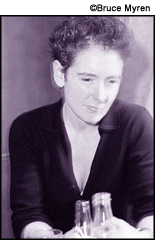
In Boston on a reading tour of 24 cities for her latest novel, The PowerBook, Winterson, 41, offsets her all-black attire with a lambent lightness of mood. Descriptions such as "pixie-like" or "mercurial" miss the charming zeal and thoroughness with which she discusses her work. Her fingers move gracefully to emphasize a point or provide a peek of her celebrated Wonderbra ("It's more impressive than the Internet," she declares). She graciously gives up the more comfortable of two chairs in her room at the Meridien, leans forward for the first question, and forgoes the seat's back for the length of the interview.
"Shall we start, then?" she asks in a lilting accent. For the writer whose motto is "There is no autobiography, only art and lies," facts hold little interest and less value. "I'm not sure you can ever really talk about the facts, even with the times of trains," says Winterson. "So many facts that feel like iron bars and solid things are utterly ephemeral and misleading, and should be pushed aside. Everything is about reading between the lines, and we need as many skills in interpreting as we can get. That's where art comes in.
"A book is a door -- not an escape, but a way into new worlds," she adds. "Early on I opened it and went through."
Jeanette Winterson was reared to knock on actual doors rather than waltz through figurative ones. Her evangelical parents foresaw a life as a missionary for their adopted daughter. They discouraged all reading save the Bible. Yet somehow Sir Thomas Malory's Le Morte d'Arthur found its way into the family library, which contained only six works. In the majesty and mystery of Arthurian legend, Winterson discovered a playground for her imagination, an invitation to invention. "Books, I learned from a very young age, give you an identity that you can't get from anything else -- not from talking to people, not from loving people, and not from experience," she says. "There's only so much that any person can fit into one life, but books give you the chance of fitting in multiple lives and multiple possibilities. You become more and not less. Time spent with a book is never wasted, because it's telling you valuable things about the human heart, about yourself, and about the world that you can't get any other way."
Winterson followed her love of literature out of Accrington and into St. Catherine's College, Oxford, supporting herself by working evenings and weekends. At 23 she wrote her first novel, Oranges Are Not the Only Fruit, which was published in 1985. She saw in her experiences the stuff of fiction rather than memoir. "When you're left on the steps of an orphanage, the question `Who is she?' can only be answered with, `We don't know,' " says Winterson. "So right from the beginning, I've been inventing myself, making up stories about myself, and putting myself as a character in my own fiction. I learned early on that if you see yourself as a fiction and read yourself as a fiction, there's no end to the rewriting that can take place."
That the protagonist of Oranges is a Sapphic daughter of humorless evangelical parents still strikes Winterson as little more than happenstance. To push any kind of parallel is to bore her, to overlook the pith of fiction as she sees it. "Without imagination, without that quality which allows a writer to touch on something fundamental in human experience, Oranges is just another story of a disadvantaged kid growing up somewhere and changing her life," she says. "Who cares? You have to take everything and use imagination to transform it into something enduring. You have to push experiences through your own sensibility the way you would push water through limestone to extract all the impurities. What's left, then, will go on having a value. It's no good simply relying on experience. Imagination is essential."