Retailing
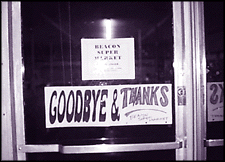
Beacon Super Market says goodbye
by Seth Gitell
With little fanfare, the Beacon Super Market in Audubon Circle closed its doors November 18. The Beacon Street market -- long a destination for bargain-hunters -- will be replaced by the Natural Frontier Market, a small Manhattan-based chain.
My first reaction when I learned of this change: who the hell needs another yuppie health-food store? Certainly, the bulk of the clientele -- a diverse mix of Boston University students, Japanese émigrés, and elderly Russian Jews -- will miss this place. Although simple and unadorned inside, the market offered high-quality and sometimes exotic food at astoundingly low prices. You could get Brazil Cerrado Oberon coffee beans for $2.99 a pound or Purdue chicken-leg quarters for 29 cents a pound. Middle Eastern goods such as hummus and couscous sold for half their price at upscale markets.
I learned about the Beacon Market years ago from my mother. She had started shopping there when she lived in her hip bachelorette pad on Park Drive in the 1960s. "I used to buy London broil there at 49 cents a pound," she recalls. Until it closed, whenever she was in town she made sure to stop at the market for coffee beans before heading back to the South Shore.
Of course, the closing of the Beacon Market plays into the broader story of the transition from the old Boston to the new, from local ownership to out-of-towners. Yet somehow the story is more complicated than that. The Beacon was no Tasty, Bow & Arrow Pub, or Elsie's, put out of business before its time by a greedy landlord. In this case, the landlord and the owner are one and the same -- 53-year-old Newton resident Berril Shief. And although Shief won't confirm it, the bustling market, which had been in business for 39 years, appeared to be making money.
So why is the Beacon Super Market closing? The company that owns the Natural Frontier Market contacted Shief about the restaurant space next door in October. Somehow, restaurants have failed repeatedly at this prime location on the Brookline-Boston line -- Pattaya, a Thai restaurant; Felucca, a North African place; La Famiglia Giorgio, an Italian joint. After a few moments of conversation, it became evident to Shief that the callers were interested not in the restaurant, but rather in his own market site. After some soul-searching, Shief decided to make a deal: he would rent out the space at cost and leave the headaches to someone else.
"I've said to the customers I've seen: to everything there is a season, and we've had 39 wonderful seasons," he says.
Still, what may be good for Shief may not be as good for everyone else. There's no way the new place will be as cheap as the Beacon Market, which was founded by Shief's father, Leo, in 1962. Shief, who began working at the market when it opened, learned from his father the value of a bargain. He was particularly proud of his affordable Passover products. ("I want to make sure everybody can afford to make seder," his father told him.) In a field where retailers generally try to exploit their fixed markets, the Beacon sold matzo at an unheard-of 49 cents per pound.
No more. Soon the new company -- a sort of cross between Trader Joe's and Bread & Circus -- will be in place. As for the restaurant space, Shief will rent it to the Muddy River Grille, an American-style café for a neighborhood filled with international cuisines.
As depressing as all this may be, there's something a little bit inspiring about the story too. Shief's father came to Boston on a flatbed truck from New Bedford during the Depression. He opened up in the 1960s, and the Small Business Administration refused to give him a loan on the grounds that the venture was too risky. Thirty-nine years later his son will finally will be able to profit (presumably) by renting the store and getting relief from 90-hour workweeks. And Shief's daughter has a journalism career in Boston.
If that ain't the American dream, what is?