The Boston Phoenix December 7 - 14, 2000

Secret stories
(continued)
by Tony Giampetruzzi
Q: How did this odyssey of yours begin?Tony Giampetruzzi is a freelance writer living in Portland, Maine. He can be reached at groovejet4@aol.com.A: I was actually given the four photo albums by a couple [of] friends -- Paul Heroux, who teaches ceramics at Bates College, and Carl Balazzolo, a well-known painter. They found the albums at a curiosity shop in Maine, which I'll disclose the name of in the book. It's a really great shop.
I pored over the books for quite some time before deciding to do something with them. In fact, a number of my friends, who assured me that the photographs are really quite significant, were influential in my decision. For years I've been writing articles for magazines like Vogue, GQ, Mirabella, and I've done a number of books, but they have always been some sort of extension of an article that I have written.
Q: How is this book different?
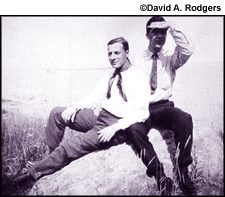
A: I had the albums for at least a year before deciding to do anything with them, and I eventually found myself really taken by the photographs. To me, abandoned family albums always touch a chord. These are not posed photographs, they are snapshots. Snapshots have so much more significance, more than I think people realize. They tell a story and really allow you to examine the essence of these people's lives. They show people being caught unawares and, because of the chronology of these albums, you see people actually grow. More significant is that in them you see people, men, at the turn of the century, holding hands. What I saw are the types of things that I know that I would like to see in my own family albums.
Q: You say that compiling this book is as much about you as about the people in the photographs. How is this about you?
A: This project came along at about the same time that I was looking for a family album to adopt. Not long ago, a fire in my grandparents' house in Houston destroyed everything, including the family photos. They are so important. You know, a lot of people say that if there was a fire in their home, the kids and the pets would be the first things out -- then the photo albums. I think that through photo albums you can also create the family of your dreams.
Q: At a lecture that you gave at USM, you said that these albums begin and end in graveyards. What did you mean by that?
A: This entire project began in a graveyard for me. That's what I love about antique shops and flea markets. They are a place for dead people's things. They are like tombs. Isn't it strange how we have such an affinity for antiques? We are constantly surrounding ourselves with dead people's things. So this entire project began in a graveyard of sorts. My favorite subject in the photographs is a man whom I identified as Ben Luckey, [who] had a different boyfriend each summer and was just the typical dandy, full of life and expression. My detective work on this project eventually brought me to a graveyard in Patterson, New Jersey, where Luckey was buried in 1916 at the age of 26. That's why, metaphorically, I say that the project begins and ends in a graveyard.
Q: That story seems indicative of the amazing amount of information you have gathered about these people in such a short period of time. Yet I know that at first you struggled, with absolutely no clues for months. What was your big break?
A: One of the photos depicted an old mansion, and I knew that if I could locate it, then I would be able to piece together much of the story. I searched everywhere and spoke to a number of historians who, oddly, had no idea where it existed. Finally I was at a party in Philadelphia and met the editor of the Philadelphia Inquirer, who took an interest in the project and offered to run the photo of the house. A man named Fred Platt saw the picture and led me to the house in the suburbs of Philadelphia; it was then that everything came together. We went there and a very old man answered the door. He had purchased the house from one of the photo subjects in 1953. It was the footprints of that building that led to the footprints of the people in the photos.
Q: The search was frustrating up to that point?
A: Absolutely. One of the photos had a car with a Pennsylvania license plate -- I thought that might turn up something. First of all, there weren't even that many cars back then, so it's odd that we could even identify a license plate in the picture. So I went to Harrisburg to look up old license-plate records. Officials at the State House totally discouraged me from doing that because they only had records back to the 1960s. I wouldn't take no for an answer, and at one point I was going through old boxes in the basement of the State House trying to find some information. Nothing showed up, though.
Q: Why do you think that these people came to Maine and, specifically, to Bailey Island?
A: Most wealthy families at that time would go to Northwest Harbor or Bar Harbor, and those retreats were just summer extensions of the stuffiness of places like Philadelphia. Bailey Island, and other areas of Maine, were clearly different. The social demands were not as accentuated and the populations were more sparse.
I still think that most of Maine is different from other resort areas. I feel so complete and compelled to be myself here. Mainers tend to mind their own business, and yet they are eccentric and tolerant. Maine is a place that gives safe harbor to self-expression.
Q: Are you surprised by how much you have been able to find out about these people?
A: Totally. I'm not trying to write a biography of these people; they are not major American figures. What interests me is how eccentric they were, and how they would come to Maine to relax and be themselves. The book is really just as much about my world as it is [about] theirs. I don't really think there has ever really been anything quite like this published before, and that's why I'm taking my time with it. No one can steal this story and write it before I do. This is history, but a history that has always been left out. I'm certain that there have been other albums like these, but they have been destroyed or never talked about. That's why I hope to see this book on the general-nonfiction shelves at bookstores. I feel that it is my job to bring these people, as a part of history, to the rest of the world.
Q: Will this have significance in the annals of gay history?
A: It simply affirms that we have a history that has been largely shut out of mainstream history. Most of these types of relics have been destroyed -- I'm helping to bring them back.