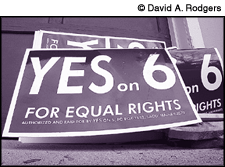
The Boston Phoenix December 21 - 28, 2000

Like nearly everyone, Paul Volle was surprised by the outcome of Question 6, a ballot question that would have prohibited employment discrimination against gay men and lesbians in Maine. Volle, the executive director of the Christian Coalition of Maine, headed the opposition to the civil-rights referendum, a measure that many of its supporters -- and opponents -- considered a sure thing. But the referendum lost by just under 5000 votes -- leaving Maine the only New England state without a law protecting gays and lesbians from discrimination. Why Maine's latest gay-rights measure failed
Maine voters delivered a shocking defeat to a gay-rights measure this past November. But why were we surprised? The campaign to pass the measure was disorganized, underfunded, and uninspired.
by Sam Smith and Loren King
Unlike many people, however, Volle wasn't surprised by the referendum's loss -- he was surprised by the meagerness of his win.
"We didn't win by as much as I thought we would," says the political activist. "I thought we'd have a more comfortable margin."
Volle surprised his opponents in 1997 when his group, along with the Christian Civic League of Maine, gathered enough signatures to force a people's veto of the civil-rights law granting protection from discrimination to gay men and lesbians, which had only just been signed by the governor. He surprised gay-rights advocates further when, despite polls showing that the veto would be defeated, it succeeded in February 1998.
Volle, it seems, has been underestimated once again.
But although the Christian Coalition and its potent political machine were highly effective, it would be wrong to give them full credit for defeating Question 6. Sure, Volle won; but the Yes on 6 campaign lost.
The only thing more startling than the loss itself is how glaring the mistakes of the campaign now appear. Of course, hindsight is 20/20, but there's more to it than that: organizers of the Yes on 6 campaign worked with blinders on. As opportunities were squandered, as fundraising deadlines were missed, Yes on 6's own polls showed the measure winning by more than a 60 percent margin -- and a false sense of security set in, just as it had in '98: organizers of Yes on 6 thought that there was simply no way the referendum could lose.
And now, as the gay and lesbian community once again licks its wounds, Volle and his team are planning their offensive.
"I don't know of any military force or sports team that's just been instructed in the art of defense that's ever won," says Volle. "There's only so long you can go with this live-and-let-live and trying to accommodate people."
Volle is currently meeting with Maine legislators to lay plans for a variety of "pro-family" bills, including measures that would repeal Maine's hate-crimes law, restrict adoption by gays and lesbians, and halt state funding of domestic-partner benefits (on this, he points specifically to the University of Southern Maine).
And as for the possibility that the legislature will try to submit any civil-rights bills in the next session, "I hope they do," says Volle. "It would help us tremendously. I mean, how arrogant are these people? What part of `no' do you not understand?"
The seeds of the Yes on 6 campaign -- and its defeat -- were sown on February 10, 1998, when the people's veto of the state's new civil-rights law succeeded. Following that special election, various gay-rights groups organized statewide meetings to discuss the loss and to begin planning the next step. The Maine Lesbian/Gay Political Alliance (MLGPA) organized a monthly meeting in Bangor; this series of meetings would ultimately lead to formation of the Maine Coalition for Equal Rights and the Yes on 6 campaign.Activists made a number of assumptions at that time about why the veto passed. Many ascribed it to the low voter turnout. Only about 300,000 people voted in the special election; if the vote had been held during a general election -- or, better still, during a presidential election -- civil rights for gays and lesbians would have been protected, supporters thought.
Another explanation for the loss centered on Maine Won't Discriminate (MWD), the campaign organization leading the opposition to the people's veto. Critics argued that MWD had ignored the rural areas of the state; the organization had been too Portland-centric and had lost the election because of it. That was the most fundamental criticism of the organization, but it wasn't the only one: MWD had started too late; it hadn't raised enough cash; the cash it raised hadn't been maximized; it never embraced the gay and lesbian community; it never attacked the opposition on its empty (but maddeningly effective) "special rights" rhetoric. By the time its evisceration was completed, MWD had lost a great deal of credibility.
But despite the general agreement on this explanation for the loss in 1998, there was no consensus about what to do next.
"When those meetings were taking place in 1998, a number of us thought 2000 was too soon to try to pass legislation," says Naomi Falcone, who was motivated by the '98 loss to start the Maine Rural Network, a statewide outreach group dedicated to educating Mainers about the need for civil rights. "Education is a long-term process," she says.
But with strong support from some legislators who were anxious to see another civil-rights bill, and with the feeling that if the bill went to referendum it would have the greatest chance of passing during a presidential election, gay-rights advocates decided to move toward 2000. In December of '98, the Maine Coalition for Equal Rights was formed.
Early in 1999, it became clear that the legislature and governor would not support a gay-rights bill unless it went to referendum, which would require a campaign. Wanting to avoid the criticisms of "Portland-centrism" that had hounded MWD -- and the lack of support in rural areas that had sunk the '98 effort -- the Maine Coalition for Equal Rights held planning sessions around the state throughout the year, hoping to give "ownership" of the campaign to as much of the gay and lesbian community as possible. Ultimately, the coalition hoped, this strategy would translate into a network of autonomous county campaigners who would carry out the kind of grassroots education effort that had been missing in '98."We wanted something that had media, but was equally focused, financially and in terms of personnel resources, to do grassroots and community organizing," says David Garrity, a veteran of Maine's equal-rights struggle who is president of MLGPA and co-chair of the executive committee of the Maine Coalition for Equal Rights.
The blueprint for this grassroots network -- as laid out in an MLGPA-sponsored training session in January 2000 -- called for up to three county coordinators in every county in the state. These coordinators would develop campaign plans specific to their locales and would develop a team of volunteers consisting of a "captain," 10 "super-volunteers," and 10 volunteers. All these county organizers would be overseen by a field director.
The effort began falling apart almost immediately, and its failure illustrates two fundamental problems in the Yes on 6 campaign: lack of support from the community and (despite a year of organizing) lack of time to do the job right.
"The [planning session] instilled a sense of failure right from the start," says Rick Gowen, a past board member of MLGPA and a long-time contributor to the Maine gay-rights struggle, who participated in the January meetings. "We were already behind on meeting deadlines [that were set in the planning session]. That's where disparities started to grow between what was on paper and what was actually happening." Those disparities would become clearer during fundraising efforts.
Garrity says the situation got worse because campaigners were still trying to get the civil-rights bill through the legislature in January. "People had to stop and work on bill passage from February to April," he says. "It held off the organizing."
Whatever the case, after a year of statewide planning, Yes on 6 found itself desperately short on time. As a result, most of the campaign's key staffers were hired late. Philadelphian Chris Morris, an alumnus of Maine's '98 campaign, didn't come on board as field director overseeing county efforts until July.
So, during their seven months without a director's guidance, volunteers in the field had to improvise. And they soon began to recognize that the presidential election, contrary to expectations, was working to their disadvantage: the pool of volunteers had been nearly emptied by the Gore campaign. Furthermore, early controversy over a religious exemption written into the bill -- and the Maine Civil Liberties Union's withdrawal of support because of it -- dampened the enthusiasm of many in the gay and lesbian community.
This lack of support in the field came as a surprise to many in the Yes on 6 camp, including campaign manager Jeanette Fruen. A veteran of 22 referendum campaigns nationwide (her most recent being the successful 1999 Maine pro-choice campaign), Fruen has only one defeat on her record: Question 6.
"There is this belief that there are thousands of grassroots volunteers out there ready to work," she says. "In most cases that's not true. But I had made the assumption that there were volunteers in the field [for Yes on 6] because the executive committee had been in touch with people around the state for a year."
But for those in the field, the truth was plain enough. "It was like pulling teeth trying to get people involved," says Janice Campbell, the coordinator for Oxford County. "People were burned out. They didn't want to volunteer."
Even so, the Yes on 6 campaign focused strongly on not duplicating the faults of MWD's '98 campaign -- and developing a touchy-feely, all-inclusive campaign that attempted to mirror the gay and lesbian community itself. In doing so, however, the group lost sight of what MWD did right. MWD was criticized for going too far toward a top-down campaign in '98, but Yes on 6, it seems, went too far toward a bottom-up model in 2000. And it left a number of campaigners lost.
"In hindsight, I think people wanted more direction," says Campbell. "[The Yes on 6 executive committee] would just say, `This much was raised by MWD at the county level,' and that was it. We really needed a central organization."