August 6 - 13, 1998
![[Features]](/standard/image/headers/features_header.gif)
Comparisons are odious, but in the great high-school class that is life on earth, the human would be voted Most Likely to Peak Early. We are -- says BU physiology professor Eric Widmaier -- physically weak, clumsy, earthbound, and utterly vulnerable to the natural dangers of our environment, naked and squirming, like a grub. Actually, the grub has a better chance of walking home with the title of Most Successful, says Widmaier, who recently published Why Geese Don't Get Obese (and We Do): How Evolution's Strategies for Survival Affect Our Everyday Lives (W.H. Freedman). Blessed with a freakishly large forebrain, we may have sent a man to the moon and invented alternative rock, but what it really comes down to is longevity, and by that standard, humans -- at the age of some two million years -- are thoroughly untested. Insects have a track record, at least. Darwin's duds
Improving on human evolution
by Ellen Barry
"Let's put it this way," Widmaier says. "All of our senses are fairly dull. The only sense we can point to with pride is our vision, and our vision pales in comparison with nocturnal animals and birds. Birds are flying around with telescopic lenses on their eyes. They're seeing colors we can't even imagine. They're seeing things move that look like a blur to us -- you know, wheels on a car or a bicycle. They see spokes."
In his new book, Widmaier takes a good hard look at human biological systems compared to those of other animals, and we don't come off too well. The book's title refers to a situation unique to our species: overwhelmingly, those humans who aren't worried about starvation are worried about chronic overeating. The problem, Widmaier reports, is that humans were programmed to gain weight in the fall to avoid starvation when food was scarce. Most mammals do that -- the brown bat, for example, increases its body weight by more than 40 percent in anticipation of winter -- but humans have so dramatically altered our environment (among our inventions is the all-night pancake restaurant) that our biological hardware is slightly obsolete.
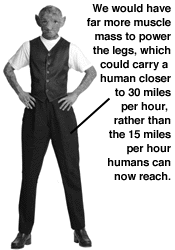
We know that humans are capable of evolving, because Sherpas and Han Chinese -- after 10,000 years in the Himalayas -- have developed larger lungs and an increased number of red blood cells, enabling their bloodstreams to deliver oxygen efficiently even at very high altitudes. Even after they move to sea level, their children are born with these characteristics. But we also know that something has, in general, kept us from developing stronger bodies, and that thing is our storied neocortex. One of Widmaier's more fanciful chapters speculates on the different ways we might have developed if we hadn't had our brains to protect us (see photo illustration below), as well as ways we might adapt to our modern environment were we the kind of creatures that adapted quickly.
Of course, many biologists would argue that the whole issue of species success and failure is absurd anyway, because the measure of a species' success is simply that it exists at a given moment; a cat is brilliantly successful at being a cat, as the anthropologist Desmond Morris pointed out. To compare species is like comparing the information superhighway to a cloud of water vapor. Besides which, humans -- dressed in skins of dead animals, with stomachs full of cooked animal flesh, trotting animals around on leashes -- should feel pretty confident about the intraspecies power dynamic.
Every now and then, some self-satisfaction does seep through. There was a trace of species boosterism in a press release sent out a few weeks ago by the United Nations Population Fund announcing that the human population is about to pass the six billion mark: Reaching this landmark is an extraordinary achievement for humanity. No era in history has sustained population growth so rapid, while at the same time improving health and nutritional standards for the world's people.
Not bad for a bunch of squirming babies.
"The proof is in the pudding. There's no reason an animal like us should have survived the rigors of living in the wild," Widmaier says. "We shouldn't have made it. We should not have made it. But we did."

Copyright © 1998 The Phoenix Media/Communications Group. All rights reserved.
