December 16 - 23, 1999
![[Features]](/standard/image/headers/features_header.gif)
At the age of 23, DJ Shannon Coen was burned out. A five-year veteran of the New England rave scene, Coen watched in dismay as his beloved all-night dance parties slipped from bacchanalian frenzy into drugged-out torpor. Everywhere he went, Coen found too much bad music, too many bad drugs, too many "high-school kids in Polo and Hilfiger walking around like a bunch of zombies." Rave parties -- once underground, intimate affairs that usually escaped official notice -- had exploded into overhyped, multi-room events that were often canceled by inept promoters or shut down by overzealous cops. To Coen, and to many New England ravers, it felt like the end of an era. The year was 1996. Rave chills out
In an increasingly teenage rave scene, irish pubs are providing a home for the elder statesmen of rave -- the ones over, say, 20 years old
by Andrew Hermann
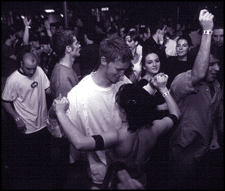
That fall, Coen walked into an Irish bar in Cambridge called the Phoenix Landing, and everything changed. At the back of the room, amid the Guinness posters and Irish road signs, a DJ was spinning techno music -- hard, frenetic techno, the kind of stuff you might hear at a club in New York. "The place was completely packed with all Irish people," he recalls, "dancing on the bar, on the benches, hands in the air, going crazy."
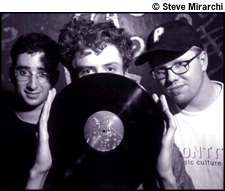
He was thrilled. Two months later, under his DJ name Shalako, he and some friends began hosting their own night at the Landing, "Thump." And burned-out ravers just like Shannon Coen have been packing the place ever since.
Rave has been a well-established subculture for more than a decade. It arrived late to New England, but long enough ago to have a history -- most people point to 1992 as the year it really got off the ground locally, when a Boston after-hours club called the Loft was in its heyday, and big underground parties with names such as "Sky High" and "Life" began popping up in the hinterlands of Maine and Western Massachusetts.
Seven years, you would think, is long enough for any scene to mature a little, to get a little sophisticated, even a little gray at the temples. But rave hasn't done any of that; in fact, despite (or perhaps because of) a tremendous growth in popularity, the rave scene has actually regressed. If you go to a rave now, chances are you'll see very few older faces and lots of startlingly young people dressed in the childlike style known as "candy raver" -- plastic jewelry, furry backpacks, pacifiers. Even rave's slang has become more youth-oriented; the term "raver" is rarely heard anymore, as most rave attendees now refer to themselves as "party kids."
All of which raises the question: what happened to all the people who were partying back in '92?
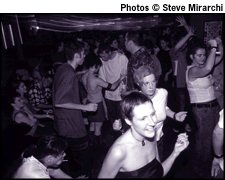
A partial answer, at least, can be found at the Phoenix Landing, whose crowd Coen refers to simply as "the older kids." The door policy for "Thump" is 19-plus, but the majority of patrons look to be at least in their mid 20s, and they present a striking mix of styles, backgrounds, and attitudes. On a typical Wednesday night at the Landing, fashion statements range from Designer Eurotrash to Yuppie Neutral to Cambridge Bike-Courier Chic. One woman, in a black choker and heavy eyeliner, appears to have stopped in on her way to goth night at ManRay; near her, a balding, bespectacled man in a cybergeek T-shirt dances with a glow stick in one hand and a highball glass in the other. There's even a young woman prowling the room with that most quintessential of candy-raver accessories, a pacifier, lodged in her mouth.
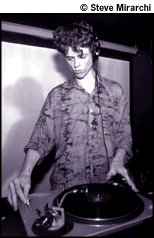
At the back of the room, one of Coen's partners, DJ Caseroc, works his turntables on the Landing's small stage, flanked by speaker towers and potted plants, while behind him trippy computer animation flashes across a five-foot projection screen. At the other end, near the door, groups of twentysomething friends sit around tables, sipping pints of Guinness and chattering happily over the din of the music.
"We got the whole rave crowd, we got the art crowd, we got the college kids," says Coen. "It's a great mix of people." Wandering through the room greeting friends, he looks nothing like a DJ/promoter and everything like a slightly hippied-out college student, all frizzy brown hair and kicked-back attitude. (He actually recently finished his bachelor's degree at MIT and now works, like everyone else in Cambridge, for a high-tech start-up.)
If none of this sounds like your image of a rave, that's exactly the point. A Landing regular puts it in a nutshell: "This place gets a lot of old-school ravers -- people who don't go to the big raves anymore because it's all 15-year-olds and drugs."
By the time Coen first showed up at the Landing in 1996, it had already been home to a Sunday techno night for almost two years. At that point there were surprisingly few venues for techno in the Boston area -- nightclubs mostly specialized in house music and various retro nights, such as '70s funk/R&B, or '80s new wave. Elsewhere around town, everyone was doing the Macarena. "You had Axis and you had nothing else," says Kevin Treanor, co-owner of the Phoenix Landing.
Treanor was inspired to launch a techno night by what he had seen in San Francisco in the early '90s, when the big clubs were dominated by screaming-diva house and disco, and the more "progressive" DJs were spinning at bars instead. "I knew it could work here," he says. He found a couple of expatriate Irishmen named Peter Bailey and "Foxy" John Prendergast to be DJs; their friends spread the word, and soon they were drawing big Sunday-night crowds like the one that amazed Coen on his first visit to the Landing.
"It was remarkable to me that I had never heard of what was going on down there," says Coen, but it was also obvious why he hadn't: the crowd was made up almost exclusively of Irish expatriates. Apparently, the Landing's American patrons found the pub/techno combination too bizarre and were staying away, but in Ireland, techno is as common and pervasive as the latest Britney Spears single. "In Ireland, you'll find techno everywhere," Coen points out. "[It's even] in the malls."
The bar's owners knew, however, that to broaden their audience they had to find a way to lure in the Americans. They heard Coen DJing a private party and invited him down to the Landing to spin a guest set. By then, Coen had already hosted his own events with 409, his production company, and had enough connections and enough of a following to bridge the cultural divide. "As soon as we started" Wednesday nights, he says, the Landing "filled up with suburban white kids."
It also filled up with people like Coen -- old-school ravers who tend to define themselves not so much by their age or how long they've been attending raves, but by a certain curmudgeonly attitude toward the current teenybopper rave scene, and an unabashed nostalgia for the good old days of, say, 1995. "It used to be [that] people would drive 300 miles to see their friends," says one old-schooler. "Now they drive 50 miles to escape their parents."
Even before its current candy-raver renaissance, raving was never exactly an adult activity -- many self-proclaimed old-schoolers are themselves only in their early 20s. "We actually talk about [that] among our friends all the time," says Coen, who is 26. "Is it that the crowd has gotten younger, or is it just that we've gotten older? Personally, I believe that it has gotten a bit younger."
Many old-schoolers share Coen's perception, and it's easy to see why. At a New Hampshire rave called "Freedom" this past summer, the vibe was more high-school dance than underground party. The event's most popular gathering spot wasn't by the speakers, but rather on the hillside out back; hanging out there felt strikingly reminiscent of sitting in the gymnasium bleachers.
There isn't much outright intergenerational tension at raves; the raver credo of PLUR -- which stands for Peace, Love, Unity, and Respect -- discourages fans from disparaging one another. Still, most old-schoolers, when pressed, express a degree of resentment toward the Party Kid Invasion. "I feel like a grandma when I'm [at a rave]," grouses one 25-year-old. A twentysomething DJ complains bitterly of the "kids out there, 16-, 17-year-olds, whose parents buy them turntables and mixers and they call themselves bona fide DJs. It's an insult to people like me."
Coen believes, however, that the issue for most older ravers isn't the kids but the raves themselves, which have become too hyped and formulaic. Today's raves are "extravagant productions -- three-ring circuses, I like to call them. They're the only things that are going to draw `new recruits,' " whom the promoters need in order to keep making money. In both raves and the local club scene, Coen explains, the emphasis on profit and publicity creates an environment in which promoters are afraid to take risks and the audience comes to expect a stock experience.
But most old-school ravers were attracted to raves in the first place by the events' radical originality in both music and style, and by the anticipation of something new and unexpected at each rave. To many old-schoolers, including Coen, today's raves and clubs are a poor substitute for those earlier experiences. "The promoters know what works, what's going to bring in people to make money, and in so doing the crowd hears the same music at every party they go to . . . But it's a downward spiral, I think, because the enthusiasm of the crowd decreases. And I think that's why you'll find the older crowd disinterested in these formulaic events, whether it be the clubs or the raves, because there's no longer that same energy there."
To avoid letting "Thump" lapse into a routine, Coen mixes up the line-up each week with guests DJs from all over the world. Among the more notable have been Belgium's C.J. Bolland and Germany's Richard Hartz, both of whom were instrumental in shaping the sound of the early-'90s electronic music that went on to become the trance and hard techno of today.
Coen is the first to admit, however, that newcomers will probably be unable to distinguish the sounds at "Thump" from what gets played at larger clubs on Friday nights. What sets his event apart is not so much the music as that intangible quality that ravers, in one of their many neo-hippie flourishes, call the vibe. "It's a more of a humble atmosphere," Coen says. "It's a more intimate setting."
Coen sees a growing trend toward smaller, more intimate venues for electronic dance music, with other nights popping up in unlikely places all over Boston, Cambridge, and Somerville. There's "Life," a Friday-night club at the Howard Johnson's in Kenmore Square; "Circle," which takes place Tuesday nights at the VFW in Davis Square; and a brand-new techno night called "Contact," on Saturdays at a downtown bar called the Times. Kevin Treanor and his partner Joey McCabe have also gotten further into the action by hosting a drum 'n' bass night on Thursdays at the Landing, "Elements," which rivals "Thump" in popularity. In each case, says Coen, the promoters "are not so interested in pulling numbers of people or becoming rich and famous; rather, they're interested in a good party and the best vibe possible. Rather than trying to pull as many people [as they can], they're looking for the right people."
Finding the right people is not always easy, especially when hosting weeknight events in unlikelier settings. Recently, for example, Coen and Treanor decided to close "Quench," a Sunday techno night at Treanor's other bar, An Tua Nua, near Kenmore Square. But Coen remains optimistic that there will continue to be a place for smaller anti-club events like "Thump," and, therefore, that there will always be a positive alternative to the hipper-than-thou club scene and the increasingly druggy, overhyped rave circuit.
"That's why I continue to be involved and create [these] environments," he says, "so I can experience them. Because nobody else, it seems, is going to do it for me."
Andrew Hermann can be reached at hermann42@aol.com.
Copyright © 1999 The Phoenix Media/Communications Group. All rights reserved.
