July 6 - 13, 2000
![[Features]](/standard/image/headers/features_header.gif)
Taking the lead
Somerville mayor Dorothy Kelly Gay is shaping the development of Assembly Square. Boston mayor Tom Menino should pay attention -- he might learn something.
by Laura A. Siegel
They've conquered the suburbs. Now they're invading the cities. They're big boxes: sprawling, horizontal, single-use stores, surrounded by immense parking lots. Think Home Depot, Staples, Wal-Mart. They create areas that draw traffic, intimidate pedestrians, and prohibit any kind of urban feel. In Somerville, a new mayor, Dorothy Kelly Gay, faced with the chance to transform a major piece of land, is trying to rein in big-box-hungry developers and create the future that she and many residents envision: a mixed-use, vibrant urban neighborhood. But will the mayor's efforts be enough?
The question resonates far beyond Somerville. As Kelly Gay tries to get the balance right, Boston should be watching. Mayor Tom Menino might have something to learn.
The tension between city planning and racing development has been in the news a lot lately. Ideally, citizens, politicians, and planners would agree on a vision for a city's future, and then developers would build it. But in the real world, development often rushes ahead of the city's vision, if it even has one. Then private interests end up shaping the urban landscape -- not always to the community's benefit. As Boston booms and huge new projects promise to change its face for years to come, the city is falling under attack for allowing development to drive planning -- especially on the South Boston Waterfront and in the Fenway. "Here in Boston, we never, ever face down a developer and say, `You have to build on urban terms,' " says Shirley Kressel of the Alliance for Boston Neighborhoods.
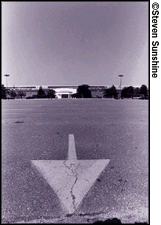
The site Kelly Gay hopes to transform is Assembly Square. At 145 acres, it's three times the size of South Boston's Pritzker and McCourt properties combined. It's a bleak wasteland of weedy parking lots, polluted waterfront, old industrial plants, a few big-box stores such as Kmart and Home Depot, and an abandoned mall.
Kelly Gay and the members of Somerville's Mystic View Task Force have a vision for that land: a mixed-use, densely built, pedestrian-friendly district like the Back Bay or Davis Square. Centered on a new Orange Line T stop, with parking in garages or underground, the site would boast well-maintained riverside parks, a vibrant Main Street, and a central square.
But the mayor has to work within the constraints of reality. The city doesn't own most of Assembly Square and can't afford to buy it -- though Kelly Gay says she'd like to. And developers from National Development and Ikea -- who, between the two of them, recently bought almost a third of the site -- want to build big-box stores and parking lots. Despite its failings, there's a market for big-box development, and the developers want to build before the economic climate changes. The city needs the tax revenue those stores would provide. "I cannot afford to let this drag on and on and on," says Kelly Gay. "I cannot see that site a wasteland anymore."
So she hired an urban planner, Steve Cecil, who worked extensively with area residents to come up with a compromise between the developers' big-box model and the dense, mixed-use one favored by city officials and residents. Under Cecil's plan, redevelopment of Assembly Square would begin with limited big-box retail, along with amenities such as pedestrian and bicycle routes, open-space development, and improvements to accommodate traffic. There would also be a street grid that, in theory, would grow over time to create a dense mixed-use area. Kelly Gay's commitment to binding developers to a public plan has already borne some fruit: National Development recently presented a scheme that, though imperfect, does provide for more small streets, mixed-use development, and green space than its first proposal. And Ikea just came back with a plan that's slightly more mixed-use than its original box-with-parking.
The mayor says she's pleased with the developers' concessions, but area activists from the Mystic View Task Force say they don't go far enough. The group fears that starting with big boxes and surface parking would be a step in the wrong direction, and would endanger the ultimate vision. "Why march in the opposite direction of your goal?" asks Mystic View member Lawrence Paolella. "Once [the big boxes] become entrenched, it will make the job near impossible."
The mayor understands she's taking a gamble, but it's one she feels she has to take. If she's wrong, Assembly Square could be left with a few small streets among big boxes in an asphalt sea -- just another dead and empty landscape. But if she's right, it would mean transforming a desolate, abandoned site into an amazing asset for Somerville: a place that would provide the city with crucial tax revenues, much-needed green space, and a lively, interesting neighborhood.
Laura A. Siegel can be reached at lsiegel[a]phx.com.