July 6 - 13, 2000
![[Features]](/standard/image/headers/features_header.gif)
Taking the lead, continued
by Laura A. Siegel
Public leadership and commitment to a consistent vision will be crucial in creating such a lively, mixed-use district, says MIT professor Denis Frenchman.
Somerville's power to hold the developers to such a vision comes from its influence over the permitting process and in the threat of lawsuits. "The developers don't want to be held up in court," says Kelly Gay. "They're losing money on a daily basis. They want to be able to work with the city." When National Development unveiled a plan last August to create a retail power center of five big boxes and call it "Riverside Square," the mayor sent the company back to the drawing board. When the mayor asked all the developers not to build until the city completed a plan for the area, they agreed. When Ikea wanted to build its usual big blue-and-yellow box, the mayor told its developers to come back with something more aesthetically pleasing. Kelly Gay insists, "We will hold their feet to the fire."
That kind of strong leadership is just what critics complain has been lacking in Boston's building boom. "Without that, the private sector will do what makes the most sense in the short term," Frenchman says.
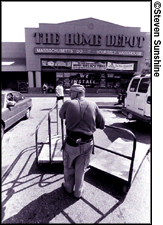
At Assembly Square, big-box retail is what makes sense in the short term. It's been proven to work on the site -- enough people flock to the Home Depot there to make the store the busiest of the chain's 24 outlets in Massachusetts. Big-box retail is cheap and easy to build, and it's guaranteed a regional market. "There are very few opportunities for big-box development in the Boston metropolitan area -- large sites that have the infrastructure, that can handle the traffic and other related impacts," explains Peter Ross, president of New Atlantic Development Corporation and a lecturer at MIT, who recently co-taught a class about Assembly Square with Frenchman. "Users are willing to pay handsomely for those sorts of sites." And they're willing to move soon.
That immediacy is a strong draw for the city. Financial strains are putting pressure on the mayor to act fast. Somerville has little commercial tax base. Its commercial tax revenues come to only $15.8 million a year (Cambridge, slightly bigger, nets more than $100 million). "Our city is in a precarious position because we don't have any developable land left," says Kelly Gay. Right now, the whole of Assembly Square generates just $2.6 million a year. Under National Development's new plan, the company's land alone would generate $1.6 million more in annual taxes than it does now -- plus a one-time payment of $850,000 in linkage and permitting fees. Still, big-box development with surface parking would provide only 15 to 25 percent of the taxes generated by urban-density, mixed-use development, estimates Ross.
But it would be better than nothing. And the developers will go only so far in their concessions, and will wait only so long. "A dream is great," says advisory group member Favaloro. "But you also have to develop a level of reality -- what's going to work."
And if the city plays its cards right, say Kelly Gay and urban planner Cecil, their long-term vision may be compatible with "limited big-box" retail -- if it's designed in a way that would set the stage for later transformation.
Developers of limited big-box retail could incorporate some different uses and create a grid of small streets upon which an urban village could be built. "Over the long term, places change dramatically, but there has to be a framework from which they can change," explains Frenchman.
The developers' deep pockets could help the city in other ways, too. "One thing you do buy with big boxes is they're willing to pay for community benefits," says Somerville's community-development director, Steve Post. The most important benefit the city hopes to squeeze out of developers is improvement of green space along the Mystic River.
Assembly Square's waterside parks are pathetic: a scraggly strip of grass with a little path, cut off by a highway from the neighboring Ten Hills residential district; and the Draw 7 park, which is poorly maintained, windswept, and overwhelmed by the roar of trains and highways on all sides. The Mystic itself is filthy. Its oxygen levels can barely keep fish alive. And as summer rains run off the hot asphalt bordering much of the river, they raise its temperature well above the state standard for sustaining life.
The potential open space could total 24 acres -- the size of Boston's Public Garden. "We'd look for private developers to pick up all the costs [of the park space], even if it's public land," says Post. And the mayor wants to clean up the river. She envisions water access to Boston and bike paths under the highway to residential neighborhoods.
Laura A. Siegel can be reached at lsiegel[a]phx.com.